Russia’s vulnerability showcased again after Putin presidential win
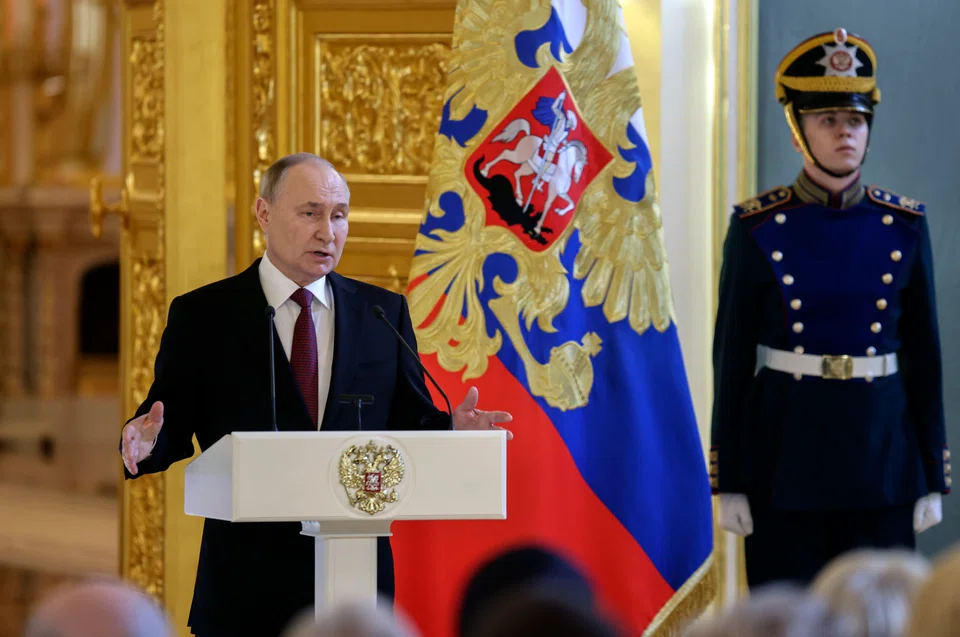
    • Despite Putin’s extraordinary skills of political longevity in the last quarter of a century, a number of key Western intelligence veterans believe he is still vulnerable to a coup.
    • Despite Putin’s extraordinary skills of political longevity in the last quarter of a century, a number of key Western intelligence veterans believe he is still vulnerable to a coup. PHOTO: EPA-EFE
    Published Wed, Mar 27, 2024 · 05:00 AM

    VLADIMIR Putin recently won a new presidential term that could see his Russian leadership lasting to at least 2030, totalling around as long as Joseph Stalin. However, Putin’s celebrations were cut short by last week’s horrific attacks in Moscow which could now have key political and economic impacts for the Ukraine war.

    The Mar 22 tragedy, the worst terrorism in Moscow for some two decades, highlights yet again the vulnerabilities of the Russian state, especially as key security resources are diverted to Ukraine. It highlights how the regime’s grip on power is seemingly a mile wide, but sometimes apparently only inches thick.

    This is the second time in less than a year that this weakness has been exposed, following the Wagner mutiny last summer led by Yevgeny Prigozhin. What that episode showed is the elite fissures within the security services and military intelligence over the trajectory for the Ukraine war.


    Last Friday’s attacks are important too as, while Russia now appears in a significantly stronger position in Ukraine than last summer, the regime may still, in fact, be fragile. A number of key Western intelligence veterans, including former UK MI6 chief Richard Dearlove, believe Putin may still be vulnerable to a coup.

    Despite Putin’s extraordinary skills of political longevity in the last quarter of a century, that high-impact scenario cannot be entirely dismissed. Yet, it is more likely that his authority will decay, rather than him being deposed in the immediate term.

    Nonetheless, last week’s tragedy is definitely a blow to the regime. This is especially so after Putin’s election win which saw him move within range of Stalin’s remarkable tenure in office during the Soviet Union. Indeed, Putin is fast becoming one of the longest-serving world leaders of modern times alongside other leaders such as Fidel Castro, who managed almost 50 years as Cuban prime minister and then president, and Iranian supreme leader Ali Khamenei who has been in his post since 1989.

    The attacks, which have been claimed by the Islamic State in Khorasan Province (ISKP), a branch of the Islamic State (ISIS) terror group in Afghanistan and Pakistan, saw a group of armed individuals open fire at concert goers at Moscow’s Crocus City Hall. ISKP has been fighting the Taliban in Afghanistan which it regards as insufficiently militant.

    According to a 2017 Soufan Centre study, more foreign fighters have joined ISIS from the former Soviet republics than any other region. Most of the perpetrators of last weekend’s attacks are apparently radicalised citizens of Tajikistan.

    ISIS has previously carried out wide-ranging attacks on Moscow’s interests, including when a Russian plane carrying 224 people exploded over Egypt. In 2017, an ISKP suicide bomber blew up a subway car in the St Petersburg metro system. Moreover, earlier this month, Russia’s Tass media agency reported authorities had prevented an ISKP attack on a Moscow synagogue.

    Last week’s tragedy, which resulted in the death of some 150 people, raises troubling questions about the Russian security apparatus’s ability to prevent such deadly attacks. This was especially after Western counterparts had issued warnings around two weeks prior.

    Russian special forces are thinner on the ground in Moscow, and even some police have been deployed to the frontlines. So a relatively small number of terrorists caused deadly chaos for a significant period, and it reportedly took National Guard troops more than an hour to arrive from their base only around two miles away.

    ISKP has released social media of the relatively small number of men it said were involved, along with details of how they planned and executed the attack. However, Putin has linked the activities with Kyiv, saying the terrorists “tried to hide and moved towards Ukraine, where, previously, a window had been prepared for them to cross the border”. He also called the attackers “Nazis”, his oft-used code for Ukrainians.

    At least part of the Kremlin’s motivation to apportion blame at Kyiv could seek to divert difficult questions over why Russia’s security services failed to take more seriously the Western warnings about an attack. However, there is also a significant possibility Putin will now use the attacks to double down on the Russian war effort in Ukraine with potentially key economic, not just political, implications.

    Even before last week’s attacks, there were signs of a shift in Russia’s gears in Ukraine. For instance, the Kremlin for the first time declared the nation is at “de facto war” with Ukraine, rather than a “special military operation”.

    The commander of Ukraine’s ground forces, Lieutenant General Oleksandr Pavliuk, also warned last Friday that Moscow has plans to build a new force of 100,000 troops for a potential new offensive. This follows a period of sustained Russian battlefield gains, including Avdiivka in February, fuelled in part by Kyiv’s lack of weapons supplies from Western partners.

    Presuming the Russian war effort continues apace, the most likely scenario in coming weeks is a continued “war of attrition” trajectory. However, one key difference with 2023 is that it is Moscow making gains on the ground now in 2024 rather than Ukraine. This attrition scenario seems most likely while both sides are still prepared to expend massive resources, albeit Ukraine’s ability to match Russia depends on a 2024 uptick in Western financial support.

    While this war of attrition may imply a degree of stability in the conflict, this is not necessarily true, and the level/ range of risks actually remains very high. This is one reason why the war’s outcome remains so unpredictable.

    In the volatile, uncertain, complex and ambiguous context, more significant “surprises” may yet occur in coming weeks. This includes the possibility of major nuclear incidents of some kind -- possibly “accidents” at nuclear energy sites.

    So the conflict will probably last for at least many months more, with possible key economic as well as political impacts. Even in the most positive scenario for peace, with major fighting ending in 2024 or 2025, there will be periodic tensions between Russia and Ukraine for longer. This could have a key impact on energy and wider commodity markets.

    Secondly, the behaviour of Putin and other Moscow decision-makers may become ever more erratic, including towards Western firms operating in Russia. Moreover, there is growing stakeholder backlash within the West against businesses continuing to operate in Russia, including from NGOs. If Russia seeks escalation in coming weeks, pressure on firms could grow significantly to pull out, with the sanction regime broadening against Moscow.

    The writer is an associate at LSE IDEAS at the London School of Economics