

S-Reits may come to rue missing out on Mercatus portfolio sale

SINGAPORE’S real estate investment trust (Reit) managers have been talking up the outlook for the retail sector in recent months.
Frasers Centrepoint Trust (FCT), the city-state’s leading pure-play suburban retail Reit, said in its latest results presentation that it saw broad-based improvement in its operating performance for the full year ended September 2022.
For FY2022, FCT reported higher revenue, net property income (NPI) and distribution per unit (DPU). The improvement came on the back of a rise in shopper traffic and tenants’ sales, positive rental reversion and higher portfolio occupancy, the Reit’s manager said.
CapitaLand Integrated Commercial Trust (CICT) – the largest Singapore-listed real estate investment trust (S-Reit) with a market capitalisation of S$13.5 billion as at Jan 12 – cited data showing positive trends in rents at both suburban and Orchard Road malls as well as Singapore retail sales performance.
The diversified Reit, whose portfolio includes a mix of suburban and downtown malls in Singapore, also pointed to data showing a slowdown in upcoming retail supply in Singapore.
According to CBRE Singapore, Singapore would add just 0.4 million square feet (sq ft) of retail space annually from 2022 to 2025. This is half of the 0.8 million sq ft of retail supply added each year in the preceding five years since 2017.
Diversified S-Reit peer Mapletree Pan Asia Commercial Trust (MPACT) made a similar observation.
Citing Colliers data, the Reit manager said about 1.23 million sq ft of Singapore retail space is expected to be delivered from 2022 to 2024. This translates to an average of 412,000 sq ft per year, lower than the past five-year annual average of 715,000 sq ft, it added.
“Consequently, the limited upcoming supply should support improvements in occupancy levels and rents and retail absorption is expected to recover,” the MPACT manager said in its results presentation for the first half ended September 2022.
MPACT’s exposure to the Singapore retail sector is headlined by VivoCity, Singapore’s largest shopping mall with a net lettable area (NLA) of 1.1 million sq ft.
Missing out on a steal
With limited upcoming supply and a professed confidence in the resilience and outlook of retail assets – especially those in suburban areas – the S-Reits ought to have been eager buyers when a portfolio of quality shopping malls in the heartlands recently became available.
The winning bidder for the retail properties of NTUC unit Mercatus Co-operative, however, ended up being a Hong Kong-listed player that until now had no presence in Singapore.
To be fair, the S-Reits found themselves up against a juggernaut in the form of Link Reit – the largest Reit in Asia with a market cap of HK$130.8 billion (S$22.1 billion) as at Jan 12, and HK$246 billion in total portfolio value.
Mercatus was initially reported to have bundled four of its retail properties in Singapore for sale, with a price expectation of S$4 billion.
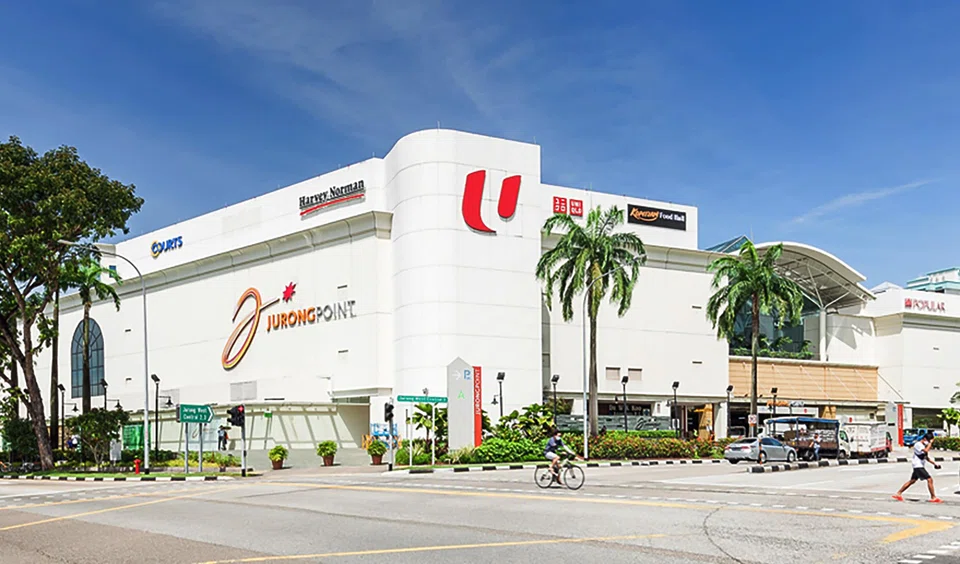
The retail assets were Jurong Point; AMK Hub; Mercatus’ 50 per cent stake in Nex; and Swing By @ Thomson Plaza, which occupies Levels 1 and 3 of Thomson Plaza.
The portfolio of retail assets for sale was later trimmed, reportedly to make the hefty price tag more palatable to potential buyers.
Link Reit eventually won the race to acquire two of these properties – Jurong Point and Swing By @ Thomson Plaza – for S$2.16 billion.
This could be seen as a steal for Link Reit.
The acquisition price is 6.1 per cent lower than the appraised value of S$2.3 billion for the two properties as at Dec 28, 2022.
Based on annualised net property income for the two assets for January to October 2022, the transaction will represent an NPI yield of 4.9 per cent for Link Reit, according to Citi analyst Ken Yeung.
The deal is also expected to be DPU accretive.
As part of the transaction, Link Reit would also enter into a 10-year asset and property management service agreement with Mercatus for AMK Hub.
Mercatus will continue to own AMK Hub, which will be managed by Link Reit. This will result in asset-light recurring income for the Reit.
Losing out
CICT, part of Singapore-based CapitaLand Investment , was said to have been one of the frontrunners in the bid for Mercatus’ portfolio, alongside Link Reit.
Frasers Property , which is part of Thai billionaire Charoen Sirivadhanabhakdi’s group, was also reported to have been in the fray. Frasers Property is also the sponsor of FCT.
Mapletree Investment’s MPACT was apparently not among the parties interested in the assets. But perhaps, it should have been.
One of the reasons the S-Reits might have been apprehensive could be the size of the deal.
Even after it had been trimmed down, the price tag of over S$2 billion could be seen as a major stumbling block.
As at end-September 2022, CICT’s aggregate leverage stood at 41.2 per cent. Gearing for FCT and MPACT stood at 33 per cent and 40.1 per cent, respectively.
The leverage ratios of all three S-Reits are some ways away from the regulatory limit of 50 per cent.
But S-Reit managers have generally been prudent, preferring to keep their leverage ratios at below 40 per cent. The additional debt to fund the acquisition may have been more than they were willing to stomach.
In comparison, the transaction will bump Link Reit’s aggregate leverage to just 27.1 per cent from 23.2 per cent.
The Reit manager said the acquisition will be fully funded through its internal cash resources and debt facilities.
The S-Reits, however, would likely have had to raise equity to fund the purchase. And amid volatile equity markets and investor appetite for S-Reits dented by interest rate fears, an equity fundraising exercise would have been challenging.
Even so, Singapore’s Reits and real estate players missed out on an interesting opportunity in their own backyard.
TRENDING NOW

OCBC Q3 profit rises 3% to S$2.04 billion, slightly above expectations

Stocks to watch: OCBC, IHH Healthcare, FLCT, SingPost, Koh Brothers Eco Engineering

From legacy to launch: Francis Yeoh and Yeoh Pei Xien on family unity and YTL’s next‑gen ventures

Wealthy Indonesians snap up government bonds as yields near 8%: OCBC

