Seatrium must manage its risks well as it tackles offshore headwinds
The company’s best defence is to broaden its non-oil and gas portfolio, in both geography and technology

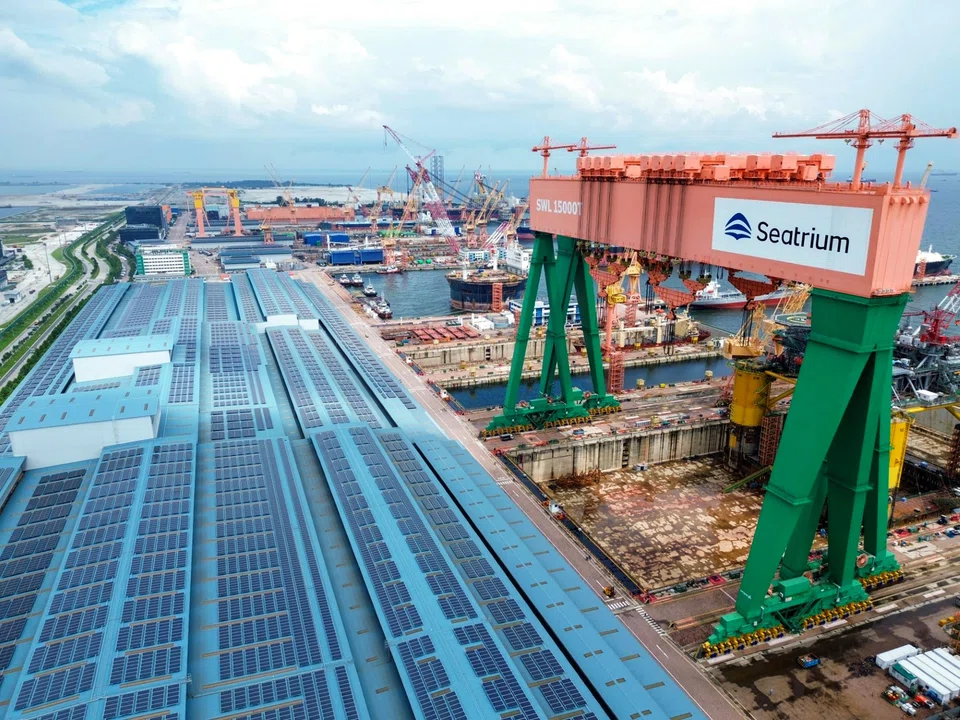
[SINGAPORE] The unexpected termination of a US$475 million contract highlights Seatrium’s exposure to the offshore wind sector and the turbulence that lies ahead.
On Oct 10, Seatrium announced that Maersk Offshore Wind is terminating the contract for a wind turbine installation vessel (WTIV) intended for the Empire Wind I project in New York. Seatrium says it is evaluating its legal and commercial options.
The news sent the company’s shares tumbling by as much as 7.8 per cent, or S$0.19, to S$2.25 within the first 40 minutes of trading following the announcement. The stock has continued to sink, closing Friday (Oct 17) at S$2.06.
The direct financial impact of the cancellation is not yet known, but analysts expect the company to make provisions for potential reversal of recognised profits.
Citi analyst Luis Hilado explains that the contract was structured so that Seatrium received 20 per cent as down payment, with the remaining 80 per cent to be paid upon final delivery. Given that the vessel is 98.9 per cent completed, Seatrium has incurred almost all the costs of construction, but received only 20 per cent of revenue.
DBS analyst Ho Pei Hwa’s worst-case scenario is one where the contract remains cancelled and the vessel remains unsold by the end of the year. This would lead Seatrium to reverse an estimated S$18 million to S$30 million of recognised profit – assuming a net profit margin of 3 to 5 per cent – and perform a mark-to-market adjustment of the value of the WTIV if it falls below cost.
To put that in perspective, Seatrium posted a first-half net profit of S$144.4 million.
Despite the cancellation, the analysts are mostly sticking to a bullish view of the stock.
DBS has maintained its “buy” call and target price of S$2.96. CGS International has kept its “add” recommendation on a S$2.80 target price. Morningstar stayed put on its S$2.92 fair-value estimate for the stock.
One road bump
The steadfast analysts mostly see the Maersk cancellation as a one-off event.
The Empire Wind I wind farm is being developed by Equinor, which has also said it is exploring options. Seatrium has also been contracted to build an offshore substation for the wind farm, and DBS expects that deal to remain intact. DBS also sees more stability in Seatrium’s other offshore wind projects, which are mainly in Europe.
Morningstar’s Lee Chokwai and Nicole Lim are confident about their positive long-term outlook for Seatrium. They cite the rising adoption of artificial intelligence and data centres as bolstering their conviction that clean-energy solutions are vital for long-term energy demand. They also view Seatrium’s diversified portfolio, which includes offshore oil and gas, as a positive for revenue stability.
Or a bumpy road
But the risk seems to lean towards a weak outlook for Seatrium’s offshore wind business in the next few years, at least.
For a start, the company’s US projects may not be out of the woods yet. Maersk’s decision could yet affect Seatrium’s offshore substation contract at Empire Wind I, especially if the cancellation forces back timelines for the wind farm.
The high upfront costs of offshore wind, relatively long construction times and potential penalties for late deliveries can make them highly sensitive to delays. Already, Equinor has taken a US$955 million impairment on the entire Empire Wind project, including just under US$200 million related to the second-phase Empire Wind 2 farm.
Those impairments have been driven by higher raw material costs due to US tariffs as well as by the scrapping of US renewable energy tax credits. Furthermore, the Trump administration’s opposition to the project continues to cast a shadow over its prospects.
Seatrium’s other US offshore wind contract is for an offshore substation for Orsted’s Revolution Wind project to be delivered in 2026. That project has also been hit with similar issues faced by Empire Wind. Work on Revolution Wind was paused for a month after the Trump administration issued a stop-work order, and only resumed in September after winning a preliminary court injunction to continue.
Orsted said this month that it will cut about 2,000, or 25 per cent, of its staff to refocus on its core European market. The world’s largest offshore wind farm developer, which is majority owned by the Danish government, has also recently raised US$9.4 billion via a deeply discounted rights issue to strengthen its balance sheet.
It’s not clear that market instability will stay confined to the US. Maritime Strategies International reported in July that offshore wind project cancellations, suspensions and delays reached 300 gigawatts (GW), with Europe accounting for 60 per cent of cancelled or suspended capacity. Australia, India and Japan have also seen a string of high-profile project cancellations.
The International Energy Agency this month revised its five-year forecast growth for the offshore wind industry down by more than 25 per cent, reflecting reduced deployment targets by some major developers.
The problem is that high costs and over-investment affect all offshore wind projects regardless of where they are being built. Maersk may have walked away from the WTIV that it helped to design, but the vessel’s capacity hasn’t gone away. In fact, it’s now Seatrium’s problem.
Diversify, diversify, diversify
Seatrium’s best defence is to broaden its non-oil and gas portfolio, in both geography and technology.
Offshore wind accounts for almost all of Seatrium’s non-oil and gas order book. Aziz Merchant, Seatrium’s executive vice-president for engineering, technology and new product development, mentions developing infrastructure for floating wind farms, ammonia production platforms and carbon capture retrofits. Those are positive steps, and a case could be made to move faster into new directions to build up resilience in the business.
Geographically, Seatrium can tap what is widely seen to be Asia’s robust offshore wind market, supported by official targets – Maritime Strategies International notes Taiwan’s 10.9 GW goal, South Korea’s 14.3 GW, Vietnam’s 6 GW and Japan’s 5.7 GW.
The offshore wind industry is certainly going through a rough patch, but the technology is proven. Replacing fossil fuels will require many alternatives, and wind is definitely in that mix. Seatrium’s strategy to remain in the offshore wind business is sound, but it must manage its risks well.
This article first appeared in BT’s ESG Insights newsletter on Oct 17
TRENDING NOW
Green fuels, autonomous ships: How Singapore is future-proofing its shipping industry
US trade chief to consider trade deal tariff caps in excess capacity probe
Grab CEO’s wife Chloe Tong on life with Anthony Tan and finding her purpose
Deal between tycoon friends sparks scrutiny of Philippine power sector