MARK TO MARKET

Seatrium’s profit warning has a silver lining

Investors should be wary of a business that Sembcorp and Keppel both wanted to exit; much depends on whether Seatrium delivers a consistently healthy level of earnings

Ben Paul
Published Mon, Feb 5, 2024 · 05:00 AM
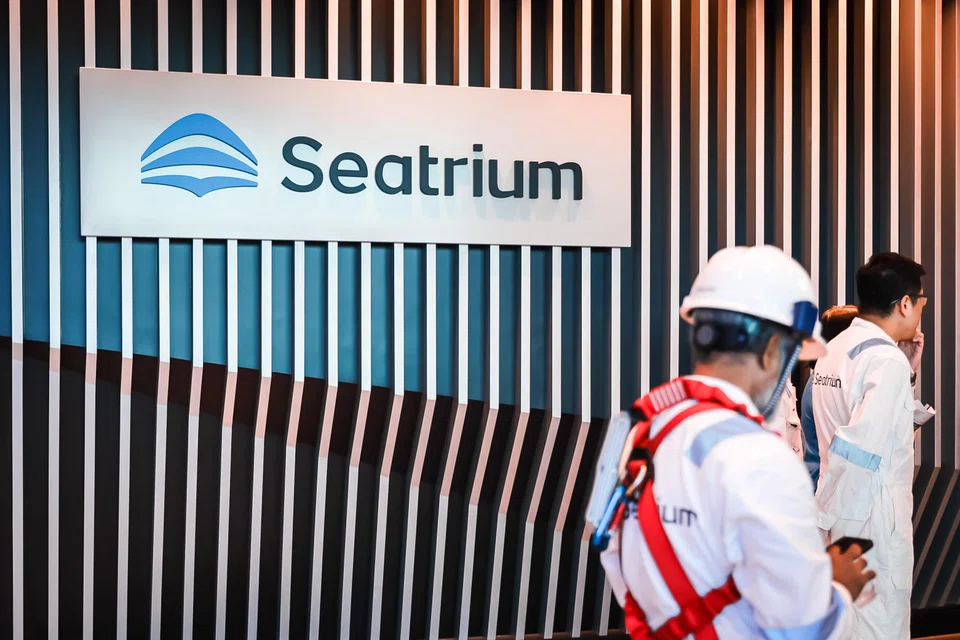
    • Minority investors who have supported Seatrium's rights issues and merger with KOM may feel that the company is now adding insult to injury by writing down the value of some of its assets.
    • Minority investors who have supported Seatrium's rights issues and merger with KOM may feel that the company is now adding insult to injury by writing down the value of some of its assets. PHOTO: BT FILE

    PROFIT warnings are never good news for investors. Yet, there is a positive aspect to Seatrium’s announcement last week that it will report a significantly higher loss for 2023 than the previous year.

    In the first place, the loss that Seatrium reported for 2022 was not all that high at S$261.1 million. Seatrium reported a much higher loss of S$1.17 billion for 2021.

    It was also not unexpected that Seatrium would suffer a larger loss in 2023. The company reported a net loss for H1 2023 of S$264.4 million, which was already slightly higher than the full-year 2022 loss.


    The H1 2023 loss was attributed to higher costs for certain projects, and expenses related to its merger with Keppel Offshore and Marine (KOM).

    More to the point, Seatrium’s warning of a big loss for 2023 is due to the expected write-down of “surplus non-core assets” and “excess and obsolete inventories” following a strategic review of its operations.

    This internal consolidation at Seatrium should improve its productivity and cost structure, and boost its future profitability.

    Brokerage firm CGS-CIMB said after the profit guidance announcement last week that it has factored in S$250 million worth of write-downs by Seatrium in H2 2023.

    It expects the company to close some of its yards in Singapore and overseas, take impairments on its fixed assets and inventories, and make provisions for cost overruns for some of its projects.

    CGS-CIMB also scaled back its forecasts for Seatrium’s earnings in 2024 and 2025, on the assumption of smaller gross margins.

    It said projects clinched by Seatrium after it completed the acquisition of KOM have double-digit gross margins, but projects secured by Seatrium and KOM before the pandemic may be suffering gross losses as a result of higher labour and supply chain costs.

    Seatrium is probably on the brink of a turnaround, though. CGS-CIMB expects Seatrium to report a net loss of S$655 million for 2023, and end the year with a book value of about S$0.12 per share.

    It is forecasting a net profit of S$94 million for 2024, and a net profit of S$427 million for 2025.

    CGS-CIMB pegs its price target for Seatrium at 1.4 times its estimated book value at end-2024, which translates to S$0.164.

    But the market took a rather more pessimistic view of the profit guidance. Seatrium’s share price has fallen 7.4 per cent since the announcement was made before the market opened last Tuesday (Jan 30). The stock ended last week at S$0.10.

    The Straits Times Index (STI) rose nearly 1.3 per cent during the same period.

    Adding insult to injury

    Why did the market baulk at Seatrium’s profit guidance despite it heralding an internal consolidation that is likely to boost the company’s future profitability?

    Seatrium’s corporate moves over the last few years have weighed heavily on its minority shareholders.

    In 2020, the company raised S$2.1 billion through a five-for-one rights issue at a deeply discounted price of S$0.20 per share. The bulk of the proceeds was used to repay a S$1.5 billion subordinated loan from its then-parent Sembcorp Industries.

    Sembcorp Industries subsequently offloaded its controlling stake in the recapitalised Seatrium to its own shareholders as a distribution in-specie.

    In 2021, Seatrium tapped its shareholders for a further S$1.5 billion through a three-for-two rights issue at an even lower price of S$0.08 per share.

    Then came Seatrium’s controversial merger with KOM. Under the deal – which was completed on Feb 28, 2023 – Seatrium issued more than 36.8 billion new shares to Keppel in exchange for KOM.

    Keppel then distributed the bulk of the Seatrium shares it received to its own shareholders as a dividend in-specie.

    Based on Seatrium’s closing price on Feb 27, 2023, the deal valued KOM at nearly S$4.68 billion.

    These transactions have greatly benefited Sembcorp Industries and Keppel. In particular, Keppel last week reported its highest ever net profit of S$4.1 billion for 2023 – thanks in part to a S$3.3 billion gain on the divestment of its offshore and marine business.

    Keppel also noted its distribution in-specie of Seatrium shares last year was worth S$2.19 per share – accounting for the bulk of its total cash dividends and distributions in-specie for 2023 of S$2.70 per share.

    On the other hand, minority shareholders of Seatrium who supported its recent corporate moves have not had much to cheer about.

    As a result of the two rights issues and the acquisition of KOM, Seatrium’s share base has expanded from less than 2.1 billion to more than 68.2 billion. Temasek now directly holds a 35.5 per cent stake in the company.

    Even though Seatrium was added to the STI in June last year, the stock has not made much lasting headway.

    Based on Seatrium’s closing price at the end of last week, the enlarged group’s market capitalisation is currently S$6.82 billion. This is not even equivalent to the combined value of the two rights issues and the value at which KOM was acquired – which total S$8.28 billion.

    Against this backdrop, Seatrium’s plan to now write down the value of some of its assets may have some minority investors feeling that the company is adding insult to injury.

    Improving profitability

    So, what should investors do? Is this a buying opportunity?

    In my view, Seatrium is not an especially exciting company. It exists in its current form because Sembcorp Industries and Keppel both wanted out of the offshore and marine sector.

    On the other hand, Seatrium may have now turned the page on its spate of value-destroying corporate moves. Immediately after completing the acquisition of KOM, the company reconstituted its board of directors.

    At the company’s annual general meeting in April last year, a resolution was passed to pay almost S$2.1 million in “special fees” to the former directors for their effort in bringing the deal to its conclusion.

    The new board of Seatrium is led by chairman Mark Gainsborough, who held several senior positions at Royal Dutch Shell over 39 years. Chris Ong, who previously ran KOM, is now chief executive of the enlarged Seatrium.

    Seatrium is also showing signs of improving operational profitability. For H1 2023, the company said it achieved positive earnings before interest, taxes, depreciation and amortisation (Ebitda) of S$27 million. For H1 2022, its Ebitda was minus $19 million.

    If Seatrium manages to deliver a consistently healthy level of earnings, it could well regain the investor confidence it lost over the last few years.

    The company will report its 2023 financial results on Feb 26.