

Seeing gold in decaying leases: Yield, unlocked potential draw property investors to likes of Hotel Miramar
It can be financially feasible to buy properties on sites with declining balance land tenures. As leases near expiry, the path to switching to interim uses needs to be smoothened for more productive land use.


[SINGAPORE] When news broke in July of the sale of Hotel Miramar Singapore, what stood out was that the property was on a site with only about 41.5 years left on its original 99-year leasehold tenure, issued in February 1968 when it was bought at a state land tender.
Despite knowing that the authorities had turned down a request to top up the site lease to 99 years, a fund managed by Singapore-based asset management firm Aravest went ahead to buy the Havelock Road property for S$160 million.
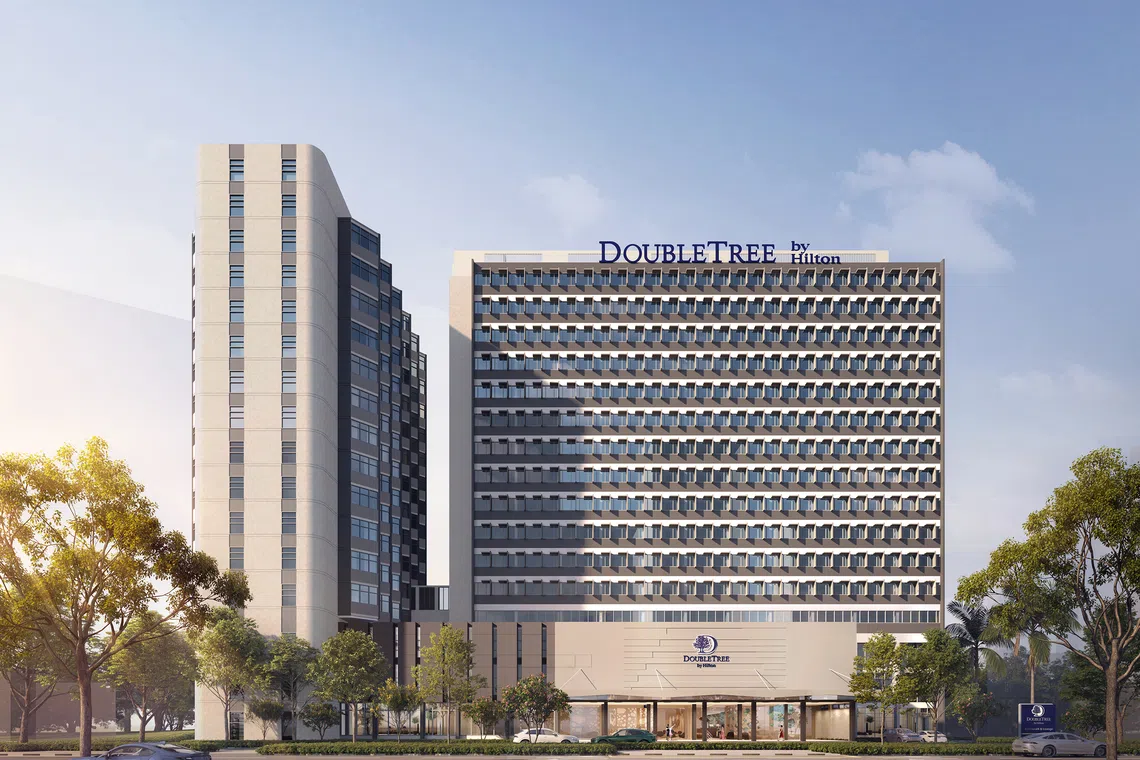
“The lease is shorter than you would normally like, but that’s accounted for in the pricing. We’re more than comfortable and quite happy to be in this investment,” Aravest chief executive officer Moses Song told The Business Times in an interview in October. The hotel has been shut for a refurbishment and will be rebranded as DoubleTree by Hilton.
Historically, transactions of properties on sites with shorter balance land tenures in Singapore have been in the industrial segment. This is a legacy feature of industrial sites issued on leasehold tenures of 60 years or less by the authorities.
For example, Mapletree Industrial Trust this year divested The Strategy and The Synergy in International Business Park as well as 33 and 35 Marsiling Industrial Estate Road 3 to Brookfield Asset Management for a total of S$535.3 million.
More recently, hospitality and living sector players seem more inclined to accept properties with shorter land leases.
Besides the Miramar Hotel, another example is the Capri by Fraser, Changi City, part of an integrated project that had a remaining land lease of about 45 years when it was sold last year for S$171.8 million. The hotel has been rebranded as Dorsett Changi City Singapore.
Also changing hands last year was The Rail Mall in Upper Bukit Timah Road, on a site with close to 22 years’ balance lease at the time.
It can be financially feasible for business operators and investors to acquire properties on sites with declining land tenures, even if there is no certainty of a lease top-up.
Moreover, properties on sites approaching lease expiry could be repurposed to alternative interim uses ranging from sports and recreation to logistics and urban farming – and even much-needed senior housing and assisted-living facilities.
Finding suitable interim uses until the site lease runs out would be a more productive use of land, while fulfilling broader social and economic needs, than letting the property stay vacant.
Some policies may need to be tweaked, though, to incentivise property owners and potential buyers to undertake a change of use.

To be clear, we are not talking about residential collective sales on 99-year leasehold sites with declining leases. For this segment, a developer making a purchase may stipulate that the deal will be subject to outline-planning approval to redevelop the site into a residential project, and in-principal approval for the site’s lease to be topped up to 99 years.
Knight Frank Singapore’s head of consultancy Alice Tan notes that in the past, properties with short balance land tenures – generally less than 60 years remaining, depending on the type of use – were viewed as less desirable due to declining value and limited financing options.
“However, given Singapore’s enhanced reputation for safety and predictability in a global climate where stability has become a blue-chip quality, more buyers and investors are willing to explore acquiring shorter-lease properties,” she adds.
“Such assets have thus become increasingly scrutinised for their potential investment proposition.”
Let’s look at the pros and cons of properties on short balance lease sites.
Appeal
One of the biggest attractions of short-tenure assets is a more palatable entry price. “These assets are often priced at a discount to their longer-tenure counterparts. Consequently, property yields tend to be higher,” notes Wong Xian Yang, head of research for Singapore and South-east Asia at Cushman & Wakefield.
Agreeing, CBRE Singapore director of industrial and logistics services Dylan Chua adds: “When paired with high leverage, the potential for elevated cash-on-cash returns is significant, especially in today’s low interest rate environment.”
Tan Hong Boon, executive director of AlpsEdge Real Estate, highlights that some properties on sites with short balance leases also “present asset-enhancement angles where the existing owners may not want to, or may lack the financial means to, undertake”.
“New investors may then enter the market and put in further investment to improve the income performance and seek to exit with a better income-producing product,” adds the veteran dealmaker.
He cites the former Hotel Miramar, which is being refurbished and rebranded under its new owners.
Another example is the former GSM Building in Middle Road, which had about 54 years’ lease left on its site when it was awarded via a collective sale in 2023.
The sale was completed in 2024 and the new owner, Coliwoo TK, is converting the property – which had housed mostly offices – into an urban co-living hub, Coliwoo Midtown.
The appeal of short-tenure properties varies by buyer profile, notes Knight Frank’s Tan.
“Owner-occupiers such as small and medium enterprises or family-run firms often buy these properties for operational use, prioritising affordability, immediate business continuity and location over tenure length,” she says.
Dr Chua Yang Liang, JLL head of research and consultancy for South-east Asia, says that “for institutional investors, the shorter lease term is less important than the potential to unlock latent value through repositioning, upgrading or pursuing alternative uses”.

Challenges and downsides
A major risk of buying assets with short balance land tenures is lease decay. “The diminishing tenure can erode asset value over time,” says Cushman & Wakefield’s Wong.
Another structural challenge confronting investors is financing constraints, as banks reduce loan-to-value ratios and shorten loan tenures for leasehold assets with limited remaining lifespan, Knight Frank’s Tan points out.
She suggests specialised lending or mezzanine products that could cater to shorter investment horizons and yield-driven buyers.
Dr Chua flags physical or functional obsolescence, and the requirement for substantial upgrades to meet modern standards, as among the key challenges for potential investors.
In this regard, Wong’s advice is: “Investors must carefully assess the level of capital expenditure required and the timeframe needed for asset enhancement in order to quickly achieve stabilised operating performance.
“For short-tenure sites, this consideration is particularly critical, as asset values are more likely to depreciate as the remaining tenure diminishes.”
Hence, investors should have deep operational expertise and strong familiarity with the local market – or work with a partner with such expertise, he adds.
“Execution speed – be it refurbishment or redevelopment – and exit strategy are particularly important for short-tenure assets,” he says.
He also notes that industrial assets typically require less capital expenditure for redevelopment, compared with large office or retail developments, which would require better finishes and fit-outs. They also typically need more time to build.

Key considerations
Tan of AlpsEdge advises those thinking of investing in a property left with a short land tenure to work their sums carefully and understand the financial implications of the asset value at the end of the leases.
“Astute investors would factor in sufficient returns to trade off the risk (decaying) of a short lease,” he says. “They would build in a sufficient buffer for an appropriate return in their discounted cash-flow model to ensure that they pay a reasonable price for the short lease.”
He adds: “An investor may be prepared to pay a price for a freehold factory unit at a yield of 4 per cent. For a shorter leasehold tenure, he may look at 6 per cent, 7 per cent or more in order to recover his investment – that is, consider his return of capital – in addition to the return on capital.
“For a much shorter remaining lease term, the yield would have to be even... higher.”
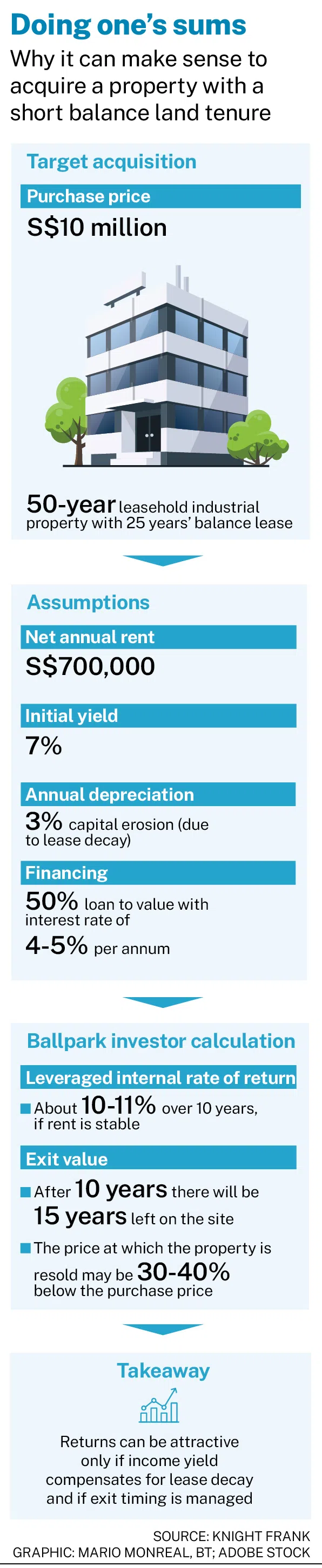
Knight Frank’s Tan says it is vital for potential investors of properties with short balance land tenures to adopt a “disciplined approach to model the investment as a finite income play rather than as a perpetual capital asset”.
Says CBRE’s Chua: “Investors need to conduct thorough underwriting to assess factors including loan type (whether to take an interest-only loan or an amortised loan) and key terms such as interest rates, as well as strength and reliability of the income stream over the remaining lease term.”
“Confidence in the tenant’s covenant and the asset’s ability to generate stable cash flow until lease expiry is critical,” he also notes. “Additionally, investors should be mindful of exit strategies, if any, as shorter tenures come with valuation degradation, which may limit resale options or refinancing flexibility.”

Optimising value extraction in final years of lease
Is there a minimum balance land tenure threshold below which a property becomes untradeable?
Says Dr Chua of JLL: “All assets are, in principle, tradeable provided they are priced correctly relative to the remaining lease tenure and asset condition.
“While shortened tenure may dampen liquidity and buyer interest, appropriate market pricing will continue to facilitate transactions.”
He offers some solutions for properties with dwindling land leases.
“Owners may consider repositioning assets for interim or flexible uses, aligning with shorter holding periods and lower capital commitment. These opportunities are often attractive to occupiers seeking operational flexibility, and conversion to temporary formats can maximise value extraction during the final lease years.”
Agreeing, Knight Frank’s Tan says that properties on land approaching lease expiry can be repurposed for alternative interim uses such as sports, last-mile logistics facilities, urban farming and for solar panels.
Dr Chua adds pop-up accommodation, weekend markets and short-term education centres to the list of potential transient or low-overhead uses.
Knight Frank’s Tan also suggests that with Singapore heading towards becoming a super-aged society, converting or repurposing short-balance leasehold land into senior housing and a range of assisted-care facilities would meet a growing urgent social and economic need.
“Such uses can extend the productive life of land that otherwise faces steep depreciation as its lease runs down, while responding to social and infrastructural demands,” she says.
To make conversion to senior housing financially feasible on shorter-tenure sites, policymakers should seriously consider a package of measures to lower upfront costs such as land betterment charges (LBC) and stamp duties, she reasons.
In Singapore, planning consent or any change in permitted land use that increases land value commonly triggers LBC, which creams off 70 per cent of the enhancement in land value.
For a party seeking to convert, say, an ageing industrial property to some form of senior housing, LBC may be levied based on residential use (which is deemed a higher-value use).
Tan therefore recommends creating a distinct use group for senior housing or assisted-care facilities instead of classifying them under the residential use groups.
She says: “A differentiated LBC rate or capped charge to convert land to senior housing or assisted-care uses would recognise the social service nature of the use.”
Tan of AlpsEdge highlights another potential hurdle. While the authorities may look into allowing new alternative uses, “without the lease extension, the lessee may be hard-pressed to put in more capital (despite) having insufficient time to recoup their investment”.
On the other hand, short balance land leases may not necessarily be a bad thing, he notes.
“Older or existing uses which may seem out-of-date and less attractive in bringing in desired activities can be allowed to expire, and the authorities may then tender out the site for new uses on fresh lease to allow new investment and rejuvenation.”
As for the Hotel Miramar site, the authorities’ turning down of the request to top up the lease to 99 years probably signals a preference for maintaining flexibility in future plans for the stretch.
On the two neighbouring hotel plots – also sold by the state on 99-year leasehold tenures from February 1968 – stand the Copthorne King’s Hotel and Furama RiverFront Singapore.
For now, the Aravest-managed fund (in which Wee Hur has a significant minority stake) can still make hay while the sun shines when the property reopens as a DoubleTree by Hilton.
“The income profile that we ultimately underwrote was very compelling,” says Song.
TRENDING NOW

Once staunchly pro-China, Malaysian Chinese businesses are now distancing themselves from Beijing

Looking beyond looming CEO succession, should UOB potentially pursue a transformative merger?

Could stablecoins be the future of money?

Grab CEO’s wife Chloe Tong on life with Anthony Tan and finding her purpose

