HOCK LOCK SIEW

Sembcorp may find it tough to stop buying renewable capacity

Janice Lim
Janice Lim

Published Wed, Aug 9, 2023 · 05:00 AM
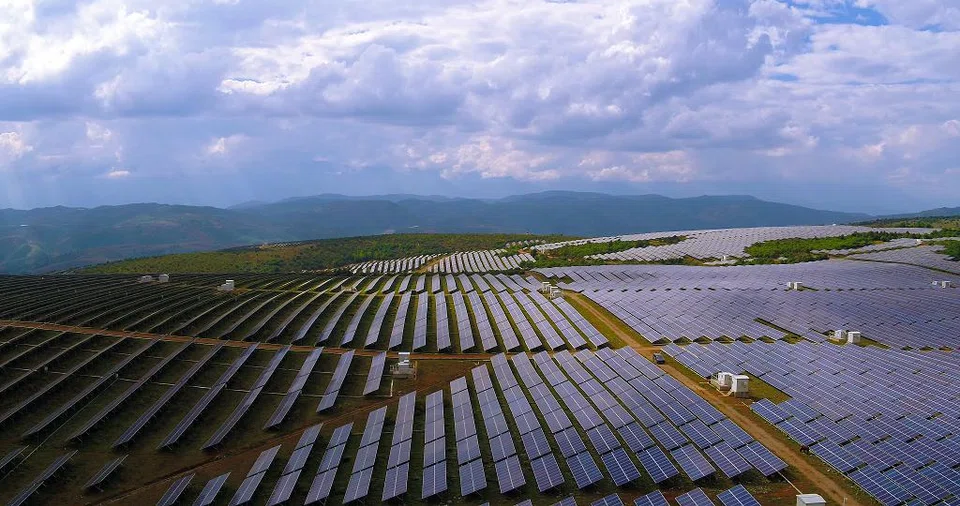
    • Solar assets in Yunnan province, China, jointly owned by Sembcorp Industries and SDIC New Energy. 
    • Solar assets in Yunnan province, China, jointly owned by Sembcorp Industries and SDIC New Energy.  PHOTO: SEMBCORP INDUSTRIES

    SEMBCORP Industries may have slowed its acquisition of renewable energy capacity so far this year, but the energy company may have to keep spending aggressively if it is to succeed in transforming into a green company.

    Based on checks by The Business Times, Sembcorp has committed to invest close to S$2 billion on acquiring solar and wind farms in China, India and Vietnam, since announcing its plans in May 2021 to pivot its business towards a more sustainable footing.

    Along with winning bids for renewable energy projects in Singapore, the Middle East and other overseas markets, the total installed energy capacity is now at 8.6 gigawatts (GW), with another 3.3 GW of capacity under development, bringing the foreseeable capacity to 11.9 GW.


    The company’s renewable capacity has been making huge leaps, increasing from 25 per cent of total energy capacity in 2020 to 39 per cent in 2021, and then to 59 per cent at the end of 2022. Sembcorp will most likely meet its target of increasing its gross installed renewable energy capacity to 10 GW by 2025 ahead of time.

    That pace of progress has perhaps allowed the company to take a breather. Renewable share of total capacity as at end-June 2023 has increased by a mere 2 per cent from end-2022 – a much-smaller increase compared to previous years.

    After the two-year buying spree, Sembcorp is likely focusing on executing its acquisitions and bringing online the renewable assets currently under development, as well as setting new medium-term goals.

    In fact, equity investment in renewables slowed in the first half of 2023 to S$578 million from S$849 million a year ago. On the other hand, capital expenditure in this segment has grown to S$247 million, more than double the S$95 million spent a year ago. That higher spending on capex instead of investments signals a focus on organic growth for now.

    However, Ho Pei Hwa, equity analyst at DBS, said this doesn’t mean that there won’t be anymore acquisitions going forward.

    “It is business as usual,” she told BT. “We should still see asset acquisitions if opportunities arise.”

    Profit perspective

    The company may provide greater clarity on how it intends to achieve its targets when it unveils its strategic review in November this year. But beyond the stated goal of greening its portfolio, Sembcorp may also face pressure to rapidly grow its renewable capacity from a profit perspective.

    While conventional energy only makes up 39 per cent of Sembcorp’s total capacity, it contributed S$2.9 billion of revenue in the first half of 2023, more than seven times the S$382 million contributed by renewables. Sembcorp’s conventional energy portfolio accounted for S$435 million of net profit, a 47 per cent year-on-year increase. Renewables net profit during the same period was a more modest S$118 million, a 55 per cent increase.

    Sembcorp has set a target for its sustainable solutions portfolio to make up 70 per cent of the group’s net profit by 2025. Including its integrated urban solutions segment, the net profit for its sustainable solutions portfolio stands at S$171 million, which is 28.1 per cent of the total net profit of S$608 million for the first half of 2023 (although this includes one-off gains from exceptional items).

    It may be challenging for Sembcorp to organically increase the contributions from sustainable solutions by over 40 percentage points in two years, especially considering how renewable energy prices from solar and wind have dropped significantly over time, and fossil fuel-based energy prices have gone up in recent years.

    Of course, cheap solar and wind energy, relative to fossil fuel-based energy sources, is always a good financial incentive to nudge governments and companies to turn to more renewables.

    But this may have caused Sembcorp’s financial returns from its renewables investments to not be as efficient, in terms of its contributions to growing the net profit of Sembcorp’s sustainable solutions portfolio to achieve its 2025 target.

    Making the targets even harder to hit is the fact that Sembcorp’s conventional energy business continues to grow. For example, a major contributor to Sembcorp’s emissions in the years ahead will be its two gas-fired cogeneration power plants on Jurong Island.

    Until sustainable feedstock such as clean hydrogen becomes feasible, the company will have limited options to lower the emissions from those plants. The outlook is still murky on that front. Both Indonesia and Malaysia imposed temporary bans on renewable energy exports last year, even though both had lifted the restrictions in recent months.

    The company has set a target of cutting emissions to 2.7 million tonnes of carbon dioxide equivalent by 2030.

    With total emissions across Scope 1, 2 and 3 coming up to 33.6 million tonnes at the end of 2022, cutting emissions by more than 90 per cent in less than a decade is nothing short of a tall order. Out of all the portfolio companies under state investor Temasek, Sembcorp has the highest level of emissions.