
Seoul’s geopolitical tightrope walk

South Korea is seeking to win US and Chinese hearts and minds, while pivoting to other markets, including Asean
Summarise
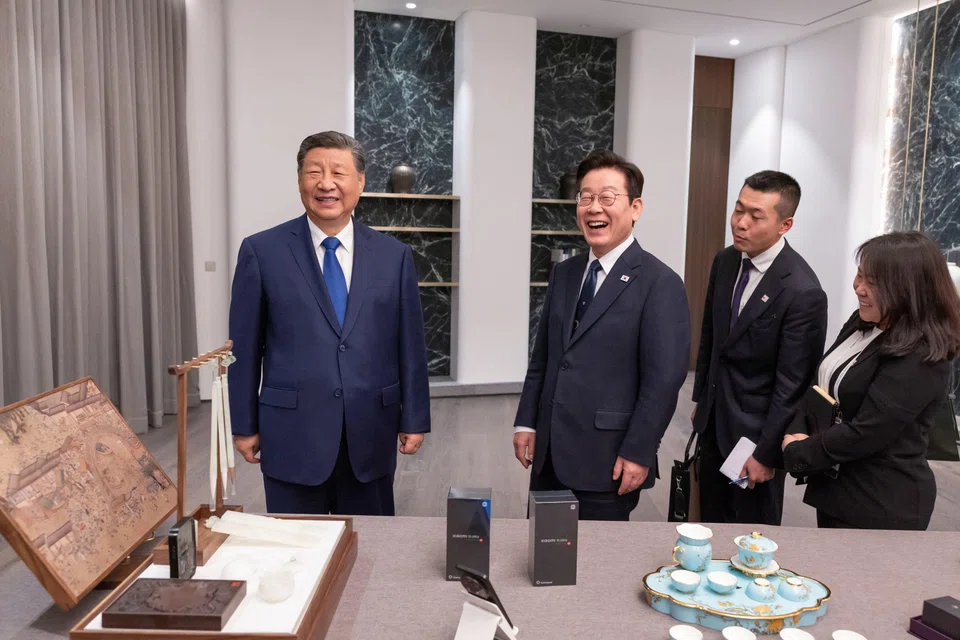
    • China's President Xi Jinping (left) and South Korea's President Lee Jae-myung (second from left) exchanging gifts at a meeting on the sidelines of the Apec summit. While Seoul has long been a security ally of Washington, it increasingly finds itself in a diplomatic balancing act with Beijing, given the latter’s growing influence in Asia and beyond.
    • China's President Xi Jinping (left) and South Korea's President Lee Jae-myung (second from left) exchanging gifts at a meeting on the sidelines of the Apec summit. While Seoul has long been a security ally of Washington, it increasingly finds itself in a diplomatic balancing act with Beijing, given the latter’s growing influence in Asia and beyond. PHOTO: AFP
    Published Wed, Nov 12, 2025 · 06:30 AM

    THE Asia-Pacific Economic Cooperation (Apec) summit held from Oct 31 to Nov 1 in Gyeongju saw around 20 nations attend. Yet, for the South Korean hosts, the big two that mattered the most were the US and China.

    While Seoul has long been a security ally of Washington, it increasingly finds itself in a diplomatic balancing act with Beijing given the latter’s growing influence in Asia and beyond.

    This was shown at the recent summit, where South Korea skilfully positioned itself as a leader advancing economic integration and resilience across the region.


    Notably, Lee Jae-myung, South Korea’s new president, successfully courted both his US and Chinese counterparts Donald Trump and Xi Jinping in high-profile bilateral meetings.

    Speaking recently on his 100th day in office, Lee said that “we will stand alongside the US in the emerging global order and in supply chains centred on the US, but it is crucial for us to manage our relationship with China carefully to avoid antagonising them”.

    Lee has so far shown diplomatic acumen in addressing questions such as whether South Korea would come to Taiwan’s aid in the event of an attack by China.

    He has said that he would answer such questions when “aliens are about to invade the Earth”, and called for “friendly competition” and “equal cooperation” with Beijing.

    This pragmatism reflects, in part, the fact that China is South Korea’s largest trade partner.

    The two powers not only have a bilateral trade deal, but Seoul is also a member of the Beijing-led Regional Comprehensive Economic Partnership.

    South Korea’s Minister for Trade Yeo Han-koo also recently highlighted the geopolitical tightrope that Seoul is walking. He noted that, while the economy grew in the third quarter of 2025 at the strongest pace in around a year and a half, with exports resilient, storm clouds could gather again.

    Yeo flagged that the government’s goal in this context is to cement cooperation with the Trump team, including in the areas of semiconductors, batteries, biotechnology, shipbuilding and nuclear energy.

    Simultaneously, South Korea is seeking to stabilise relations with China, while keeping open a window of opportunity to broaden and deepen its ties with other trading partners, including Malaysia, Thailand and Singapore in Asean.

    While this appears to be a common-sense strategy, it is difficult to implement in practice. Navigating the competing demands of Washington, especially under the Trump team, and Beijing is super-challenging with sometimes irreconcilable policy options.

    US: challenges and opportunities

    For one thing, Seoul has faced significant pressure from the Trump team over trade imbalances.

    South Korea hopes that last month’s breakthrough bilateral agreement will now avoid what might have been even larger tariffs, with Seoul’s pledge to make hundreds of billions of dollars of investment in the US economy.

    Specifically, the deal reduces the US’ so-called reciprocal tariffs from 25 per cent to 15 per cent. South Korea will invest around US$350 billion further in the US economy (some US$200 billion in cash investment and US$150 billion in shipbuilding), while also buying US$100 billion worth of liquefied natural gas.

    To help sweeten the deal further, and playing to Trump’s ego, Lee ensured that the US president was greeted at the Apec summit by a large honour guard and given gifts that included a gold crown.

    Trump also received the Grand Order of Mugunghwa, South Korea’s highest honour. He became the first US president to receive the award, which was given “in recognition of his contribution to peace on the Korean peninsula”.

    On the security front too, US-South Korea ties were deepened significantly, which has provoked hostility from North Korea as well as China. Washington has approved Seoul’s use of enriched uranium nuclear fuel from the US for a new nuclear-powered submarine.

    This is a significant breakthrough for Seoul as, under the terms of the two powers’ deal on nuclear, South Korea was previously not allowed to reprocess spent nuclear fuel, or to enrich uranium for military purposes. This is despite the fact that Seoul has nuclear reactors to generate power.

    Regarding China

    Despite Trump’s “amazing” meeting with Lee, the South Korean president went on to have a surprisingly positive session with Xi too, who was on his first visit to South Korea in 11 years. The upbeat tone of the session defied recent tensions.

    China recently sanctioned South Korean shipbuilder Hanwha Ocean because of the company’s cooperation with “relevant US investigations”.

    This builds on longer-standing challenges including Beijing’s restrictions on South Korean entertainment content, which were banned after the 2017 deployment of the US-led Terminal High Altitude Area Defense anti-missile system in South Korea.

    Moreover, in April, South Korea expressed concern over China erecting a structure in an area of sea between the two countries where their exclusive economic zones overlap. Beijing has said that this is fish-farming equipment, and has nothing to do with any territorial claims.

    Nevertheless, the Xi-Lee meeting ran for longer than scheduled, over an hour and a half. This led to an optimistic assessment from a senior South Korean official that there has been “complete restoration of bilateral ties”.

    To be sure, the meeting may partially reset relations, with Xi and Lee stressing the importance of the strategic partnership. Xi even said that the two are “inseparable partners”, and China appears pleased that former South Korean president Yoon Suk-yeol – who had leaned even more towards Washington – has been replaced by Lee.

    With Lee now in office, Xi’s objective appears to be to discourage the South Korean leader from leaning too strongly on Trump.

    He has further cards to play to encourage this, including potentially helping to facilitate next-step peace dialogues with North Korea.

    Asean and beyond

    However, it is likely that there will continue to be periodic tensions between Seoul and Beijing, just as tensions will likely persist between Washington and Seoul.

    The South Korean government is also therefore deepening its focus on diversifying trading partners to reduce economic dependence on both the US and China. Asean is a specific target, as is Asia more generally, for Seoul to deepen ties, including on issues such as digital transformation, supply-chain resilience and climate change.

    At the Apec summit, South Korea signed a trade deal with Malaysia, and is also pursuing negotiations with other regional players, including Thailand.

    Singapore and South Korea also recently launched a strategic partnership to deepen economic and defence ties. Seoul is kick-starting trade negotiations with countries in South Asia, too, including Bangladesh and Pakistan.

    Taken together, Lee will now seek to build from his success at Apec in deepening ties with both China and the US. He is aware that there are no guarantees of success with this agenda, which is why he will also double down on economic relations with other key players, including in Asean.

    The writer is an associate at LSE IDEAS at the London School of Economics


