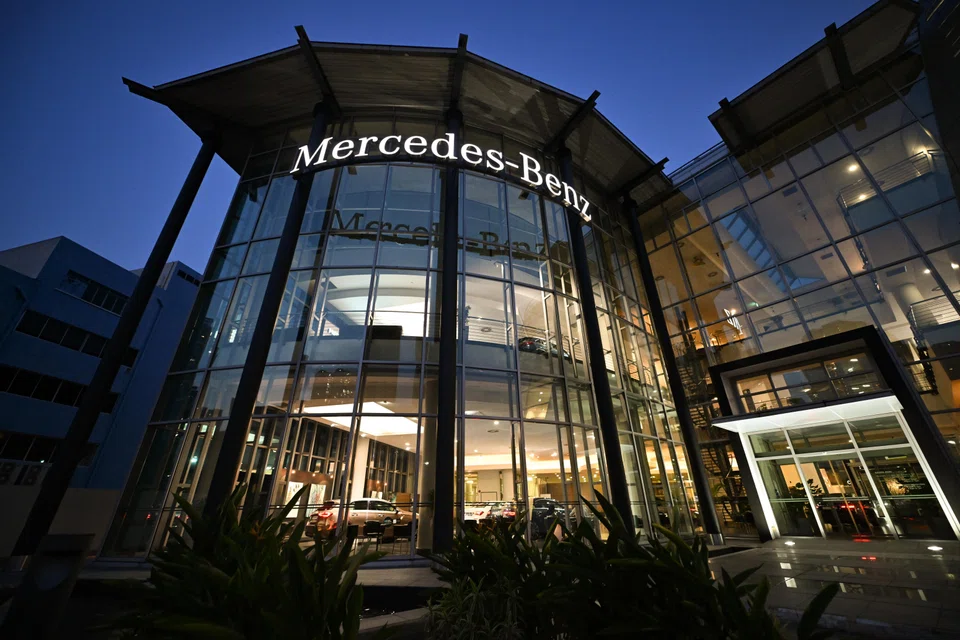
Shedding the iconic ‘Cycle & Carriage’ will be a loss – but perhaps a necessary one for Jardine
Its famous Mercedes-Benz dealerships in Singapore and Malaysia account for only 4 to 5% of the company’s total earnings

THE name Cycle & Carriage is deeply woven into Singapore’s corporate history.
For three-quarters of a century, the company has been a fixture in the local consumer mindset as the longstanding distributor of Mercedes-Benz. It even once-upon-a-time operated an assembly plant in Singapore that produced the luxury marque.
Yet, recent market chatter suggests this storied era might end.
Singapore-listed Jardine Cycle & Carriage (Jardine C&C), a unit of the Jardine Matheson Group , is reportedly exploring a sale of its automotive dealership businesses in Singapore and Malaysia, in a move that could value the business at between US$250 million and US$350 million.
While this potential sale could be seen as a loss of corporate identity, a more pragmatic investor should see it as a timely and necessary evolution.
Looking beyond sentiment to its balance sheet: The Singapore and Malaysia distributorships are relatively small contributors to the bottom line, even though they punch far above their weight in brand visibility.
Last year, the Cycle & Carriage division brought in about US$48 million in underlying profit. That figure sits against a total group underlying profit of about US$1.1 billion.
In other words, the famous dealerships account for only about 4 to 5 per cent of the company’s total earnings.
Since reports of the potential dealership sale broke on May 8, the market reaction has been calm. From May 8, the share price ticked up 1.2 per cent to S$32.78, giving the company a market value of about S$13 billion. The muted response suggests that the market is not mourning the loss of a heritage brand. Instead, investors are likely viewing this as a sensible portfolio clean-up.
Over the past year, Jardine C&C has generated a total return – with dividends reinvested – of 33.7 per cent. This is just shy of the 35.5 per cent total return of the benchmark Straits Times Index.
“Grow faster than South-east Asia”
To be sure, the real engine of Jardine C&C moved out of Alexandra Road a long time ago.
The company operates as an investment holding firm with deep roots in the broader region. Its crown jewel is a majority stake in Astra International, a Indonesian conglomerate spanning the automotive sector, financial services, heavy equipment and agriculture.
Its Indonesian businesses, which include car dealership Tunas Ridean, ran up a total of US$945 million in underlying profit for FY2025 – accounting for around 85 per cent of total earnings.
In Vietnam, it holds significant stakes in Truong Hai Group, Refrigeration Electrical Engineering Corporation and Vinamilk.
The group’s stated strategy is to “grow faster than South-east Asia”. Managing a local car dealership simply does not move the needle on that regional ambition.
On the Singapore Exchange (SGX), where Jardine C&C has long been a steady constituent, the company was a publicly listed company even before the bourse was known as SGX.
It is a shift that highlights a broader market theme.
The local stock market is increasingly defined by companies that use Singapore as a corporate base to capture regional growth, rather than by those relying purely on domestic consumption.
Ironically, shedding its local retail operations could sharpen this profile, and make the firm a purer play in the region’s developing economies.
A pressing reality on the streets is driving this decision, as the automotive market in Singapore undergoes a structural shift.
The rapid rise of electric vehicles (EVs) and Chinese EV makers are changing the rules of the game – and data from the Land Transport Authority paints a stark picture.
In the first quarter of 2026, EVs made up nearly 60 per cent of all new car registrations in the Republic.
Chinese giant BYD alone registered 3,239 units in those three months, accounting for nearly one in four of total new car sales.
BYD was Singapore’s best-selling car brand in 2024 and 2025; other Chinese brands have broken into the top ranks as well.
Meanwhile, traditional European luxury car makers have come under intense pressure.
Mercedes-Benz registrations have stalled as buyers turn to newer, cheaper alternatives. Local dealerships that rely on these legacy brands are forced to compete against aggressive prices and new technology from Chinese rivals.
Defending market share in this environment requires a lot of cash and means accepting lower profit margins.
Tanks over cars
But the reality facing European legacy brands in Singapore is part of a much larger reshaping of capital.
In Germany, the traditional automotive engine that drove the continent’s economy is sputtering. Giants like Volkswagen and Mercedes-Benz are watching profits fall as they lose ground to Chinese competitors.
Facing idle factories and a difficult electric transition, the heartland of European carmaking is being forced to pivot.
Rather than clinging to a declining consumer market, German industry is quietly putting its might into the booming defence sector. Automotive parts manufacturers are retooling their assembly lines to build drone engines and components for armoured vehicles.
Companies such as Rheinmetall are repurposing car parts factories to manufacture military equipment and absorbing skilled auto workers to meet the surging demand for European rearmament.
It is an industrial transformation driven by pragmatism, and a global shift that mirrors the difficult choice facing Jardine C&C.
A heritage showroom in Singapore faces a similar harsh truth as a sprawling car factory in Bavaria. As structural economics change, capital must move to where demand and margins are actually growing.
In this light, selling the dealership business is a shrewd – if not also a necessary – move.
For one thing, the dealership sale would reportedly move Jardine C&C from a net-debt position to a net-cash one.
This newly freed capital gives the firm significant flexibility to pursue new acquisitions, invest deeper into its high-growth Indonesian and Vietnamese assets, or return value to shareholders through share buybacks.
Investors should not mourn the potential loss of the Cycle & Carriage showrooms. In a market dominated by rapid electrification and fierce new competitors, staying still is the biggest risk.
By selling its historic dealerships, Jardine C&C is choosing to drive forward – even if it might not be called Cycle & Carriage for much longer.
TRENDING NOW
Three ex-employees of Envy group join Ng Yu Zhi in bankruptcy
He built the Vingroup empire. Now South-east Asia’s richest man is handing some key roles to his sons
Grab CEO’s wife Chloe Tong on life with Anthony Tan and finding her purpose
Incidence of civil servants buying property near unannounced MRT stations ‘a concern’, but may not establish misconduct: PSD