Shocking! Why ‘chumbox’ ads are bad by design, yet still in business
One weird trick: trashy headlines and redundant clicks are features, not flaws


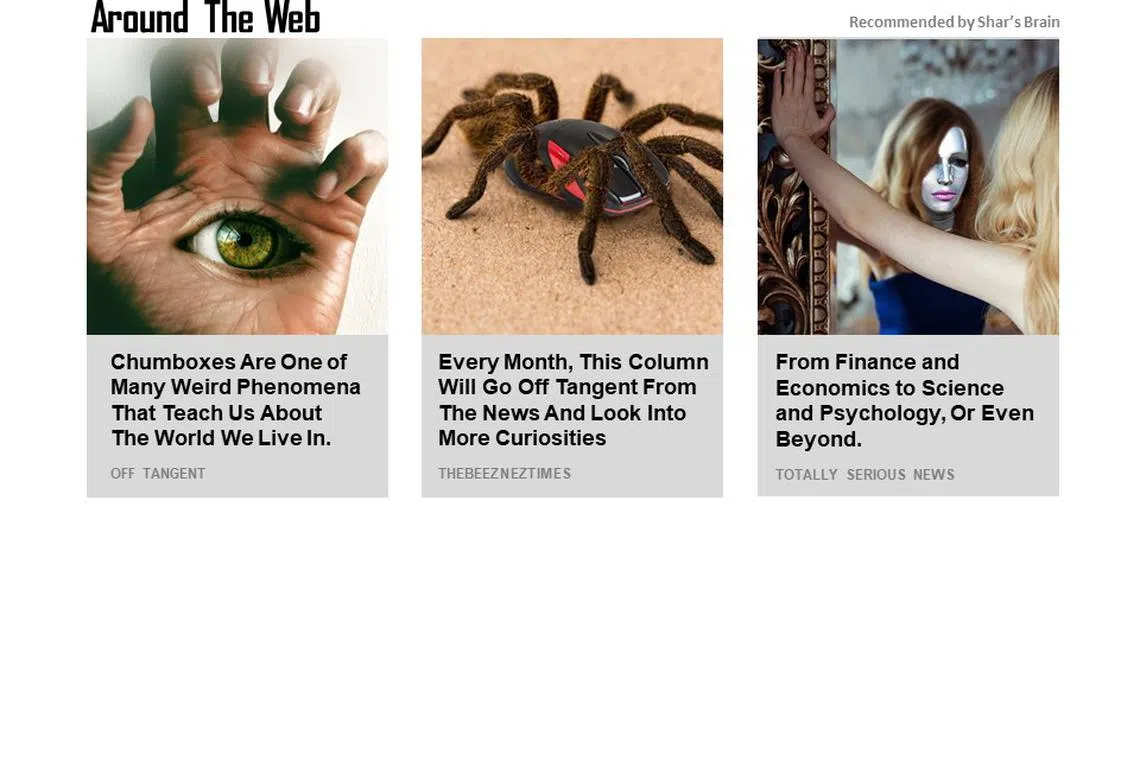
AT THE bottom of many online articles, including those on reputable news sites, there is a grid with thumbnails that seemingly lead to other articles. It’s innocuously labelled “Around the web” or “You may also like”.
But what you really get is a mind-boggling mix of ads posing as trashy articles, otherwise known as “chumboxes” – the online equivalent of containers filled with chopped-up fish bones and gristle, used as bait for bigger fish.
This isn’t just an Internet oddity, but a billion-dollar industry that has survived for close to a decade. In 2021, there were even two chumbox unicorn listings on the Nasdaq: Outbrain at US$1.1 billion and Taboola at US$2.6 billion.
How is this an actual business?
I ask myself this as I browse through the spectrum of chumboxes, from tame to unhinged. Many feature questionable health-related claims, like “one weird trick” for fat loss, or miracle cures that “your doctor will HATE”.
They also tease you with financial hacks (seven outrageous credit cards), salacious gossip (Top 15 ugliest celeb spouses) or oddly specific listicles (20 things to stop wearing after age 30).
The headline images range from mundane stock photos and Wall Street bros, to grotesque body parts, icky food and dotted patterns that make your skin crawl – anything to stand out from the noise of the Internet.
Even the more innocent-looking chumboxes can leave you confused. I tried clicking on one found at the bottom of a mainstream Singapore news site that didn’t sound too much like clickbait: “What’s my car worth? Online calculator for car resale”.
You won’t believe what happens next
Well, it wasn’t that dramatic, but it was weird. The link led me to trendingresults.com, a webpage with no other feature besides a prompt to choose between “vehicles” and “properties”. I clicked the former and was once again prompted to choose “motorcycle” or “car”. I picked the latter.
Only then was I offered a hyperlink to an online platform that finally would let me calculate the vehicle’s value. But why did I have to make four clicks to get to what the ad promised?
It all boils down to the chumbox business model, which is as simple as it gets: more clicks mean more money. Chumbox providers such as Outbrain and Taboola are paid per click by the websites to which readers are directed. The chumbox chaps then pay publishers a cut.
The bizarre design and poor user experience (UX) are thus features, not flaws. Chumbox ads force as many clicks as possible with numerous redundant links and ‘next’ buttons, says marketing specialist Wong Pei Wen, a senior lecturer at the Wee Kim Wee School of Communication and Information (WKWSCI).
“These types of articles usually would lead you to pages where, unlike the more credible sites that pay attention to UX and the article is in full, there’ll be two sentences, one irrelevant ad, and then you have to click ‘next’. By the time you finish reading the article, you’ve probably clicked 13 times,” she explains.
This becomes a cheap way for publishers to expand their ad inventory in this age of widespread programmatic buying, notes Wang Xiaofeng, principal analyst at research company Forrester. “Publishers do this due to the pressure to generate ad revenue.”
Leading astrologer predicts end of times
In an age where news publishers are struggling to make money online, the trashy economics of chumboxes makes sense. While researching this piece, I casually wondered if chumbox providers might even get a boost from generative artificial intelligence, with tools such as Midjourney able to whip up bizarre images on demand (hello, distorted hands) and ChatGPT getting weaponised to generate even worse clickbait.
But thankfully for humanity, the Internet may not be headed towards a click-fuelled dystopia after all. Chumboxes have had their glory days, but the providers now face pressure to get clean.
As Wang of Forrester notes, the easy money from chumboxes comes at the expense of brand quality for publishers. Advertisers are also cautious about the image they present.
“(Mature) advertisers will move away from low-quality inventory and easy-to-measure but less meaningful metrics – such as the number of clicks – and bear consumer data privacy, trust, brand quality and long-term growth in mind,” she says.
Investors have also lost their appetite for funky tech things. As of writing, Outbrain’s market cap was just over US$250 million, a quarter of its valuation at its initial public offering. Taboola’s valuation has likewise more than halved to about US$940 million.
The business of recommendation engines is actually still sound in this age, where content marketing is on the rise, notes Wong of WKWSCI. But maintaining good control and quality is a separate matter.
“If you don’t operate based on the right editorial and advertising principles, then you might run yourself into the ground with no demand from credible advertisers anymore,” she says. “But if you run your business well, and you’re more discerning with your advertisers and clients, as well as the keywords that you promote, then you will not be in this predicament.”
The business of chumboxes could continue, but with less chum. This is already visible to some degree; I have observed that chumboxes on some news sites are less bizarre and clearly marked as sponsored content.
But will the true-blue chumbox ever be fully erased? I’m not sure, but until we find out, you may also be interested in the content below.