

Should the S$5 billion EQDP roll-out be slowed amid elevated valuations, global market risks?
Even if the worries of a disorderly correction are overblown, some richly priced stocks may struggle to deliver worthwhile returns over the next couple of years

[SINGAPORE] If I had a dollar for every time some market watcher has been quoted reciting that old adage about time in the market being more important than timing the market, I might have enough cash to ride through the big sell-off they all seem to be anticipating.
Staying invested in a diversified portfolio of high-quality companies through market cycles is a good idea, of course. And, the relatively high dividend yields offered by constituents of the Straits Times Index (STI) tend to keep them looking attractive to income-focused investors even in the face of potential downturns.
Yet, dividends are just one element of the total return from owning stocks. Since the Covid-19 pandemic, some of the largest components of the STI have charted big gains, driven by the market’s increasingly bullish perception of their ability and willingness to unlock value and grow their businesses.
After their strong advance, investors should carefully consider whether holding out for further upside makes sense.
Take ST Engineering . Its shares ticked up 2.4 per cent last week, versus the STI’s gain of 1.2 per cent, following a third-quarter business update that showed solid performance across its key business segments and further growth in its order book.
The group also said it is “reviewing strategic options” for a unit within its satellite communications business that suffered a S$667 million impairment charge in Q3 2025.
With its strong financial results and value-unlocking initiatives, ST Engineering’s dividend payouts are rising. The group said it will pay an interim dividend of S$0.04 per share for Q3 2025, and propose a final dividend of S$0.06 per share. It will also propose a special dividend of S$0.05 per share, which amounts to about one-quarter of the cash proceeds from recent divestments.
Together with interim payouts of S$0.04 per share for each of the first two quarters of this year, ST Engineering’s dividends for 2025 will total S$0.23 per share, up from S$0.17 per share for 2024.
Yet, after ST Engineering’s strong run this year – it has climbed 82.2 per cent versus the STI’s gain of 20 per cent – this higher dividend doesn’t seem all that compelling. In fact, it amounts to a yield of just 2.7 per cent against ST Engineering’s current share price of S$8.49.
While the group may well raise its dividend further in 2026 and beyond, its shares are now arguably less interesting to yield-hunting Singapore investors than they were a couple of years ago. Investors who buy the stock now are clearly betting on further price gains.
Big gains, heightened risks
This is part of a wider trend across the Singapore market. During the decade leading up to end-2019, the STI rose just 11.2 per cent. But it chalked up a total return of 54.3 per cent on a dividend-reinvested basis. Put another way, share price gains accounted for only one-fifth of the STI’s total return during the decade.
By comparison, the S&P 500 index rose 189.7 per cent and delivered a total return of 256.4 per cent over the same period. In other words, share price gains accounted for nearly three-quarters of its total return.
From the beginning of 2020 to the end of last month, however, the STI’s total return on a dividend-reinvested basis was 78.6 per cent – with share price gains of 37.4 per cent accounting for close to half of that total return.
Taking a more recent period, from the beginning of 2024 to the end of last month, the STI’s gain of 36.7 per cent accounted for almost three-quarters of its total return of 50.7 per cent.
While the STI’s strong performance in the past few years was at least partly due to stronger profitability at the three local banks – as well as value-unlocking and business-transformation activities at some other index constituents – the gains occurred against the backdrop of heightened bullishness around the world.
There is now growing concern that global market sentiment may sour, and poison investor optimism in the Singapore market.
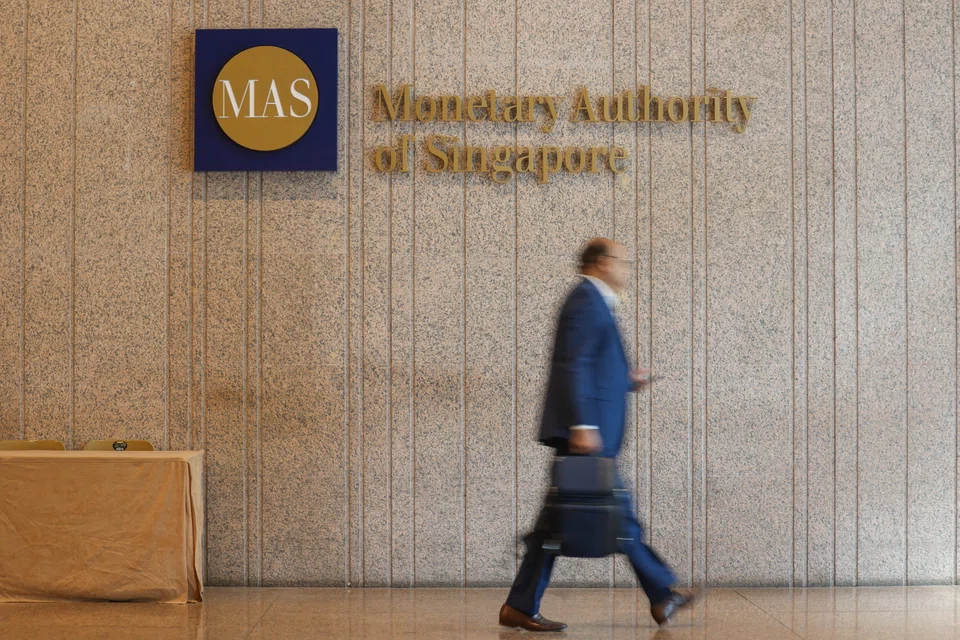
The Monetary Authority of Singapore (MAS) noted in its Financial Stability Review earlier this month that geopolitical risk and trade policy uncertainty remain elevated relative to a year ago. Yet, public equity markets have been setting new record highs, fuelled by gains in the technology and artificial intelligence sectors.
“The continued divergence between equity market valuations and rising downside risks to growth raises the prospects of disorderly corrections in the event of shocks,” MAS said.
“Some Big Tech firms (primarily hyperscalers) have also turned to the use of novel and potentially circular private financing arrangements to fund their expansions,” it added. “These include the use of special purpose vehicles, private credit structures and novel accounting treatment that could mask leverage and increase funding dependencies.”
Slow down EQDP roll-out?
While it’s impossible to know when these excesses might become a problem for the Singapore market, the risk they pose should not be ignored, in my view.
One measure that MAS should perhaps consider is slowing the pace of its Equity Market Development Programme (EQDP). The scheme – which will farm out S$5 billion to fund managers with a strong focus on Singapore stocks – is widely seen to have spurred local market sentiment since it was introduced early this year.
So far, a total of S$1.1 billion has been allocated to three fund managers. In the light of concerns about stretched valuations in markets around the world, channelling the rest of the S$5 billion into the market now might be akin to pouring kerosene on a raging fire.
It could amplify the risk of an ugly correction down the road, which may destroy investor confidence and undermine the national effort to revitalise the Singapore market.
Indeed, keeping the bulk of the EQDP powder dry may reduce the risk of the Singapore market stumbling too badly in the event of a global rout. With those funds waiting to be deployed, many investors may view a sell-off as an opportunity rather than a reason to panic.
So, what should investors do now? My own inclination is to take advantage of the currently elevated market, by harvesting some gains and tilting towards cash.
Even if the worries of a disorderly correction are overblown, some richly priced stocks may struggle to deliver worthwhile returns over the next couple of years, in my view.
My intention is to re-invest the money over time in a wide range of promising stocks, in order to achieve diversified, long-term exposure to the local market.
The writer owns shares in ST Engineering
TRENDING NOW

Once staunchly pro-China, Malaysian Chinese businesses are now distancing themselves from Beijing

Looking beyond looming CEO succession, should UOB potentially pursue a transformative merger?

Could stablecoins be the future of money?

Grab CEO’s wife Chloe Tong on life with Anthony Tan and finding her purpose

