
HOCK LOCK SIEW

SIA’s elevated profitability won’t last forever

Ben Paul
Published Thu, Aug 3, 2023 · 05:00 AM
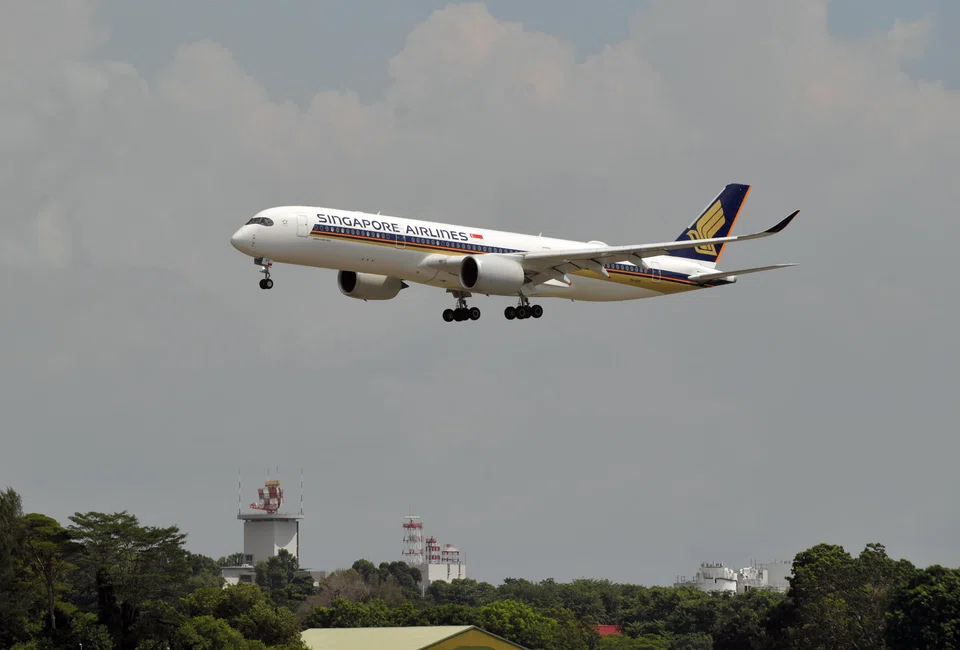
    • SIA is still managing to sustain sky-high fares a year after Singapore fully reopened its borders.
    • SIA is still managing to sustain sky-high fares a year after Singapore fully reopened its borders. PHOTO: BT FILE

    IF YOU have a hankering for the changing hues of autumn in Britain, Singapore Airlines (SIA) can get you to London and back during the first week of September for just over S$13,000 in its vaunted business class cabin.

    Alternatively, a round-trip ticket in SIA’s less-salubrious economy class would set you back about S$3,800.

    More than a year after Singapore fully reopened its borders, SIA is still managing to sustain sky-high air fares as it quickly reinstates its services. Riding this strong tailwind, SIA’s share price closed as high as S$7.91 on Jun 15.

    The stock closed at S$7.14 on Aug 2, up 29.1 per cent since the beginning of the year. (SIA traded ex for a dividend of S$0.28 per share on Aug 1).

    Investors should not get carried away, though. Commercial aviation is a famously cut-throat business, and SIA’s premium brand positioning could work against it as competition from other carriers normalises.

    One important lesson from the rise of low-cost carriers is that most travellers are prepared to dispense with luxuries in exchange for lower fares.

    Last week, SIA reported a 98.4 per cent year-on-year increase in its net profit for the first quarter of FY2024 to a record S$734 million. Revenue rose 14 per cent to S$4.5 billion. (The company has a March financial year-end.)

    The airline group said that the strong financial numbers were achieved “amid robust demand for air travel through the mid-year school holidays and the start of the summer travel season”. Its cargo business weakened during the quarter, but a decline in net fuel costs helped boost its overall profitability.

    SIA noted that near-term forward passenger bookings remain robust, and that its group passenger capacity is on track to reach an average of around 90 per cent of pre-Covid levels by March 2024.

    Earlier this year, when it reported its FY2023 financial numbers, SIA said that its group passenger capacity in March 2023 had recovered to 79 per cent of pre-Covid levels, while international scheduled services for other Asia-Pacific airlines had returned to only 58 per cent of their pre-Covid levels.

    Earnings peak in FY2024

    While analysts expect SIA to achieve highly elevated levels of profitability in FY2024, many of them see the group’s financial performance subsequently waning.

    Nomura said in a research note earlier this week that it had cut its relatively bullish earnings forecasts for FY2024 to FY2026 by between 3 per cent and 8 per cent, to factor in weaker contributions from the group’s cargo business and higher fuel prices. It now sees SIA’s earnings per share hitting a peak of S$0.917 in FY2024 before declining to S$0.786 in FY2025 and S$0.619 in FY2026.

    Yet, Nomura hiked its target price for SIA’s shares from S$7.23 to S$9.17. Its previous target price was set at 1.2 times SIA’s book value, while its revised target price is pegged at 10 times its forecast FY2024 earnings per share.

    The research house noted that SIA’s price-to-earnings ratio is 38 per cent lower than those of its regional peers.

    OCBC Investment Research said in a report earlier this week that it had maintained its earnings forecasts for SIA at S$0.767 per share for FY2024 and S$0.746 for FY2025. It adjusted its fair value for SIA shares down slightly, though, from S$7.94 to S$7.81.

    This fair value was based on a target price-to-book ratio of 1.13 times, which is one standard deviation above the rolling 10-year historical average.

    “SIA’s operating environment is set to become more competitive as regional airlines continue to return more international capacity to the market. A recessionary outlook also remains a key overhang on discretionary travel expenditure,” OCBC said.

    CGS-CIMB said last week that it had raised its “core” earnings per share forecasts for SIA by between 3 per cent and 14 per cent, following the company’s strong Q1 FY2024 performance. It also adjusted its target price upwards, from S$6.53 to S$6.78.

    This was based on a target calendar year price-to-book multiple of 1.12 times, which is 1.5 standard deviations above the historical mean since 2011.

    CGS-CIMB warned that SIA’s shares are “very expensive” now, and that its stock price is likely to be more sensitive to bad news than positive surprises. It also warned that the redemption of the remaining S$3.1 billion of mandatory convertible bonds (MCBs) will reduce SIA’s book value and inflate its price-to-book ratio.

    If SIA had redeemed the remaining MCBs in the recent quarter, CGS-CIMB estimates that the airline’s shares would be trading at 1.59 times its Jun 30 book value – more than five standard deviations above the historical mean.

    “We think that SIA’s elevated valuations once the MCBs are redeemed will make it more difficult for investors to justify the high share price, especially if aviation industry fundamentals deteriorate in the future with rising competition,” CGS-CIMB said.

    A top-end carrier

    SIA has a long history of setting standards as a full-service carrier; and a strong profitability track record.

    During the two decades preceding the pandemic, it managed to stay in the black and pay a dividend every year – despite periodic economic downturns, massive volatility in oil prices and the rise of low-cost carriers.

    Yet, SIA cannot be all things to all people. The very strong negative public reaction to its experiment of serving meals in paper boxes earlier this year underscores the constraints it faces in making adjustments that detract from its overall image as a top-end airline.

    SIA was widely mocked for the seemingly cheap “serviceware” that appeared out of place in its cabins. The airline explained that the paper boxes retained heat and moisture well, and were actually more costly than its usual plastic casseroles.

    Nevertheless, it decided not to use the paper boxes on medium and long-haul flights.

    If there is a lesson here, it is perhaps that SIA should not lose sight of why its most loyal customers choose to pay its premium prices. Once its competitors add more capacity, and the pent-up demand for travel abates, these customers will be the key to its financial performance.



