

Singapore fashion players head overseas as homegrown labels take off
Russell Marino Soh

SINGAPORE fashion brands are gaining popularity among local consumers, with some consumers attracted to the green credentials of several of these homegrown labels, and others seeking a piece of home in their wardrobes.
“There is a renewed interest in local companies, and that includes fashion companies,” said Leonard Choo, director of industry development at the Singapore Fashion Council (SFC). Working-age consumers today are increasingly likely to opt for local brands when shopping, he added.
Success on home turf has nudged some brand owners into thinking about expanding outside Singapore.
Among them is 28-year-old Sheryl Ho, who co-founded tailoring business SuitYourself in 2016. Six years in, the business has established itself among the most well-known names in local custom apparel.
Business boomed in 2022, said Ho, who runs SuitYourself with her husband Lester. This was partly thanks to pent-up demand for custom wedding attire, as couples waited for relaxed safe-distancing measures to hold their ceremonies. Such orders accounted for about 90 per cent of SuitYourself’s total sales in the year.
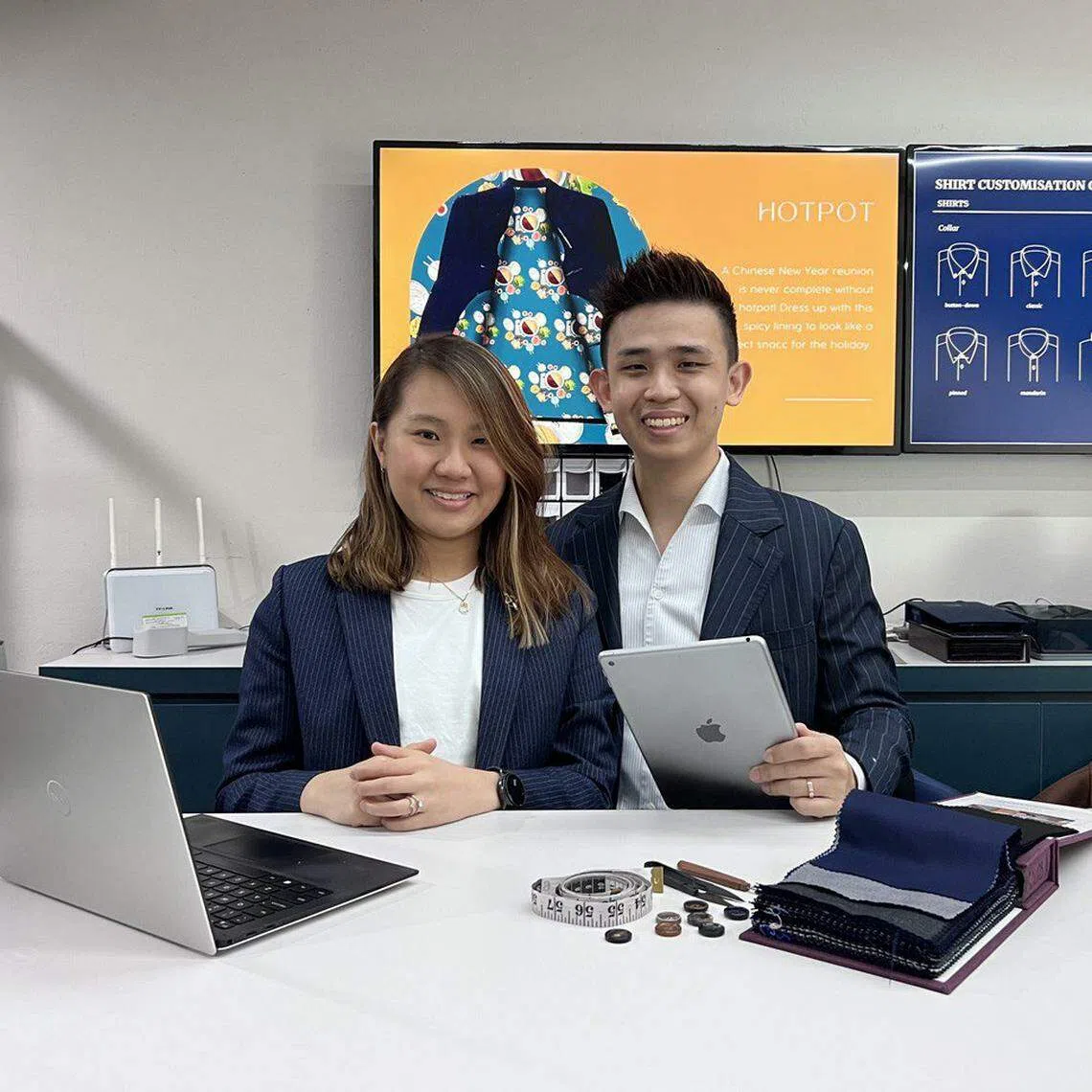
The company is now considering several locations for its expansion. “We see great potential, with some locations being studied and tested, such as Sydney,” said Ho.
Another homegrown icon, womenswear label Love, Bonito, opened its flagship store in Hong Kong in July. It previously operated as an online-only business there. The company also acquired activewear line Butter, another local creation.
Chief executive Dione Song told The Business Times in August: “I just didn’t believe that we don’t have the talent over here in Asia. We know as well that the supply chain is mainly in Asia, so there’s no reason that a brand shouldn’t be successful, from Asia.”

To support the growth of the local fashion industry, the SFC is trying to grow a pool of local fashion talent.
In October, it partnered with Temasek Polytechnic, Ngee Ann Polytechnic and the Lasalle College of the Arts to develop education opportunities for those seeking to enter the industry. It also supports The Bridge Fashion Incubator – an eight-week programme to help young companies refine their offerings through mentorship and design-thinking workshops.
Even as its local brands are looking outward, Singapore is looking to draw big names in the fashion world here. The government has been looking to attract big brands to set up strategic and sourcing offices on the island, said the SFC’s Choo.
Some brands have already expressed interest in doing so. This could in turn transform and scale the industry here, he said. With multinationals setting up shop here, it would be easier for independent local brands to meet minimum-order quantities.
These new strategic and sourcing offices would create demand for and help grow the pool of fashion talent in the local workforce, as well as open up opportunities for partnerships with existing local brands.
Speaking to Singapore’s value proposition for big manufacturers, Choo said: “We’re not the only cosmopolitan Asian city… But certainly our relative stability, infrastructure and skilled labour are very promising to these operational systems.”
The local workforce’s expertise in corporate functions, such as human resources and finance, are a further plus point for the country, he added.
The pandemic has posed some challenges to the local fashion industry. Choo noted that many local brands were hit by supply-chain disruptions in China, arising from its strict pandemic containment policy. A recent surge in infections has further impacted its production capacity.
Meanwhile, alternative sourcing has proven to be a struggle, given the sophistication of China’s manufacturing ecosystem.
Consumers have also been more cost-conscious, although that side of things appears to be improving. Choo noted that although fashion did not make a full recovery in 2022, there has been an upswing – as seen in the heightened consumer engagement and purchases over the festive period.
Nevertheless, Choo is optimistic about the health of Singapore’s fashion scene.
“It is commonly perceived that fashion actually holds more of a decorative than functional purpose in our lives – clothing is association; clothing is status; clothing is uniformity; clothing is individualism,” he said. “(Fashion) is, in some ways, I think, inextricable from what it means to be human.
“As long as there are people and culture around, there will always be fashion.”
TRENDING NOW

High Court rules against Julius Baer’s Singapore trust arm in US$50 million family trust dispute

MSCI proposes standalone status for Indonesia; Jakarta stocks plunge 8%

Once staunchly pro-China, Malaysian Chinese businesses are now distancing themselves from Beijing
No chicken feed: How Malayan Flour Mills built an empire from flour to fowl

