Singapore malls are in fine fettle as visiting them remains a way of life

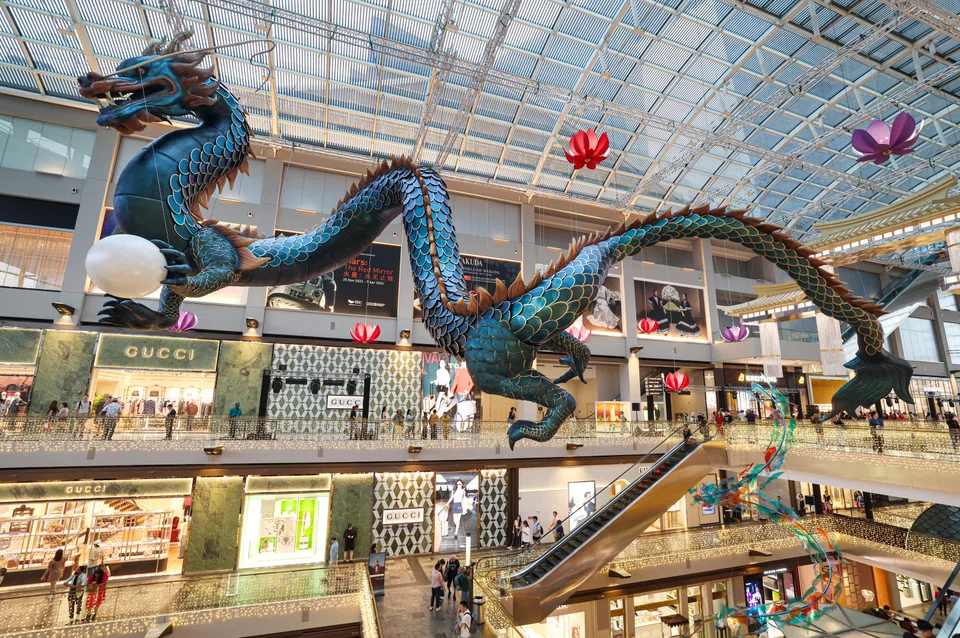
NOT long back, gloomy predictions were made about how malls here might become obsolete amid the growth of online shopping.
The Covid-19 pandemic and the ensuing movement restrictions hit malls hard. Debate raged over how the pandemic would alter consumer habits, with people switching to dine out less, do more online and avoid crowded places.
However, many mall owners here appear to be doing fine.
In marking The Woodleigh Mall’s official opening in November 2023, Cuscaden Peak Investments said the mall, which caters to millennial families with young children, achieved full occupancy.
Recently, a joint venture involving Far East Organization opened a mall at Holland Village – the outdoor concept pet-friendly One Holland Village.
CapitaLand Integrated Commercial Trust (CICT) had rent reversion of 8.3 per cent and 8.8 per cent for its Singapore suburban malls and downtown malls, respectively, in 2023.
CICT’s manager reported improvement in tenants’ sales for most trade categories in 2023, led by shoes and bags. The valuation of the trust’s retail portfolio as at end-2023 increased 2.9 per cent from the year before.
For 2023, Suntec City mall posted rent reversion of 21.8 per cent as shopper traffic and tenant sales per square foot rose year on year by 8 per cent and 4.1 per cent, respectively.
Paragon Reit reported full occupancy for Paragon in Orchard Road and The Clementi Mall as at end-2023.
Suburban malls in the portfolio of Frasers Centrepoint Trust such as Century Square, Causeway Point, Nex, Waterway Point and White Sands were at or near full occupancy as at end-2023.
Along Orchard Road, Nike opened its largest store in Asia outside of China earlier this year. The store occupies three storeys and around 28,000 square feet.
According to data from the Urban Redevelopment Authority (URA), price and rentals of retail space in Singapore’s central region rose year on year in 2023, reversing the declines in 2022.
Islandwide, the vacancy rate of retail space fell to 6.5 per cent as at end-2023, from 7.1 per cent the previous year.
Various groups are working on major development plans with large retail components.
A proposed mixed-use redevelopment of the voco Orchard Singapore hotel, Forum The Shopping Mall and HPL House in the Orchard Road area by Hotel Properties Limited includes offices, hotel rooms, homes and around 288,583 sq ft of retail space.
Strong demand drivers
Demand drivers for Singapore malls appear robust.
Singapore’s weather drives people to find refuge in air-conditioned malls on hot and humid days. Some people hole up in malls on rainy days, especially those that are seamlessly connected by covered walkways to MRT stations, bus interchanges, office buildings or homes.
The generally compact nature of homes here, coupled with good public transport, lead people to meet with family and friends at malls.
These factors also drive people to visit malls for necessity as well as discretionary shopping, dining, enrichment classes, wellness activities and working out at gyms.
Efforts to upskill people and strengthen social safety nets, as well as grow the income of lower-wage workers and middle-income earners, can help boost spending at malls. In particular, lower-income groups may have a higher marginal propensity to spend than high-income earners.
The provision of an additional S$600 in Community Development Council Vouchers to each Singaporean household plus other goodies unveiled in Budget 2024 can boost retail spending here.
Rising international visitor arrivals coupled with huge investments to improve Singapore’s tourism offerings will help mall owners. Visitors who come here for sightseeing, conventions, sports events or concerts will almost invariably patronise retail and food and beverage outlets at malls.
In 2024, Singapore could welcome 15 million to 16 million international visitors, bringing in S$26 billion to S$27.5 billion, according to the Singapore Tourism Board (STB). In 2023, tourist arrivals stood at 13.6 million.
STB expects continued recovery in tourism to be driven by improved global flight connectivity and capacity, as well as the mutual 30-day visa exemption between Singapore and China.
The latest figures from STB showed international visitor arrivals rose 15.9 per cent from the previous month to over 1.4 million in January – marking the highest post-Covid figure yet.
Crucially, the planning regime and ownership structure underpin the positive picture for malls here. Strict planning guidelines dictate what can be built in different land parcels islandwide. Thus, a key mall serving a particular vicinity may not have any direct competitor and there is no glut of retail space.
Many larger malls are held by financially strong owners, such as leading listed real estate investment trusts (Reit) and property groups.
Strong owners invest heavily in asset enhancements, branding, marketing and property management to ensure their malls offer a compelling experience.
These landlords actively manage tenant mix to cater to customer needs. At thriving malls, the tenant mix constantly evolves as more space gets taken up by popular trade categories and brands.
Technology
While technology can be used to lure shoppers online at the expense of visiting malls, strong retail landlords use technology to their advantage.
Effective tracking of spending and shopper traffic can lead to better curation of tenant mix. Analysing data on spending habits of different visitors contributes to targeted marketing that yields superior results.
Customers who shop online but visit the mall to collect their purchases have time freed up to do other activities during their visits.
Moreover, technology is used to help manage running costs of malls, which is critical amid high inflation. Mall owners benefit indirectly when retailers leverage technology to improve productivity and mitigate manpower challenges.
Still, vigilant retail landlords will be mindful that consumers can be fickle, and that online shopping platforms will compete fiercely for a larger share of consumer wallets.
Locals may also tighten their belts given the rising cost of living and a hike in the goods and services tax, or shop abroad more.
In addition, with an ageing population, owners need to step up efforts to make visiting malls conducive to an older crowd.
Nonetheless, as visiting malls remains a way of life here, owners who invest in innovation, are creative, manage their properties well and respond to changing customer needs can prosper.