

Singapore Reits need to stay relevant by scaling up and owning more good domestic assets
The government can consider a stamp-duty waiver for the transfer of properties into existing listed trusts or trusts eyeing a public listing

AS THE review group set up by the Monetary Authority of Singapore carries out its work on strengthening equities market development in Singapore, expect the development of the listed real estate investment trust (Reit) sector to be studied.
However, much needs to be done if Singapore is to continue as a leading Reit hub.
Singapore was an early mover in establishing a listed Reit market in Asia, with the successful debut of the then CapitaMall Trust in July 2002.
Today, listed trusts here own an array of property types, such as offices, malls, warehouses, industrial facilities, data centres, business parks, hotels, serviced apartments, healthcare facilities, student housing and rental housing.
Numerous trusts hold geographically diversified property portfolios, with some owning purely overseas assets.
Reits had a rough time when interest rates rose. Higher interest rates resulted in higher borrowing costs for the trusts and led yield-driven investors to put money in safer instruments such as Singapore Treasury bills.
Should interest rates decline, Reits will be a prime beneficiary.
Unfortunately, the likely inflationary effects of policies during the US’ second Donald Trump presidency have complicated the Federal Reserve’s lowering of interest rates.
Still, even if interest rates decline, there are growing threats to Singapore’s status as a Reit hub.
China and India have established their Reit markets. Given the heft of these giants, their markets can quickly overshadow Singapore’s.
As property assets often get the best value from a domestic listing, expect Chinese and Indian properties to largely find their way to list in China and India, respectively, and liquidity to mainly come from domestic investors.
Moreover, as many Singapore investors have had poor experiences with some local-listed trusts that hold purely Chinese or US assets, they are understandably wary of Reits that own predominantly overseas properties.
In short, from both an issuer and an investor perspective, the path ahead for Singapore to attract listed trusts that focus on overseas properties could be tricky.
Perhaps, the Singapore Reit market’s continued development will need to rely mainly on existing listed trusts scaling up, and more good-quality local properties finding their way to the listed space.
Scaling up
Scale matters for listed entities. Institutional investors, in particular, gravitate towards trusts with large property portfolios, substantial free float and good trading liquidity.
Increasingly, amid competition among many listed entities for investor attention as well as from private markets, local-listed trusts will need to scale up or risk being irrelevant to large pools of capital. The price of irrelevance is poor valuation, which in turn hurts a trust’s ability to tap the equities market to support growth via acquisition.
Fortunately, there is ample liquidity when good names raise funds from the equities market to buy high-quality Singapore assets. Recently, CapitaLand Integrated Commercial Trust (CICT) completed an equity fundraising that raised around S$1.1 billion of gross proceeds in relation to its purchase of retail asset Ion Orchard and its connecting underpass.
To help fund its purchase of two data centres in Genting Lane, Keppel DC Reit raised over S$1 billion in equity from a private placement, a preferential offering and an issue of new units to its sponsor.
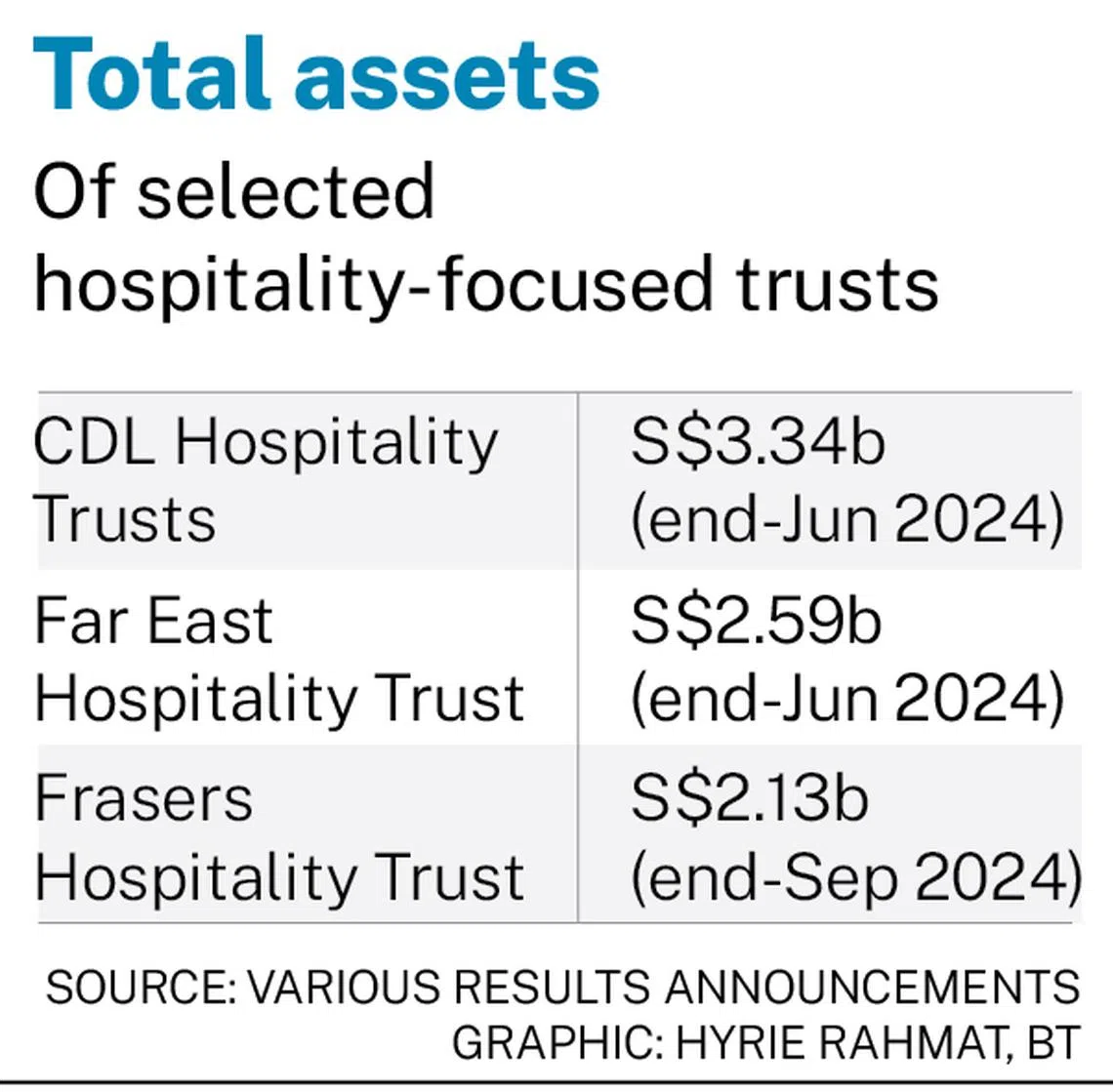
Listed trusts such as CDL Hospitality Trusts , Far East Hospitality Trust and Frasers Hospitality Trust have mandates that largely overlap. The aggregate of the total assets of these three trusts is well below the total assets of market leaders such as CICT and CapitaLand Ascendas Reit (Clar). Should the said three hospitality-focused trusts merge so they can realistically aim to reach, say, S$10 billion in portfolio size more quickly?
Also, ESR Logos Reit , which owns industrial properties, logistics assets and business parks, might consider consolidating with Clar – a much bigger player in the same space.
Precedents exist of leading local property groups joining forces to undertake property development projects. In the same vein, property groups that sponsor Reits with overlapping investment mandates should consider merging their trusts to achieve scale.
The rewards are rich if investors give the merged entity better valuation. Meanwhile, sponsors who join forces can share the fees of the manager of the merged entity.
In addition, property owners interested in launching Reits should consider joining hands so portfolio sizes are larger from the outset and hence more attractive to institutional money.
Today, many high-quality properties in Singapore such as Nex, Raffles City and VivoCity are held by listed Reits.
However, many top-grade investment properties here are still held outside listed Reits. Could tax transparency enjoyed by investors in listed Reits, plus helping locals invest for their retirement needs, propel more property owners to inject their assets into listed trusts?
Tax incentives
With the tax transparency treatment, a Singapore tax resident property owner may enjoy a tax-advantageous position from holding a domestic property via a Singapore Reit.
Singapore Reits that distribute at least 90 per cent of their taxable specified income in the same year in which the specified income is derived qualify for tax transparency treatment, such that specified income which is distributed to unitholders is not subject to corporate tax at the Reit level, and is only taxed, where applicable, at the unitholder level.
Meanwhile, the government could consider offering a tax incentive by waiving stamp duty for the transfer of properties into existing listed trusts or trusts that are eyeing a public listing. It is hoped that such a waiver may spur property owners to inject their properties into the listed trust space.
To give urgency to property owners, the said waiver can be effective for a limited time. Currently, the Buyer’s Stamp Duty (BSD) for non-residential properties is 5 per cent for sums in excess of S$1.5 million. A BSD waiver on the transfer of a S$1 billion property portfolio can amount to savings of nearly S$50 million.
The growth of the Singapore Reit market is a bright spot in Singapore’s equities market this century. Still, stakeholders in the Reit sector cannot rest on their laurels.
Scaling up existing Reits and getting more premier local properties to be held by trusts are needed to grow the Singapore Reit market.
TRENDING NOW

Britain’s mansion tax shows the difficulty of targeting wealth

Once staunchly pro-China, Malaysian Chinese businesses are now distancing themselves from Beijing

The only common thing in S-E Asia is that we all eat rice: Cisco’s Asean president

Singapore data centre operator DayOne opts for US IPO at likely US$20 billion valuation

