As Singapore’s society evolves, our attitudes towards ‘basic needs’ can change too

Tessa Oh
IN ACADEMIA, new findings tend to prompt new responses. Academic research can only achieve a positive impact, however, if the conversation moves past academia and takes a similarly enlightened path in the public sphere.
Specifically, a study published on Sep 14 showed how public conceptions of an adequate minimum income – what a Singaporean household needs for basic living standards – continue to evolve.
The findings offer an opportunity for the government to calibrate its position on the concept of a salary floor, especially in light of Singapore’s steadily rising gross national income.
The 2023 edition of the Minimum Income Standard report argued that a family of four – consisting of parents, a pre-teen and a teenager – needs at least S$6,693 a month to afford a basic standard of living.
The researchers from the Nanyang Technological University and the Lee Kuan Yew School of Public Policy derived this figure through “consensus-based focus group discussions” with Singaporeans from diverse backgrounds.
Participants had determined household budgets based on a definition of basic living standards as being “more than just housing, food and clothing”.
Said the report: “It is about having opportunities to education, employment and work-life balance, as well as access to healthcare.
“It enables a sense of belonging, respect, security and independence. It also includes choices to participate in social activities, and the freedom to engage in one’s cultural and religious practices.”
In response, the ministries of Finance, Manpower, and Social and Family Development said in a joint statement that the study’s findings and recommendations should be interpreted as “what individuals would like to have”, not their basic needs.
They said the findings were “highly dependent on respondent profiles and on group dynamics”, pointing out that the proposed budget of around S$1,680 per capita is similar to the average monthly expenditure of S$1,650 per capita for all families with children, “rather than reflecting a more basic set of needs”.
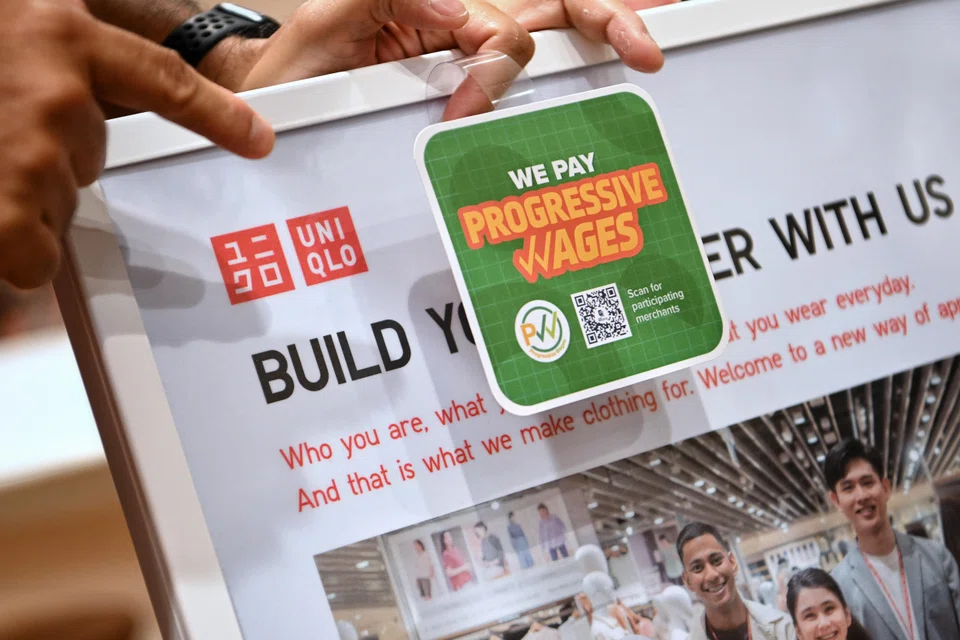
The ministries also reiterated that a universal wage floor is “not necessarily the best way” to ensure that lower-wage workers can earn decent wages: “Set too low, the wage floor will benefit fewer workers than the Progressive Wage Model (PWM). Set too high, workers who are less-skilled risk losing their jobs, especially if their jobs can be automated.”
If the government’s response sounds familiar, that is because it gave a similar reply to the 2021 edition of the same study.
Back then, the Ministry of Finance had similarly noted the limitations of the study’s approach and pointed out that the S$1,600 per month per capita budget derived then was closer to what an average household spends per member, and thus “in excess of basic needs for an average household”.
Similar remarks have been made when the topic is brought up in Parliament.
In 2020, in response to calls by the Workers’ Party (WP) for a universal minimum wage of S$1,300, then-National Trades Union Congress (NTUC) deputy secretary-general Dr Koh Poh Koon said setting a minimum wage could put the most vulnerable workers at a disadvantage.
An arbitrarily prescribed wage level may either be too low to benefit all workers, or too high such that companies cut back on hiring or pass the costs to consumers, he said.
Moreover, government initiatives such as the PWM and Workfare Income Supplement already ensure the majority of low-wage workers take home more than the WP’s proposed benchmark, said Dr Koh.
This year, WP’s Jamus Lim renewed calls for an official poverty line in Singapore, arguing that what is conventionally regarded as a basic need rises as a country gets richer.
Noting that there is often a distinction between the “absolute minimum” and what is actually needed to participate in a society, he said that many Singaporeans may struggle to access basic government services or stay afloat in school without smartphones and tuition – even though some may regard these as “unnecessary perks”.
To this, NTUC assistant secretary-general Desmond Choo said a single poverty line has “inherent problems” such as creating an “unintended cliff effect” for those who are financially needy but whose incomes are just above the threshold.
In its responses, the government usually notes that it regularly reviews policies to ensure their relevance and adequacy. Yet, it seems less willing to review the underlying assumptions and philosophies guiding such policies.
No matter the argument, the government is quick to bring up the limitations of setting a minimum wage or poverty line – but is less inclined to engage with the argument that what Singaporeans view as basic needs may have evolved over time.
The closest that the ministries came to doing so, in their statement, was to say that the report offers an “additional data point on the expectations and aspirations of Singaporeans”.
Rather than seeing these as aspirations, why not allow for new definitions? Surely it is a good thing if Singaporeans need no longer worry about ensuring fundamental survival, but see a life which meets “basic needs” as including a higher sense of fulfilment. Society’s baseline has risen.
Government replies also tend to stress the role of public support in making up for low wages. Yet in the face of rising demands on public coffers, and concerns on how these will be funded in the future, would it not be worthwhile to consider changing this balance? Perhaps employers should bear a larger share of the responsibility.
After all, it would be a win-win if all Singaporeans are able to earn enough to support themselves, and rely less on public assistance. This, in turn, will help to lower the cost burden on the state.