
THE POLITICS THAT MATTER TO BUSINESS

Sound and fury: China and the US talking
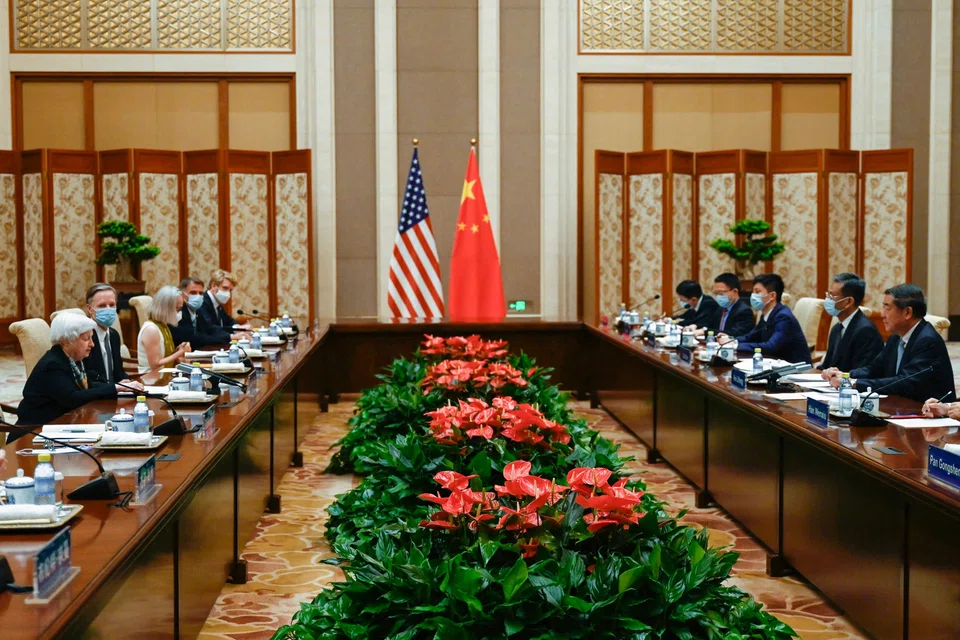
    • US Treasury Secretary Janet Yellen's recent visit to China is evidence of efforts to restart dialogue with the US, but it remains to be seen if this will mean anything for businesses.
    • US Treasury Secretary Janet Yellen's recent visit to China is evidence of efforts to restart dialogue with the US, but it remains to be seen if this will mean anything for businesses. PHOTO: AFP
    Published Fri, Jul 14, 2023 · 05:00 AM

    IT IS an axiom of our anxious, poly-crisis times that politics now matter more to business than ever. Yet the well-known Shakespearean quote also warns us to be watchful of “sound and fury, signifying nothing”. There continue to be political events that occupy attention and yet may lead to nothing of consequence for business.

    Efforts by the US and China to restart dialogue might remind us of that quote. Recent visits to Beijing are of high profile and much headlined. Yet substance seems scant.

    Something is better than nothing

    Communication between the world’s two greatest powers and largest economies had all but ceased after February, when the US decided to shoot down an alleged spy balloon and cancel a planned visit to China by Secretary of State Antony Blinken.

    A mid-June visit by Blinken, finally, and then by Treasury Secretary Janet Yellen last week are evidence of efforts to restart. In this context, some will defend these visits on the basis that something is better than nothing.

    Yellen’s own evaluation of her talks with Vice-Premier He Lifeng was that the two sides had “significant disagreements”. That is the reality of dialogue now: disagreements will not melt away. The objective is only to reopen channels of communication, in order to help avoid the misunderstanding of intentions and miscalculation of reactions from the other party that could trigger a downward spiral.

    One key message from Yellen was that the US is not committed to a policy of confrontation and does not “seek to decouple” the two economies.

    Yellen herself means this sincerely. She was one of the first officials to prefer the softer language of “de-risking”, also used by the EU.

    But the attitudes of others in the Biden administration are less clear, not least when the president himself labelled his Chinese counterpart Xi a “dictator”. Whether words are softer or harsher, it makes sense to instead watch what is done, and see where the words and actions connect, or fail to do so.

    Actions speak louder but inaction yells

    Consider the hopes among some that the US would relook Trump-era tariffs that have hit China’s exports. Across the political spectrum and in most opinion polls, American attitudes to China have harshened.

    As the election season begins to heat up in the US, being soft on China can lose votes. Conversely, the temptation will be to woo voters by promising to get tougher. Measures to allow more imports from China therefore seem unlikely to gain support.

    The treatment of businesses will face the same political realities. China smartphone maker Huawei has learnt the hard way what the US can and will do in the name of security, after export controls cut it off from US suppliers. Others such as TikTok are paying for painful tuition.

    Add to this what the Biden administration has done to restrict access to high-tech chips, roping in allies and friends to cut off supply chains to China. Large subsidies are offered to companies to establish US home-shored facilities for high-tech production in chips and electric vehicle batteries.

    Some therefore shook their heads in disbelief when Yellen criticised China’s treatment of American companies. The complaints include expanded subsidies for China’s state-owned enterprises and domestic firms, barriers to market access for foreign firms, and new export controls on metals used in semiconductors.

    Beijing is no angel, but given what the Biden administration is doing, these measures just seem like tit for tat.

    If the renewed economic dialogue between both countries will discourage further measures – especially those taken with the broad invocation of security concerns – this would not be half bad. But there is little prospect that either side will unwind what has already been done. Actions speak louder than words, but the inaction yells.

    What was not discussed

    Reopening the Sino-American dialogue is insufficient, but it is necessary. Much of the time, the two sides have been at loggerheads over political issues such as democracy versus autocracy and the question of Taiwan. While Yellen’s visit was not a breakthrough, it was not a waste of time either.

    Yes, the rivalry and the reality of potential conflict bear attention. But the two countries must also reckon with certain fundamentals in their relationship: the longstanding but much de-emphasised truth of their deep and enduring economic interdependence.

    That includes but goes beyond the tariffs, technology and other issues discussed. What was not discussed includes critical questions of global finance. The continuing US rate rise is putting pressure on all Treasury bondholders, and increasing borrowing costs for many emerging markets. China is not unaffected.

    Some may feel the US still holds the upper hand, and that it acts that way. But neither side can really afford to sever that economic and financial interdependence.

    Growth in both countries – and across much of the world – is far from robust. Leaders on both sides know the high domestic political price if their economy stagnates. China might face unrest. In the US, a slowing economy will diminish the prospects for Biden’s re-election.

    Security issues – even those related to the future of Taiwan – are not everything. If Yellen’s visit helps underscore the importance of economic issues, even if there is no immediate impact for businesses, then that would be worth noting.

    The writer is chairman of the Singapore Institute of International Affairs (SIIA). This is an occasional SIIA column on The Politics that Matter to Business.



