

South Korea’s chip surge hides the market’s vulnerabilities
The Kospi’s sharp sprints and volatility make for a perilous investing landscape, especially for average investors
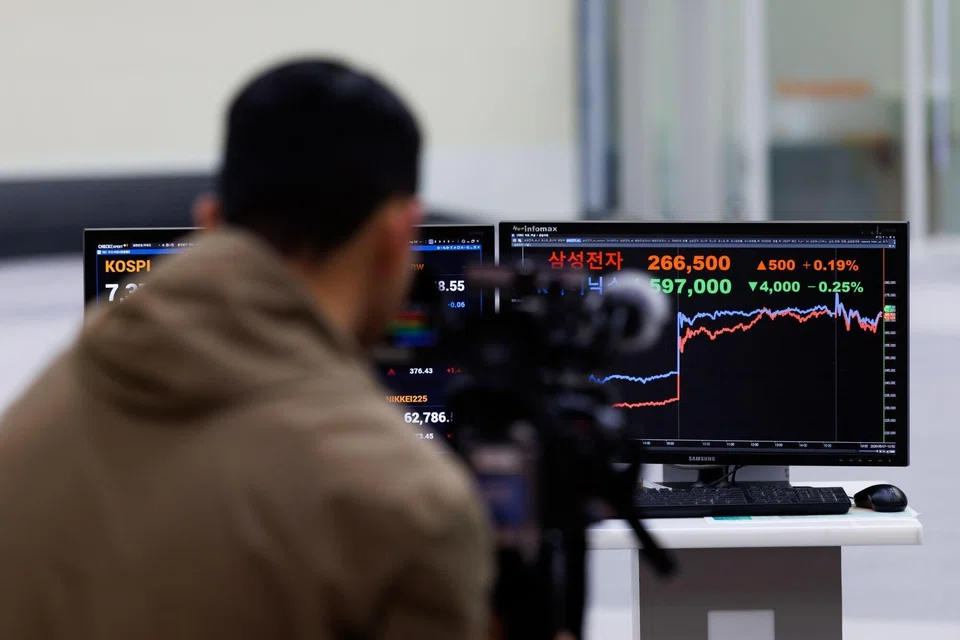
SOUTH Korea’s world-beating equity rally this year would appear to be the perfect advertisement for President Lee Jae-myung’s efforts to increase household investment in stocks – a generally healthy goal that can foster wealth creation and deepen the pool of capital available to businesses.
But a truly healthy investing culture starts with diversification, something that is not easy in the South Korean stock market today. In fact, the concentrated nature of the current rally shows why the market is still ill-suited to helping residents invest for the future.
There is no doubting the extraordinary nature of South Korea’s performance. The Kospi has gained 78 per cent this year, compared to a 7 per cent gain for the MSCI World Index of global developed market stocks, and a 23 per cent increase in the MSCI Emerging Markets Index.
Yet just two stocks – Samsung Electronics and SK Hynix – account for most of that extraordinary performance. If you zero them out, the Kospi’s advance would be a much less impressive 30 per cent.
Even if the memory chipmakers have further to run on the back of the artificial intelligence boom, their dominance illustrates everything that is wrong with the South Korean market as a destination for everyday savers.
Concentration is a double-edged sword for investors: If they are lucky enough to hold the right mix of stocks in portfolios, returns can beat benchmarks, and that has been true in spades for tech-focused investors in the last five years.
But sooner or later, the economy shifts and fortunes change, and diversification has proved the best formula over time. In the longer term, remarkably few professionals, let alone hobbyist investors, succeed at the stock-picking game.
The AI revolution is taking the Kospi’s concentration to new extremes. Not only is the index dominated by a couple of companies, they also happen to be in the notoriously cyclical semiconductor industry, where the good times tend to be great and the bad times, excruciating.
Semiconductor profits globally tend to be extremely up and down, with fleeting booms often followed by a supply glut and shrinking margins. Here is what has happened to the weighting of electric and electronic equipment in the past few years.
Concentration is not a recipe for steady wealth creation, and steadiness is all-important.
The Kospi’s problem has given it one of the lumpiest return profiles of any market in the world. While the gauge has delivered a 7.3 per cent compound annual growth rate since early 1990, effectively all of the capital appreciation occurred during 10 or 11 calendar years.
In other words, the index tends to do well less than a third of the time. The rest of the time, it is treading water (or worse).
Put another way, it has recorded only 264 new highs since the start of 1990, with the longest drought lasting over a decade. Compare that with the US, which has a robust retail culture and where the S&P 500 has had 780 all-time highs.
The Kospi’s sharp sprints and overall volatility make for a perilous investing landscape, especially for average investors. It is human nature to hate experiencing losses (even if we gain them back later with patience), and we want our portfolios to follow a smooth-ish upward sloping line.
When that is not the case, we tend to buy and sell way too often – and at the wrong times. If you cannot tamp down on the lumpiness, you cannot encourage investors to act in their own best interest.
Ultimately, it is fair to wonder whether Lee actually wants to foster a responsible investing culture, or just create a nation of day-traders – “ants”, as they are known locally.
He uses a day-trader’s vocabulary, campaigning on getting the Kospi above 5,000 and referring to himself as a “big ant”, all in a country where the investing environment was already tilted towards speculation when he took office.
To the extent that tax incentives exist to encourage long-term equity ownership, South Korea is an imperfect mirror of the US system: The investment caps are noticeably lower. In as much as exchange-traded funds (ETFs) are gaining favour, investors too often use them to make excessively risky bets.
The most popular products with South Korean retail traders include leveraged ETFs that use derivatives to target several times the daily return of a particular stock or index, with extreme downside, especially when markets are choppy or selling off.
Rhetoric aside, Lee is clearly ushering in some real improvements; recent corporate governance reforms, for instance, aim to support minority shareholders.
But he will need to do a lot more if he wants to create a culture of long-term stable investing that serves his voters, including updating tax incentives to encourage efficient investing and financial planning around retirement.
More entrepreneurship and initial public offerings would certainly help, too, but that is difficult to achieve in a country where family-controlled conglomerates, known as chaebols, absolutely dwarf every other company.
Even efforts to curb their influence would take decades to affect change. In the absence of swift movement on that front, the most responsible way to help South Koreans is to encourage them to build truly diversified portfolios, including large allocations to equities abroad.
Yet, Lee is doing the opposite by criticising investments in global equities and portraying investments in South Korea as a patriotic imperative.
All told, I hope South Korea’s leadership is enjoying its world-beating stock market, because history suggests its run of outperformance will not last much longer.
In the meantime, the best way forward is to seek diversification elsewhere and hope that Lee will choose to turn the country into a legitimate destination for long-term wealth creation – not just a trading playground for his fellow ants. BLOOMBERG
TRENDING NOW

LTA proposes combining car COE categories, adding rebate-surcharge system
StarHub to acquire MyRepublic’s mobile business amid ongoing telco consolidation

DBS, OCBC, UOB rout lops billions off STI as inflation, rate concerns spook investors

Grab CEO’s wife Chloe Tong on life with Anthony Tan and finding her purpose

