

SpaceX’s IPO may hold lessons for Singapore
When companies go public, their founders and managers should communicate a big vision rather than a plan to just deliver incremental gains

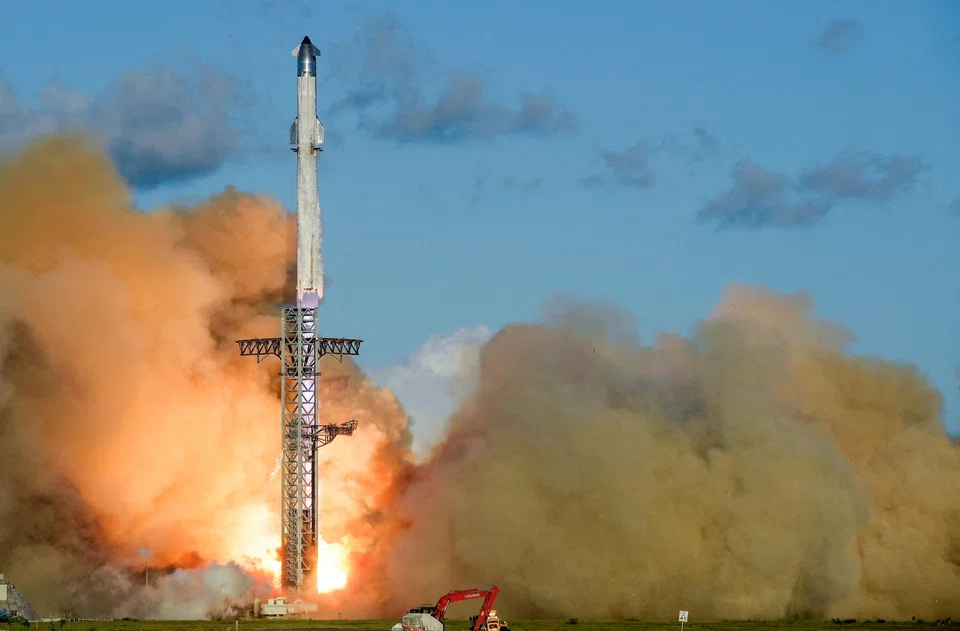
[SINGAPORE] When news broke last week that Elon Musk’s SpaceX had confidentially filed for an initial public offering (IPO) in the US, I couldn’t help wondering if it was an April Fool’s Day prank.
While there had been lots of market chatter about the company going public, reports of the confidential IPO filing first appeared on Apr 1 – which also happened to be the day that the National Aeronautics and Space Administration’s (Nasa) Artemis II blasted off on a 10-day trip around the moon.
The timing seemed rather too coincidental.
Then there was the reported valuation of SpaceX. The initial news stories said the group would raise as much as US$75 billion, and that it could seek a valuation of US$1.75 trillion.
Subsequent reports said SpaceX had boosted its target IPO valuation to more than US$2 trillion.
This seemed quite ambitious. Barely two months ago, SpaceX had merged with Musk’s artificial intelligence startup xAI in a transaction that valued the combined entity at US$1.25 trillion. The targeted IPO valuation is now said to be some 100 times the enlarged group’s revenue.
The listing of SpaceX could be one of the most interesting market developments in years, though. For one thing, there isn’t another company quite like it.
Besides its rocket launch business, SpaceX owns a satellite-based Internet broadband service called Starlink. The merger with xAI has also brought the Grok AI assistant and the microblogging platform X (formerly Twitter) into its fold.
Holding all these businesses together is Musk’s overarching vision of humans becoming a multiplanetary species.
Among SpaceX’s immediate priorities is to complete the development of its Starship spacecraft, which will enable it to carry larger payloads of people and cargo to space at lower costs.
It also wants to create space-based AI supported by a network of data centres orbiting Earth, which it is betting will sidestep the water and energy constraints of terrestrial data centres.
SpaceX is also working towards building a base on the moon, and planning missions to Mars where it intends to build a colony.
‘Space economy’ universe
Detailed financial information on SpaceX will probably become available in the weeks ahead, as the company begins engaging with investors and eventually puts out its IPO documents.
In my view, SpaceX’s listing will further spur growing investor interest in companies that are part of the “space economy” universe. It may also hold some lessons for Singapore as it works to turn itself into a growth capital hub.
Multibagger returns
The global space economy is expected to reach US$1.8 trillion in size by 2035, according to a much-cited report by the World Economic Forum and McKinsey.
Among the drivers of this growth are falling satellite-launch costs and the growing number of applications that require satellite connectivity.
Geopolitics is clearly a factor too. The Artemis II mission that is currently under way is part of a programme by Nasa to send astronauts on increasingly complex lunar expeditions that began in late 2017 – just as tensions between the US and China were ratcheting up.
The first moon landing under the Artemis programme is scheduled to take place in 2027 or 2028 – more than half a century after the last crewed lunar landing in 1972. Nasa is expected to begin building a moon base in 2028. Its stated subsequent goal under the Artemis programme is to undertake missions to Mars.
China has already sent unmanned probes a number of times to the moon – even to its far side. It has also sent an unmanned probe to Mars. This year, it is expected to send a probe to the lunar south pole, which contains water deposits that could be crucial in sustaining a permanent base on the moon.
China is expected to put an astronaut on the moon in 2030.
Against this backdrop, a number of US-listed companies linked to the space theme have delivered multibagger returns over the past year.
Among them is Rocket Lab, which provides launch services and produces satellite platforms and parts for spacecraft. It has a market capitalisation of US$41.9 billion, and has delivered a return of 313.7 per cent over the past year.
EchoStar, a satellite communications player, has a market capitalisation of US$37.2 billion, and has achieved a total return of 497.7 per cent over the past year.
Planet Labs, which provides images and data from its fleet of satellites, has a market capitalisation of US$12.4 billion. Its stock has risen more than 10 times in value over the past year.
There are also a number of exchange-traded funds (ETFs) that offer broad exposure to the space economy. For instance, the VanEck Space Innovators UCITS ETF and the Procure Space ETF both own all three of the companies mentioned above, as well as several others.
The former has returned 153.8 per cent over the past year, while the latter has returned 121.5 per cent.
The State Street SPDR S&P Kensho Final Frontiers ETF – which holds Planet Labs and Rocket Lab as well as Intuitive Machines, Boeing, RTX and Lockheed Martin – has returned 96.5 per cent over the past year.
Moonshots and markets
The growth of the space economy hasn’t gone unnoticed in Singapore. Last week – on Apr 1, coincidentally – the National Space Agency of Singapore was formally established under the Ministry of Trade and Industry.
The agency’s aims include developing the Republic’s space industries, strengthening its research and development capabilities, forging international partnerships and putting in place appropriate legislation and regulations for the burgeoning sector.
There are already a couple of prominent players in the sector among Singapore’s listed companies. One of them is ST Engineering, which designs and manufactures satellite systems, and provides satellite imagery and geospatial analytics.
ST Engineering – which owns a wide range of other businesses – has a market capitalisation of S$34.4 billion. Its shares have returned 68.5 per cent over the past year.
Another locally listed player in the sector is Addvalue Technologies. The group, which was once on the dreaded financial watch list, provides satellite-based communication and digital broadband products and solutions.
Addvalue’s shares have returned 788.9 per cent over the past year, inflating the company’s market capitalisation to S$294.7 million.
Will SpaceX’s IPO appeal to Singapore’s famously dividend-focused investors?
My sense is that the company will come to market at a price that may be hard to justify on conventional valuation metrics. Yet, I wouldn’t underestimate Musk’s ability to win the support of retail investors with his moonshot mindset – and to maintain their support when he inevitably fails to reach promised milestones.
He may, in fact, be counting on the support of these investors. SpaceX is reportedly setting aside 30 per cent of its IPO for individual investors.
Perhaps one lesson Singapore should take from this as it works to turn itself into a growth capital hub is that companies venturing into risky, new fields need believers rather than just investors.
And, when these companies go public, their founders and managers should be prepared to communicate a big vision rather than a plan to just deliver incremental gains.






