Spain’s economic endorsement of China is a major Trump rebuke
Could warmer ties between Madrid and Beijing help move EU closer to China?
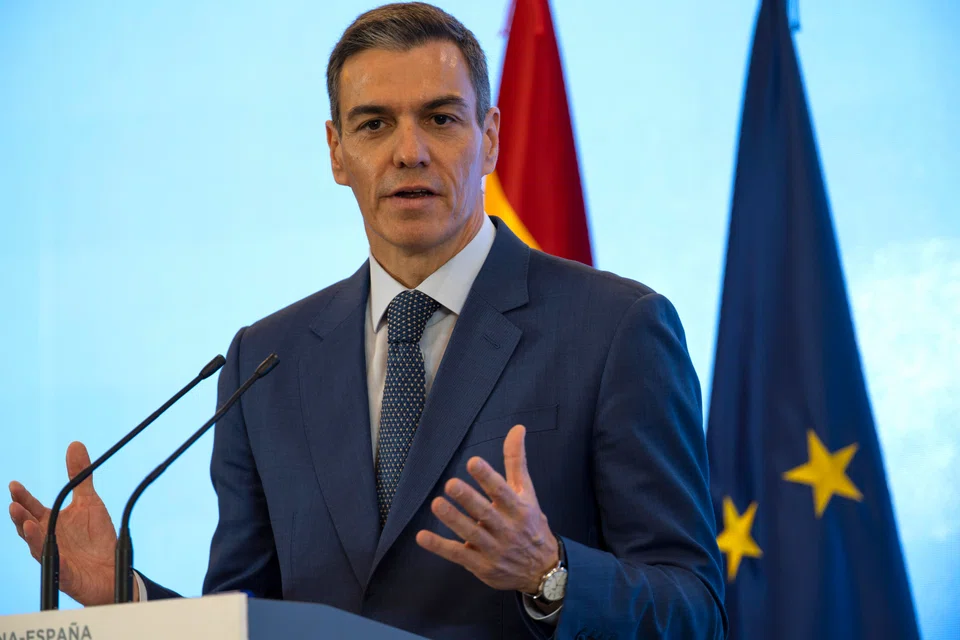
DESPITE being the eurozone’s fourth-largest economy and a major middle power, Spain rarely makes the world headlines. However, Prime Minister Pedro Sanchez’s recent trip to Beijing (Apr 11 to 15) represents perhaps the strongest European economic rebuke to US President Donald Trump since 2019 – when Group of Seven nation Italy signed up to Beijing’s Belt and Road infrastructure initiative.
It was only on Mar 3 that Trump threatened to put relations with Spain into a deep freeze. The US president declared in the Oval Office that “Spain has been terrible” over the Iran war, adding that the US did not “want anything to do with Spain”. He noted he had told US Treasury Secretary Scott Bessent “to cut off all dealings” with Madrid.
Following Trump’s outburst, Bessent claimed trade embargoes could be enforced under the US International Emergency Economic Powers Act. He also asserted that Madrid’s attempts to forge closer trade relations with China were akin to “cutting your own throat”, warning that Chinese manufacturers would increasingly dump goods into Spain.
Trump has also slammed Madrid’s military expenditure. Spain is the only country in Nato that has not agreed to meet his recent request to spend 5 per cent of gross domestic product on defence, although it has now surpassed the 2 per cent benchmark that Nato allies previously agreed on.
The Trump team’s reprimand of Spain is reminiscent of 2019 when Italy signed up for Beijing’s Belt and Road project. Predictably, this infuriated the White House. Garrett Marquis, a US National Security Council spokesperson, asserted that there is no need for the Italian government “to lend legitimacy to China’s vanity infrastructure project”.
Fast forward to 2026, and Trump’s tensions with Spain and other longstanding US allies highlight how much the world is in flux during this current presidency. Sanchez’s four-day trip to China, coupled with his wider criticisms of Trump, marks a clear tilt away from the White House, despite Spain being a long-term US ally.
Sanchez has been one of Europe’s most vocal critics of US and Israeli military actions in the Middle East in recent weeks.
His government has closed airspace to US planes involved in the conflict, and is not allowing Washington to use two jointly operated military bases in southern Spain. Washington has since relocated 15 aircraft, including refuelling tankers, away from these bases.
To be sure, the longer-term significance of this can potentially be overplayed. Chinese President Xi Jinping, for instance, told Sanchez on Apr 14 that the “world order is crumbling into disarray”, a bold assertion whose accuracy remains to be seen until subsequent US presidencies materialise in the post-Trump era.
US relations with allies
However, US relations with many traditional allies unquestionably are at a very low ebb. Notably, Italian Prime Minister Giorgia Meloni – a fellow national populist – recently criticised Trump, despite reversing Italy’s earlier commitment to the Belt and Road project.
Meloni this week called Trump’s extraordinary criticisms of Pope Leo XIV – the first American head of the Catholic church – “unacceptable”. In response, the US president labelled Meloni “unacceptable” and said that she lacked courage. This is an astonishing rupture with the only European leader invited to his presidential inauguration last year.
With multiple US relationships with long-term allies near rock bottom, China is turbocharging a charm offensive. This week, Sanchez made his fourth trip to Beijing in three years, following a state visit last November by King Felipe VI, the first by a Spanish monarch in almost two decades.
The visit saw “love bombing” between Sanchez and Xi ahead of next year’s 20th anniversary of the establishment of the China-Spain comprehensive strategic partnership. Around 20 agreements were signed, half of them economic, including more Spanish exports such as agrifood products, and greater cooperation on sustainability, artificial intelligence and the digital economy.
One specific deal – the High Quality Investment Agreement – is designed to ensure Chinese investments in Spain include tech transfers to local companies, contracts for local suppliers and job creation to create win-win outcomes for Beijing and Madrid.
Like Xi, Sanchez framed the visit in a wider geopolitical context. He declared that the world benefits from “EU-China relationship based on trust, dialogue and stability” and highlighted the ambition of a “multipolar order built from respect and pragmatism”.
To be sure, Sanchez is a Spanish socialist who has perhaps been the fiercest European critic of many of Trump’s policies, not only in Iran and Gaza, but also wider issues including trade tariffs.
Yet, outrage towards Trump is now felt by an increasing range of regional leaders, including those who had shown public rapport with the US president, from Meloni to German Chancellor Friedrich Merz and UK Prime Minister Keir Starmer.
Moreover, at the supranational EU level, key officials in Brussels also appear to be moving towards closer engagement with China.
Last week, European Commission vice-president and industrial strategy commissioner Stephane Sejourne said the EU needs stronger ties with China, including to secure greater Chinese investment.
Growing trade imbalance
Obstacles remain, however. Many in Brussels take issue with Beijing’s diplomatic and wider support for Russia, including in Ukraine. This week, the Spanish prime minister became the latest European politician to call China’s large and fast-growing trade imbalance with the EU “unsustainable”.
Spain’s bilateral trade deficit with China was 42.3 billion euros (S$63.4 billion) in 2025. This makes Beijing Madrid’s largest trading partner, outside the EU, so this issue is key for Sanchez.
The concern for Madrid is shifting the relationship towards more fair, balanced trade, especially as Spain generates more than half of its electricity from renewable sources – with a growing need for Chinese raw materials and green technology.
Growing tensions between Europe and the US may provide more openings for Beijing. Yet, Italy’s previous flip-flopping over the Belt and Road project suggests that the current warming between Europe and China may be curtailed by disagreements over issues such as the trade imbalance and Russia.
The writer is an associate at LSE Ideas at the London School of Economics
TRENDING NOW
Fed hike throws Singapore banks a margin lifeline; UOB likely to benefit more
He built the Vingroup empire. Now South-east Asia’s richest man is handing some key roles to his sons
Chagee, Mixue and Luckin won the market. Sustaining their edge is the harder part
Canada is upping oil flows to Asia, but South-east Asia’s refineries aren’t ready to handle them yet