The stakes of the Trump-Starmer summit
Ahead of the looming tariff deadline, will the US president and UK prime minister hammer out a deal in Scotland?
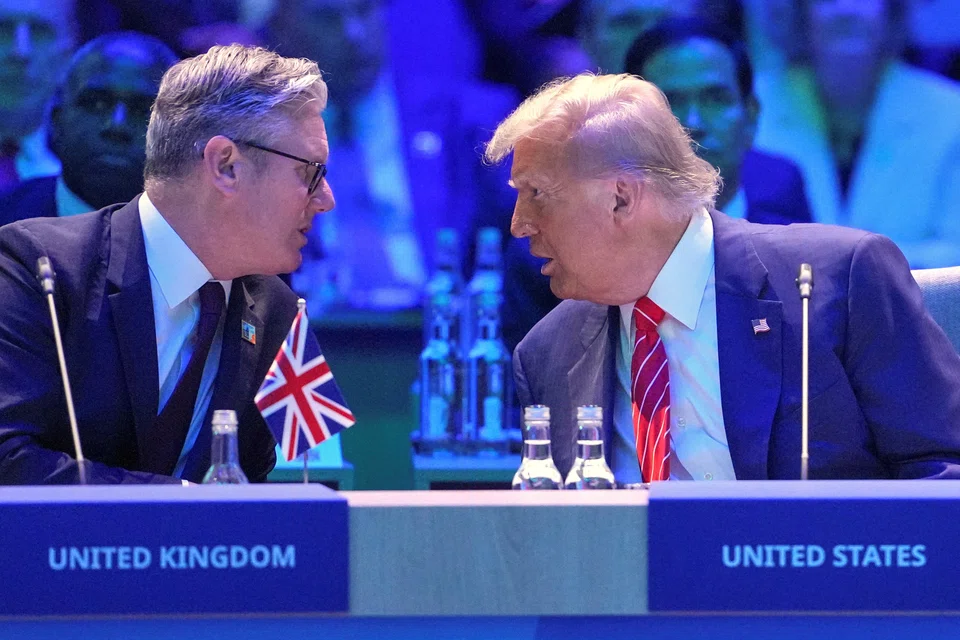
DONALD Trump heads to Scotland this Friday (Jul 25) for a four-day trip to visit his two golf resorts. Yet, while the visit is being billed as largely a private one, there is much public business that could be transacted, including potential US presidential announcements about reciprocal tariffs due to be levied across much of the world from Aug 1.
The key scheduled public focus of the trip will be Trump’s summit with UK Prime Minister Keir Starmer, their fourth meeting this year. The two met at the White House in February, at the G7 in Canada in June, and also at the Nato summit in the Netherlands later that same month.
Top of the agenda for Trump and Starmer will be an attempt to finalise the US-UK tariffs deal package that has taken weeks of negotiations already. In particular, Starmer wants an agreement that exempts UK steel exports to the US from Trump’s sectoral tariff regime for steel.
Reports suggest a UK disagreement with the US over whether Indian-headquartered Tata Steel’s products produced in the UK would be covered by the US tariffs as the firm is currently finishing foreign-produced metal while blast furnaces are updated. Trump also reportedly has concerns about British Steel, which was acquired in 2020 by Chinese steelmaker Jingye Group before the UK government seized control of the assets in April this year.
Starmer and Trump appear to have struck up a good political relationship, but this steel issue could be a key test. If the UK prime minister secures key concessions, he will show himself yet again to be a skilful negotiator with the US president, despite their very different political personas and philosophies, including disagreements over Brexit.
Such a successful Starmer achievement would be especially noteworthy in a context where Trump has threatened to impose reciprocal tariffs on a wide range of nations on Aug 1. Beyond the UK, only Japan, Vietnam and Indonesia have so far cut a tariff deal with the US president, alongside China’s so-called framework agreement that has eased tensions between Beijing and Washington. Given the negative market reaction to Trump’s tariffs in April, many traders are growing increasingly uneasy as next week’s deadlines near.
Yet, while Starmer and Trump may deepen their relationship in coming days, there is a significant possibility of diplomatic fireworks when the US president meets with Scottish First Minister John Swinney. To be sure, the US president is fond of Scotland, not least as his mother Mary Anne MacLeod Trump was born on Lewis in the Outer Hebrides before emigrating to the US when she was 18.
Still, Trump may have a score to settle with Swinney, who gave his support to Democratic presidential nominee, Kamala Harris, in last year’s US election. Swinney’s decision was described as an “insult” by Trump International, the president’s firm which owns two golf courses in Scotland – in Aberdeenshire and Ayrshire. Trump’s son, Eric, went so far as to call Swinney’s action “nasty”.
This is not the only reason why the meeting with Swinney could go south. Trump has called Scotland the “oil capital of Europe”, urging the nation to “get rid of the windmills and bring back the oil”. The president has long been an opponent of wind farms, objecting to a development off the coast of Aberdeen which can be seen from his golf course there. In his own words, “the windmills are really detrimental to the beauty of Scotland and every other place they go up”.
Trump-Swinney challenges notwithstanding, the bigger picture is that Starmer may have – surprisingly – brought a potential spark back to the so-called US-UK special relationship. Despite some breakthroughs such as the Aukus military deal delivered by ex-president Joe Biden and former prime minister Rishi Sunak, there have been many years of ties failing to reach their potential.
Such was the case under successive prime ministers and presidents of all key parties. Indeed, the last UK prime minister who forged close ties with the US may have been Tony Blair with the Clinton administration over a shared “third way” philosophy.
This isn’t to suggest sky-high expectations are warranted for the Trump-Starmer relationship. Instead, the bar has simply been set low in recent years.
Moving forward, and building from the US-UK tariff deal, there remains an outside chance of a wider economic agreement, even though bilateral trade already stands at about £300 billion (S$518.8 billion). In recent years, the UK has been pursuing a multi-track approach, including seeking trade deals with specific US states.
Secondly, London has focused on targeted deals with Washington on key UK exports, for example, on Scottish whiskey. Another area of interest is critical minerals, key materials used in goods from electric cars to flat-screen TVs.
Starmer hopes to seize opportunities in the bilateral relationship while managing the risks posed by the president’s notable volatility. However, it is far from clear that the good personal relations between the two leaders today can continue until January 2029, when Trump’s second term ends.
What Starmer can strive to forge is a constructive UK-US partnership, building on the nations’ traditional ties rooted in demographics, religion, culture, law, politics and economics. This will also be supplemented by the longstanding security cooperation that has been the relationship’s core, reinforced by the Aukus pact with Australia.
Amidst the uncertainties ahead, Starmer will want to make the relationship work as smoothly as possible based on such policy fundamentals. This may provide some protection for bilateral relations if personal dynamics, especially under Trump, sour or break down, as was the case with Trump and former UK prime minister Theresa May, as well as Biden and former UK prime minister Boris Johnson.
Starmer knows it will be wise not to overestimate the UK’s ability to shape US power, under Trump’s turbulent second presidency. Ultimately, Trump may well care little for fundamental UK interests, despite any personal fondness for the nation rooted in his mother’s Scottish heritage.
The writer is an associate at LSE Ideas at the London School of Economics
TRENDING NOW
Grab CEO’s wife Chloe Tong on life with Anthony Tan and finding her purpose
Singapore-based Ryde accused of pump-and-dump fraud in class action lawsuit
Malaysia’s F1 return: A low-cost second chance, possible Singapore boost
Canada is upping oil flows to Asia, but South-east Asia’s refineries aren’t ready to handle them yet