

Step up efforts to grow the Reit sector or more could follow Paragon Reit to head for the exit
Privatisations make sense when trusts have poor liquidity and face constraints in upgrading assets

IF INTEREST rates do not fall much further, equity fund-raising in the Singapore-listed real estate investment trusts (Reits) space could be muted.
Reits are sensitive to interest rates as higher borrowing costs affect distributions by Reits, and yield-driven investors flock to Reits when interest rates are low.
Also, investors today may be highly selective in supporting Reit equity fund-raising and prefer trusts to finance new acquisitions by selling existing assets.
Ominously, Singapore’s once high-flying Reit sector, which turns 23 later this year, risks shrinking if more listed property-related trusts get privatised and delisted.
Recently, Times Properties, a wholly owned subsidiary of Cuscaden Peak Investments, proposed privatising Paragon Reit via a scheme of arrangement at S$0.98 per unit.
Cuscaden Peak Investments is Paragon Reit’s sponsor. It is in turn owned by Cuscaden Peak Pte Ltd – a consortium comprising Temasek’s CLA Real Estate Holdings and Mapletree Investments – which has a deemed interest of about 61.5 per cent in Paragon Reit.
Woes of smaller Reits
Among the rationale cited for Paragon Reit’s proposed privatisation is its low trading liquidity. Poor trading liquidity can contribute to a trust having a weak unit trading price and limited ability to grow via equity-funded acquisitions.
Times Properties is eyeing carrying out major asset enhancement works on Paragon Reit’s key asset Paragon, which accounted for about 72 per cent of the trust’s property portfolio valuation as at end-2024.
The works could potentially take three to four years to complete and require capital expenditure of S$300 million to S$600 million, which would increase Paragon Reit’s aggregate leverage substantially. Crucially, while major works are underway at Paragon, the trust’s distribution per unit (DPU) might be severely hit by business disruption that affects rental and occupancy at the property, as well as higher financing costs.
Paragon Reit is hardly unique in facing the above issues. Poor trading liquidity afflicts numerous other Singapore-listed Reits. Many trusts receive little coverage from equities analysts or support from institutional investors.
Meanwhile, various trusts might face difficulty in funding major asset enhancement works that are needed for their properties to be competitive. Also, trust managers may baulk at the potential DPU hit when carrying out such works. Generally, trusts that own larger property portfolios can better manage the adverse DPU impact when major asset enhancement works are being carried out on key properties.
In short, sponsors of Reits that trade poorly and whose properties may require major upgrading could be tempted to privatise and delist said trusts. Such moves are easily justified for Reit sponsors when a listing does not deliver value and restricts their ability to optimise the performance of the properties. Indeed, maintaining a listing comes with various associated costs as well as tough compliance requirements.
In 2022, Frasers Property narrowly failed to secure the required level of support from stapled securityholders in its proposed privatisation of Frasers Hospitality Trust . Is another attempt to privatise the trust, which trades below its end-2024 net asset value, forthcoming?
The Singapore Reit sector has come far since the first Reit successfully made its trading debut in July 2002. Arguably, Reits are the local bourse’s major equities market success story thus far this century.
However, the sector needs urgent rejuvenating, especially as ultra-low interest rates are unlikely to return. Various stakeholders should step up to boost the sector.
Rejuvenating Singapore Reits
One, consider giving listed Reits more tax incentives. For example, waive stamp duty when existing Reits, and Reits eyeing a listing, purchase properties. Also, waive stamp duty when a special purpose vehicle acquires a property from a Reit to carry out redevelopment works and then sells the said property back to the Reit after redevelopment works are completed.
Two, private-sector property owners should inject more high-quality properties into Reits. This applies to groups that are existing Reit sponsors as well as those who have yet to embrace Singapore Reits such as UOL Group , GuocoLand and Pontiac Land. Smaller property-owning groups with portfolios that lack the scale to attract Reit investors can work with peers to jointly sponsor a Reit that owns properties injected by various groups.
Three, the government should actively explore divesting properties into Reits. I have suggested that government-owned Changi Airport Group launch a Changi Airport retail Reit. Also, think of injecting government-owned commercial buildings and car park lots into Reits.
Four, if the idea of a Central Provident Fund (CPF) retirement investment scheme that members can opt in comes to light, such a scheme can have among its core investments several Singapore Reits. Creating more liquidity pools for Reits can supplement efforts to educate investors on why Reits are suitable investments for retirees in a fast-ageing Singapore.
Privatising and delisting a listed entity that does not trade well is sensible for any major shareholder or unitholder of such entities.
With Paragon Reit, Times Properties’ offer represents a premium over adjusted end-2024 net asset value as well as over the last traded price of the trust prior to the offer announcement.
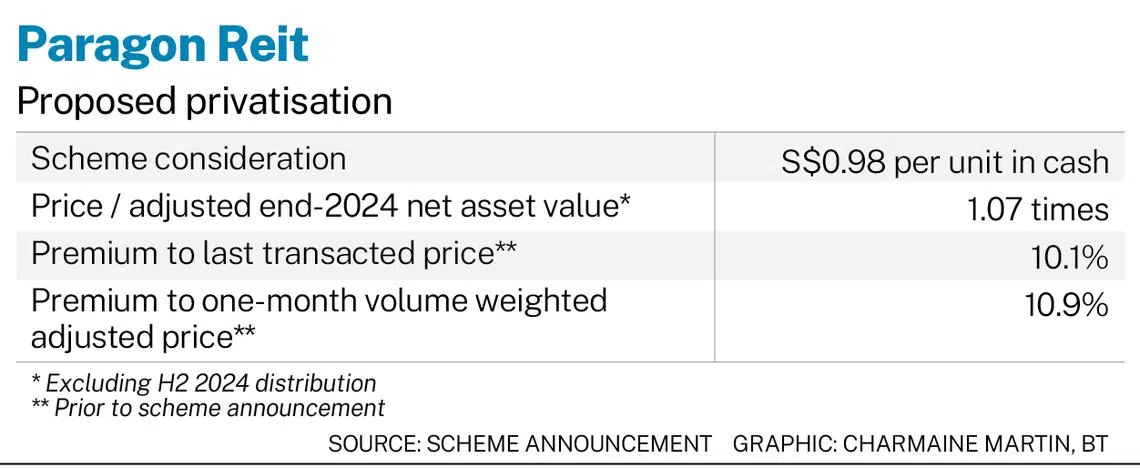
Paragon Reit’s minority investors hold the scheme of arrangement’s fate in their hands. And they may not have much to complain over what is being offered.
Nonetheless, would selling Paragon Reit’s properties – comprising Singapore assets Paragon and The Clementi Mall as well as Australian asset Westfield Marion – on a portfolio or piecemeal basis achieve a better outcome for minority investors?
Paragon Reit’s minority investors may welcome a third party stepping forward with an unsolicited bid for the trust. Think of the allure of snaring a hard-to-buy chunky prime Orchard Road asset such as Paragon. However, barring any such development, minority investors might approve Paragon Reit’s proposed privatisation.
A successful privatisation of Paragon Reit could in turn spur more privatisation bids in the Reit space, thereby spelling trouble for the sector.
More work needs to be carried out urgently to grow Singapore Reits amid efforts to strengthen equities market development here.






