

Strengthening Asean’s economic resilience through RCEP’s 2027 review
Practical reforms will make South-east Asia’s biggest trade pact more effective and beneficial
WHEN conflict in the Middle East disrupts shipping through the Strait of Hormuz, Asia feels it fast.
In 2024, 84 per cent of the crude oil and condensate and 83 per cent of the liquefied natural gas that moved through the strait went to Asian markets. Disruption there quickly feeds into higher energy costs, rising freight rates and renewed inflation across the region.
Asia has no military answer to shocks like these. Its best protection is institutional, and its strongest instrument is the Regional Comprehensive Economic Partnership (RCEP), the 15-member trade pact that accounts for about 30 per cent of global gross domestic product.
That is why its first general review in 2027 matters. Article 20.8 requires a review every five years to keep the agreement aligned with the trade and investment challenges facing its members. This should not be treated as a procedural check-in. It is the first real test of whether RCEP is fit for a more volatile world.
That message was reinforced at a recent conference hosted by the Asia Competitiveness Institute (ACI) and jointly organised with the RCEP Support Unit.
Indeed the work must start now to secure early wins. The review should not become a box-ticking exercise.
RCEP matters, but still underdelivers
The case for urgency rests on a simple fact: RCEP already helps hold the region steady.
The conference findings described the pact as a core pillar of Asia’s institutional architecture, and a stabilising force amid rising uncertainty and weakening multilateralism.
The bloc’s weight is hard to overstate. In 2024, RCEP economies accounted for about US$13 trillion in total goods trade with the world, including roughly US$7.49 trillion in exports and US$5.59 trillion in imports.
That is about a third of global exports and around a quarter of global imports. A pact of that scale should not be allowed to drift.
RCEP’s benefits are real, but too often underused. So far, it has done more to reinforce existing trade and investment links than to create new ones.
Tariff cuts have generated only modest trade creation with gains concentrated in intermediate inputs and processed goods.
The early impact has been uneven. One reason is straightforward: many firms still find it easier to trade under older bilateral or Asean+1 agreements.
That is the central challenge for 2027. The review should not be driven by abstract ambition or a desire to make RCEP look grander on paper. It should be driven by practical reforms that make the agreement easier to use in the real economy.
Make RCEP work in practice
Start with the basics. Where politically feasible, members should accelerate scheduled tariff reductions, scrap low-yield nuisance tariffs, and narrow tariff differentials that raise compliance costs.
They should also establish a serious utilisation-monitoring mechanism so governments can see where firms are getting stuck.
Rules of origin should follow. The review of full cumulation – which allows all materials and production processes used within the bloc to be counted towards the origin status of goods – needs to be completed.
Product-specific rules should be updated so supply chains can operate on a genuinely regional basis, instead of through a patchwork of partial preferences. This is the unglamorous work that determines whether RCEP lives on paper or in production networks.
RCEP also needs a supply-chain resilience agenda. The most useful reforms here may not make headlines, but they will matter when the next shock hits.
These include interoperable customs single windows; real-time electronic exchange of certificates of origin and related trade documents; sector-specific channels to tackle regulatory barriers; and stronger information-sharing across members.
“Asia cannot prevent every war, blockade, export control or tariff shock. But it can decide whether its biggest trade pact is ready for one.”
Resilience now runs through data
Asia’s next resilience test will not be only about ships, ports and chokepoints.
It will also run through data, digital trust and the ease with which firms can transact across borders.
RCEP’s e-commerce chapter was a useful baseline. It is no longer enough.
Research at the ACI found that trade in digitally deliverable services within RCEP has expanded quickly, while regional patterns are shifting towards a more Asean-centred structure.
Yet RCEP’s digital rules still lag newer agreements, with broader carve-outs on data protection and weaker commitments on cross-border data transfers.
That gap should be a priority in 2027. The review should push for clearer rules on digital payments, e-invoicing, digital identity and data governance.
In a region where resilience increasingly rests on trusted digital interoperability, this is core infrastructure, not optional extras.
The environment must be on RCEP’s resilience agenda
The green economy belongs in the same conversation.
RCEP already contains environmental provisions built around cooperation and broad principles. That is a foundation, not a finished agenda.
The 2027 review should make it operational: a fuller environmental chapter, a clearer environmental goods agenda and stronger mechanisms for implementation, monitoring and accountability.
This is trade policy catching up with reality, rather than a mission creep. Resilience and decarbonisation no longer live in separate boxes, and the region’s rules should stop treating them as if they do.
Singapore’s energy strategy makes the point. It has conditionally approved 1.75 gigawatt (GW) of low-carbon electricity imports from Australia’s Northern Territory via subsea cables, as part of a wider plan to import around 6 GW by 2035.
The next generation of shock absorption will depend not just on oil and gas routes, but on trusted cross-border clean-energy connections too.
The template already exists
None of this is unrealistic. RCEP members have already tested more modern approaches elsewhere.
The region has experimented with more ambitious digital economy agreements that go further on digital trade facilitation, trusted data flows and interoperable digital systems.
The upgraded Asean-Australia-New Zealand Free Trade Area (AANZFTA), which entered into force on Apr 21, 2025, introduced new e-commerce commitments, consumer-related provisions and a trade and sustainable development chapter.
The Asean-China Free Trade Area (ACFTA) 3.0 upgrade protocol, signed on Oct 28, 2025, added digital economy, green economy and supply-chain connectivity to the agenda.
There is also already a practical model for crisis management. In April 2026, Singapore and Australia agreed to conclude a legally binding protocol under the Singapore-Australia Free Trade Agreement on economic resilience and essential supplies, supported by the new Economic Resilience Dialogue and the inaugural Energy Ministerial Dialogue.
The importance of that step lies not only in the existing energy relationship between the two countries. It lies in what the arrangement represents: resilience turned into policy, with trusted supply lines, early consultation and concrete mechanisms to keep essential goods moving when disruption hits.
The 2027 review should scale that logic across RCEP.
Institutions will make or break the review
Reform will not stick without stronger institutions. A more capable secretariat-like structure, better data exchange and stronger support for less developed members would help prevent implementation gaps from widening across the bloc.
To be sure, the economic and technical cooperation chapter of RCEP identifies the necessary aid for developing countries, in areas such as capacity building, technical assistance and cooperation in trade, small and medium-sized enterprises and the digital economy.
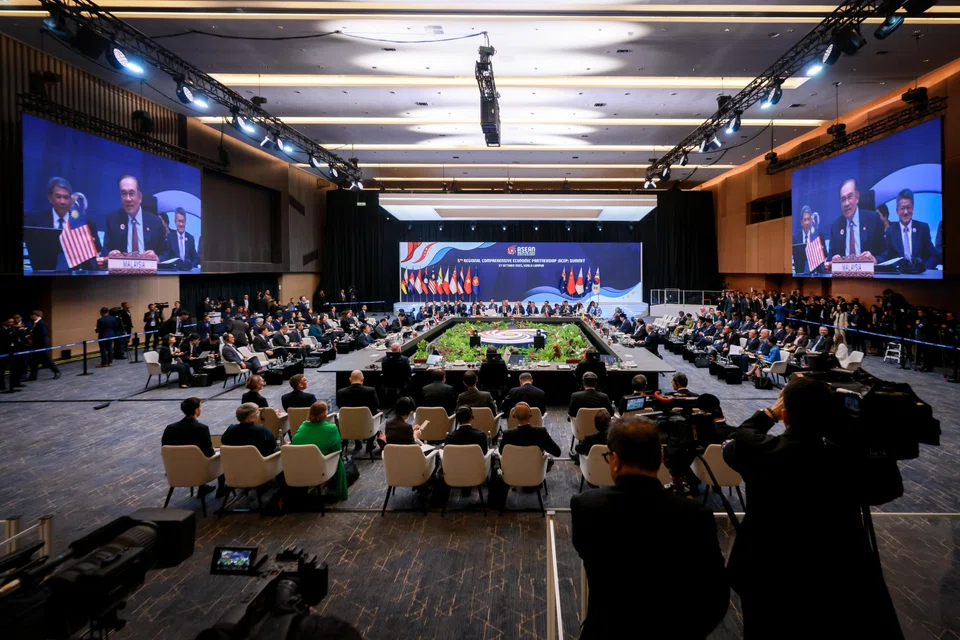
The political mandate is already there. At the Fifth RCEP Summit in October 2025, leaders explicitly called for stronger RCEP institutions through an effective RCEP Secretariat and for preparations to begin for the 2027 general review.
Asia cannot prevent every war, blockade, export control or tariff shock. But it can decide whether its biggest trade pact is ready for one.
Treat the 2027 review as ceremony, and RCEP will remain a large but underpowered pact, delivering marginal gains while events outrun it.
Use it properly, and RCEP can become Asia’s main instrument of economic resilience in an age of recurring disruption.
The writer is a researcher at the Asia Competitiveness Institute, Lee Kuan Yew School of Public Policy, National University of Singapore
This essay is part of New Global Order, a series which explores how the changing world landscape is reshaping business, politics and beyond
TRENDING NOW

LTA proposes combining car COE categories, adding rebate-surcharge system

StarHub to acquire MyRepublic’s mobile business amid ongoing telco consolidation

DBS, OCBC, UOB rout lops billions off STI as inflation, rate concerns spook investors

Grab CEO’s wife Chloe Tong on life with Anthony Tan and finding her purpose

