

Sunak seeks new UK net-zero settlement in face of ‘green-lash’
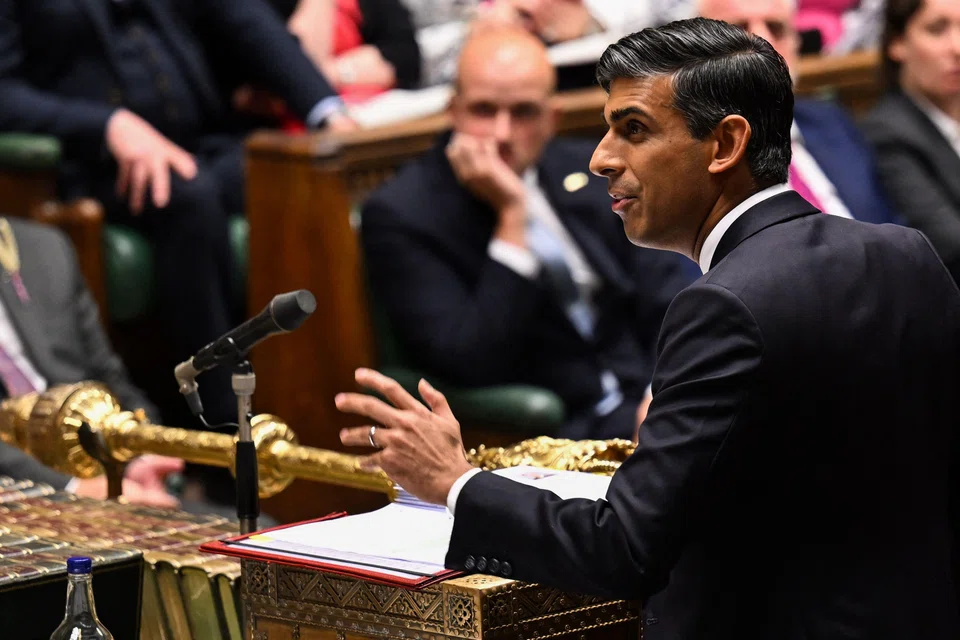
THE United Kingdom was the first large economy to make a legally binding commitment to 2050 net-zero goals – but Prime Minister Rishi Sunak is now seeking to reassess this.
Last Wednesday (Sep 20), Sunak held an emergency UK cabinet meeting with Parliament in recess. This built upon his earlier announcement of granting hundreds of new licences for North Sea oil and gas production, which started to shatter the UK’s two-decade-long climate consensus.
In a press conference on Wednesday, Sunak’s big claim was that the UK has “stumbled into a (net-zero) consensus about the future of the country that no one seems to be happy with”.
His argument was that given this perceived unhappiness, and with the UK so far ahead of competitors in reaching net zero – in his assessment – it is time for the country to take a different pathway to the 2050 goals.
Sunak therefore announced a host of measures, with the biggest probably being a delay of the planned ban on the sale of new UK petrol and diesel cars – pushing this back from 2030 to 2035.
This triggered criticism from the industry, as it disrupts their investment assumptions about 2030. The opposition Labour Party – which opinion polls indicate will probably form the next government – re-emphasised its commitment to retaining the 2030 timeline for the ban.
Sunak also announced policy changes to provide “far more time” for people to transition from gas boilers to heat pumps, and scrapped plans to force landlords to upgrade the energy efficiency of properties.
His speech received support from some – but not all – Conservative politicians. But observers have highlighted that if this was really intended to be a major speech on the future of the country, it looks to have been very rushed.
For instance, Jess Ralston at the Energy and Climate Intelligence Unit said: “This looks chaotic and not the way long-term policy should be made around important issues, with emergency cabinet meetings and investors spooked.”
Simon Evans of the Carbon Brief outlet argued that Sunak’s announcements may put the UK’s legally binding 2050 net-zero targets at risk.
Countering the ‘green-lash’
Despite such criticism, however, Sunak’s speech clearly reflects his considered thinking, building from his North Sea announcements.
He is aware of a growing “green-lash” – a backlash to environmental policies – that means the political consensus around the energy transition is breaking down, with the UK economy stuck in what Finance Minister Jeremy Hunt has called a “low-growth trap”.
Over the last fifteen years – from Q2 2008 until Q1 2023 – the UK’s gross domestic product (GDP) per capita grew less than 4 per cent. This was a tenth of the growth rate achieved over the preceding fifteen years, from Q1 1993 to Q1 2008, of more than 40 per cent.
At the moment, the UK is facing a five-year stretch of lost growth, with GDP still some 0.5 per cent below its pre-pandemic level, and not forecast to rise past that until at least 2024.
Opposition to net zero is growing particularly on the right of the political spectrum, quite often fanned by the leaders of the Brexit movement.
For instance, Nigel Farage has called for a UK public referendum on what he terms “ruinous” policies. He argues net zero is “net stupid” and that green subsidies are an excessive burden on UK energy users.
There is no prospect of such a referendum any time soon, though it cannot be ruled out in the future. What is more likely is that Farage’s influence could cause a future Conservative leader to adopt an even more sceptical stance on net zero.
So, a clear political divide is opening up in UK politics. Labour has said that if it comes into power, it will introduce a Green New Deal, in response to criticism that the UK needs a bigger policy response to moves by other powers, such as the United States’ Inflation Reduction Act (IRA).
Sunak’s ministers are aware of these criticisms, but argue that the UK has much greater green policy stability than the US, thus providing greater certainty for investors. Should Republicans win the 2024 presidential election, the IRA regime could be cut back, they note.
Areas of focus
One policy area that deserves a closer look is offshore wind energy, which is key to the UK’s climate targets. The country’s commitment to decarbonising the electricity system by 2035 will be met, in part, by a near-quadrupling of offshore wind by 2030.
But senior energy industry figures have warned that a swathe of projects could become economically unviable under the current regime. Even as the industry faces rising costs, the government has failed to adjust the scheme that guarantees the price paid to power generators.
Labour has not revealed the full details of its offshore wind energy plans yet, but Shadow Secretary of State of Energy Security and Net Zero Ed Miliband has pledged to reach 60 GW by 2030, 10 GW more than the current government’s target.
Labour believes that “an active industrial policy is necessary” for the renewable power push, said Miliband: “It means us as government making investments that private-sector companies on their own won’t necessarily make.”
A Labour government would also lift the current planning ban on new onshore wind farms, which party leader Keir Starmer has said is a “national act of self-harm, choking off our economic potential”.
One of the few earlier Sunak announcements that did get approval from across the political divide is the confirmation of the third and fourth carbon-capture usage and storage clusters.
The country’s four such clusters could support up to 50,000 jobs by 2030. The North Sea gives the UK one of the largest potential carbon-storage capacities in Europe, making it an attractive environment for such technology.
Rather than retreating from net-zero pledges, the UK needs to raise its game further, and remain a key player in the global transition.
The writer is an associate at LSE IDEAS at the London School of Economics
TRENDING NOW

Two Singapore-listed palm oil firms named in Greenpeace report on Indonesian plantation fires
Singapore Airlines flight returns to San Francisco after ‘unruly’ passenger incident

Singapore looking into which companies responsible for haze-causing fires: PM Wong
Deluge IPO 3.86 times subscribed ahead of SGX debut

