

Sunak’s surprise summer election gamble won’t work
Latest opinion surveys indicate that Labour is likely to be the largest party in the House of Commons
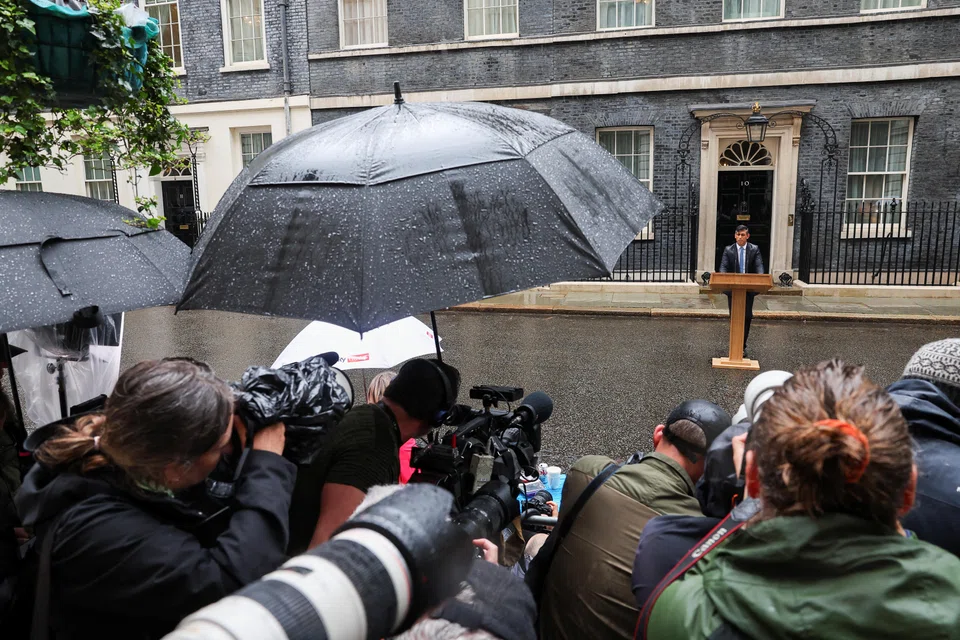
UK PRIME Minister Rishi Sunak’s political track record is one of a cautious, conservative leader. Yet on Wednesday (May 22), he threw the dice in an extraordinary summer gamble, calling a general election for Jul 4 that he is likely to lose – potentially very badly.
This will be the UK’s first July national election since 1945. That year was a very poor one for the Conservatives, with wartime leader Winston Churchill losing by a landslide to Labour.
Recent polls indicate that Labour, more than 20 percentage points ahead in recent election surveys, will win a significant majority in the House of Commons.
According to the May 23 forecasts from Electoral Calculus, the likelihood of Labour being the largest party in the House of Commons is 100 per cent, based on the latest opinion surveys. The political consultancy asserts a 98 per cent chance that Labour will have the majority of Members of Parliament in the House of Commons post-election, and just a 2 per cent chance that other parties will deny Labour such a majority.
This offers an outside possibility that Labour might win a majority comparable to that in 1945, or its last landslide year in 1997. To be sure, polls may tighten in the coming weeks, but the direction of travel appears clear towards Labour being the largest party again in the House of Commons.
However, Sunak (a former US green card holder) believes Jul 4 (US Independence Day) might be a lucky day for him, perhaps allowing him to defy the polls. His announcement on Wednesday is based on his belief that, bad as the political landscape looks now for the Conservatives, it could be even worse in the autumn.
Firstly, UK inflation has fallen from double digits last year to 2.3 per cent, near the Bank of England’s 2 per cent target, and the lowest level in around three years. Secondly, after a series of tax cuts in recent budgets, it is unlikely that the UK public purse can stretch any further for the time being at an autumn fiscal event.
At the same time, Sunak fears that if he delays the election until autumn or winter, several adverse developments could occur. Firstly, he is concerned that his flagship Rwanda policy, which will send asylum seekers to that African nation, might be frustrated by legal delays. Secondly, he perceives that the migration challenges his government faces from small boats crossing the English Channel will intensify during the summer.
Thirdly, Sunak remains worried by the political challenge to the right of the Conservatives from the populist Reform party. He has been especially fearful that, if he waits beyond the summer to call the election, there is a growing possibility that Nigel Farage (who helped lead the Leave campaign during the 2016 Brexit referendum) could head the Reform campaign.
While it is plausible that the political prognosis for the Conservatives could be worse in autumn or winter, this does not equate with July being a good time for them to go to the polls. When Sunak became prime minister in 2022, conventional wisdom was that he would significantly enhance the electoral fortunes of the Conservatives. However, the party’s numbers in recent polls have been as bad as those in the premierships of Boris Johnson and Liz Truss.
Little wonder that the private reaction of many Conservative MPs on Wednesday was bemusement about both Sunak’s decision not to wait until autumn or winter, and the unprofessional choreography of the announcement, with Sunak calling the election outside 10 Downing Street in the pouring rain – a picture that has drawn much unfavourable commentary.
He got drenched, and he looked miserable. The front pages of Thursday’s UK national newspapers highlighted this with headlines poking fun at “rain-soaked Sunak”, “things can only get wetter”, and “drown and out”.
The reason why so many pundits, not just Conservative MPs, were surprised at the timing is that history shows that Sunak and other recent “tail-end” prime ministers (beleaguered politicians who come into office at the end of a long period of rule by their parties) tend to want to put off big ballots as long as possible. This was true of previous Conservative prime ministers Alec Douglas-Home and John Major, who called the ballots in 1964 and 1997, respectively – very close to the last possible legal date.
Some Conservatives also worry about voter turnout on the designated Polling Day, given that many people will be on holidays in July. Moreover, the election campaign coincides with the Euro 2024 football tournament in Germany, in which both England and Scotland are competing. The election day will also fall a few days after the Wimbledon tennis tournament kicks off.
Even two Conservative ministers apparently expressed reservations about the election timing in Wednesday’s UK Cabinet meeting. It was reported that Cabinet Office Minister Esther McVey and Northern Ireland Secretary Chris Heaton-Harris said Sunak would be better off waiting until the improving economic outlook had filtered through to voters.
So, while the Conservatives should never be underestimated as a political force, the party is badly divided heading into the six-week election campaign. Almost a decade and a half since David Cameron first took power in 2010, and four prime ministers later via Theresa May, Johnson, Truss, and now Sunak, the party looks increasingly tired and divided. This is shown in the growing numbers of Tory MPs who have recently announced their retirement from politics – well over 60 at the time of writing.
Indeed, there is much speculation that Sunak has, politically speaking, “given up” after a long period of exasperation. Since he assumed office, he has made numerous political reboots, thousands of policy announcements, but nothing has fundamentally changed the UK’s political weather.
Despite the huge diversity of tail-end premiers in backgrounds, beliefs and styles, a common pattern is that – despite their various talents – they ultimately prove unable to stop the flow of the political tide against them, as is likely the case for Sunak, too. After multiple years in office, the growing momentum for the opposition party eventually proves insurmountable. In part, this is because the intellectual climate is shifting towards Labour, with many voters increasingly recognising the poor state of public services, and that further investment is needed in them.
Taken together, Sunak’s attempt to win a fifth straight term for the Conservatives, which would defy political history, is most unlikely to succeed. The prime minister has struggled to secure sustained, significant political momentum in the last couple of years, and the campaign is unlikely to see a fundamental reversal in this pattern that is powerful enough to reverse Labour’s momentum towards a new era of power.
The writer is an associate at LSE IDEAS at the London School of Economics
TRENDING NOW

Things to know about DBS’ incoming chairman Anthony Lim
DBS eyes prime brokerage business as Q3 profit falls 5% on weaker trading income

Royal Group and Sunset Hospitality abandon plans to open Casa Mett hotel off Orchard Road

George Yeo adds 100,000 Wilmar shares at S$2.97 apiece, taking stake to over 1 million shares

