The sweet, futile search for productivity
Tons of apps, systems and philosophies have been created around the need for productivity. So why are we so close, yet so far?

Claudia Chong

I’LL be the first to admit, without shame, that it was agonising having to churn this piece out.
Don’t get me wrong – I did have fun. But when everyone’s in a month-long holiday mood and you’re stuck writing an article about maximising productivity, you begin to question your life choices (and story pitches).
Nevertheless, responsibilities and deadlines exist. Part of being productive is knowing how to get things done, even when the mind and flesh are unwilling. Last-minute panic is always a good motivator, of course.
And the new year is as good a time as any to instil order in life, or at least find a system that works.
Is there anything nearly as dreadful as the To-Do list? For centuries, people have been finding ways to stay on top of tasks and track information. Leonardo da Vinci filled reams of notebooks with writing and intricate sketches as he pondered everything from mathematics to human flight.
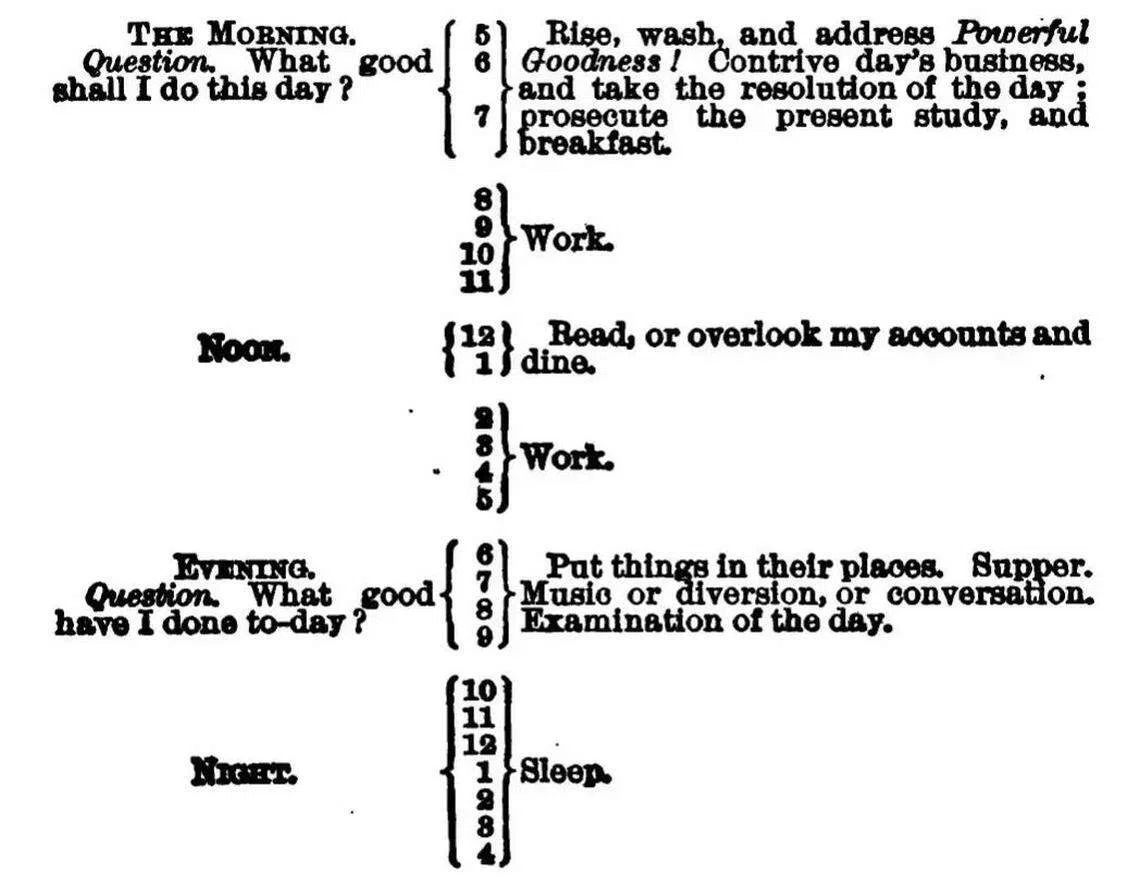
American founding father Benjamin Franklin, who observed that “lost time is never found again”, had a six-part schedule he obsessively followed every day.
A century and a half later, Dwight D Eisenhower inspired the Eisenhower Matrix, which bases decision-making on urgency and importance. The former US president once said: “I have two kinds of problems, the urgent and the important. The urgent are not important, and the important are never urgent.”
Even 50 years after Eisenhower’s death, the search for the productivity sweet spot continues. Tiago Forte’s “Second Brain” approach has recently been sweeping through the masses like wildfire.
It expands on a concept, introduced by godfather of productivity David Allen, that the brain is made for generating ideas, not storing them; hence the need for an external repository.
Meanwhile, millions of teens are getting their advice from TikTok. The hashtag #productivitytips has racked up 171.3 million views, with #productivitytok influencers making age-old techniques like timeblocking and the Pomodoro method go viral.
Then there are upstart tools like Notion and Calendly that have raised hundreds of millions of dollars in venture capital, and are aiming to be the productivity app that actually sticks around.
Not in Kansas anymore
Approaches to productivity have evolved since the creation of the Internet. One of the biggest issues with staying focused in this age is the sheer amount of information people are constantly bombarded with.
The world was a different place when Foo Tiang Lim brought Evernote to Asia-Pacific in 2012. “The way we live, work and play right now – the difference is that there is 10 times more information, at a higher frequency,” he says.
Foo was just a university student when the Apple App Store was launched in 2008, revolutionising the way software was created and distributed. Not long after, he took a trip to Silicon Valley and chanced upon Evernote co-founder Alex Pachikov at a conference.
A fan of the note-taking app, Foo made a cold phone call that Tuesday night – “I heard a very loud sigh on the other end” – that landed him a visit to the Evernote office. Years later, it turned into a chance to expand the product to Asia.
With a sleek interface modelled on an “infinite roll of paper”, Evernote was a straightforward application that saved humanity from the frustration of wanting to CTRL+F their notebooks.
It saved images, links, clipped articles, audio recordings and digitised handwritten notes within seconds, synced them across devices, and made them easily searchable.
Evernote became profitable just three years after launching. By late-2011, it had 13.6 million registered users.
But over the years, the company was plagued with intense competition and product missteps. It launched niche apps and Evernote-branded lifestyle accessories. Then came a collaborative team-based product just when the market was getting saturated with offerings like G Suite and Slack.
“It couldn’t scale. And it dawned on me that one big reason was because productivity and note-taking are very personal things,” says Foo. “Each person has their own way of taking notes and organising their thoughts.”
All systems go
There’s some anxiety in making one’s life so central to an app that could one day simply disappear.
Foo left Evernote in 2015 but the platform, which is getting acquired by Milan-based developer Bending Spoons, still forms the core of his workflow.
His “billionaire pipe dream” is to one day buy the company and make sure it – and his notes now numbering close to 20,000 – never dies.
“People thought these companies would live forever,” says Foo, now an early-stage startup investor all too familiar with how transient some businesses can be.

The Verge writer Victoria Song recently wrote about her frustration with trying several of the thousands of apps out there. Todoist, Trello, Asana, Notion – no matter which ones she tried, they all had gaps, to the point where she had to use at least 10 apps on a daily basis.
Song’s case may sound like an extreme example, but it wouldn’t be the first time someone faced such struggles. Others simply toss out apps altogether in favour of the elegant pen and journal.
Terry Toh, a tech employee and productivity coach, used bullet journals for years until his life and goals became too complex for it. (The bullet journal method, created by Ryder Carroll, became a hit in 2013 for its straightforward analog way of indexing, rapid logging, and task migration across timelines.)
About a year ago, Toh chanced upon an article about a system of organising digital information, created by Tiago Forte, author of Building a Second Brain.
Picture this: every day, information and inspiration are fed to a person through conversations, articles, podcasts, books, social media, new experiences and more.
They swirl around in the brain till one day, something becomes useful. What then? Reach into the deep recesses of the mind to retrieve mangled fragments of it? If we were to build a graveyard of almost-ideas, how large would it be?
Forte’s method proposes four top-level categories encompassing every type of information one might encounter. These are broken down into separate systems guided by clear principles. Actionable items are separated from non-actionable items, for instance, to minimise cognitive load.
“I got quite obsessed with it. I read all his articles. I enrolled in his course. Then when the book came out, I bought the book, even though I knew exactly what was in it!” says Toh with a laugh.
He spent a week building the first iteration of his personal productivity system on Notion. It’s evolved into a multilayered database spanning work, relationships, personal projects and any fleeting thought that comes to mind.
The invisible side of productivity
The first thing Toh does after waking up is to write for 1.5 hours for his online audience – part of his process of building a following as a coach. Then he walks for an hour on the treadmill in his office’s gym, doing all his reading and collecting screenshots and highlights for inspiration that will be stored in Notion. Only then, does he start work.
Complex databases. Bill Gates-style routines. It’s enough to intimidate people who struggle to even get up in the morning. But Toh says that’s getting ahead of ourselves.
“The first thing anyone needs to have is clear intention or what they want to achieve. And they have to crystallise it with as much detail as possible,” he explains.
The absence of a clear goal is a common symptom of people who feel like they’re always busy, but not progressing. These individuals crave the short-term adrenaline of crossing tasks off their lists, but lose sight of the big picture.
“If someone doesn’t have that intention, then no tool, framework, book, article, or coaching will help you, because you don’t know where you want to go,” says Toh.

Much of the emphasis around work efficiency centres on time and knowledge management. In recent years, more of the conversation has shifted towards energy management.
Lakshmi Ramachandran, a life coach and keynote speaker, knows most work tools inside-out. These days, she’s more interested in the intersection between productivity and well-being.
It struck her years back that some of these productivity tips were not difficult to implement. Yet, many people could not sustain the practice. With each new year resolution, they would eventually fall off track.
Ramachandran thinks it’s because most methods don’t fit neatly with everyone’s life circumstances. “For example, it may work very effectively for a man, but for a woman, it depends on so many different factors like life phases, or even your monthly cycles,” she says. But finding an approach that works firstly requires a deep understanding of oneself.
“When there is an element of personal fulfilment, it immediately gives people energy… that provides the fuel needed to complete the other responsibilities and tasks,” says Ramachandran.
There is an intimate relationship between mental well-being and productivity. Toh, who has been coaching some of his Google colleagues in addition to external clients, was surprised to find many of them suffered from imposter syndrome. They doubted their own abilities and feared being exposed as a fraud.
Even the most outwardly high-flying individuals can be crippled by this, says Toh.
In a world obsessed with prizing constant output, a movement to combat productivity guilt is gaining ground. An oft-discussed topic is procrastination, and how to redefine our understanding of it.
Madeleine Dore, author of I Didn’t Do the Thing Today: Letting Go of Productivity Guilt, suggests terms like “lazy” and “unmotivated” are misnomers associated with procrastination.
The phenomenon could point to deeper underlying issues, such as a fear of judgment or making mistakes – especially relevant to those in the creative industry. The antidote to this is to embrace trying to do the work, according to Dore.
“There’s no such thing as perfect. There’s no perfect space, there’s no perfect time, there’s no point where you will be perfect and ready,” she says in an episode of her podcast Routines & Ruts.
Ramachandran is a firm believer that consistent small steps can lead to big changes. She’s met with countless students struggling with getting enough sleep. One of her suggestions is to establish a habit of shifting sleeptime forward by just five minutes every day. Before long, a significant change can be observed.
Otherwise, setting unrealistic goals could lead to the entire plan falling apart. “And then you feel horrible,” she says.
As to how this article was eventually written? A digital Pomodoro timer, and a handy quote from English author Neil Gaiman: “Anything you do can be fixed. What you cannot fix is the perfection of a blank page.”