The tariff war that wasn’t: What economists missed about Trump’s trade gambit
Reality proves more complex with non-traditional factors at play, including structural shifts
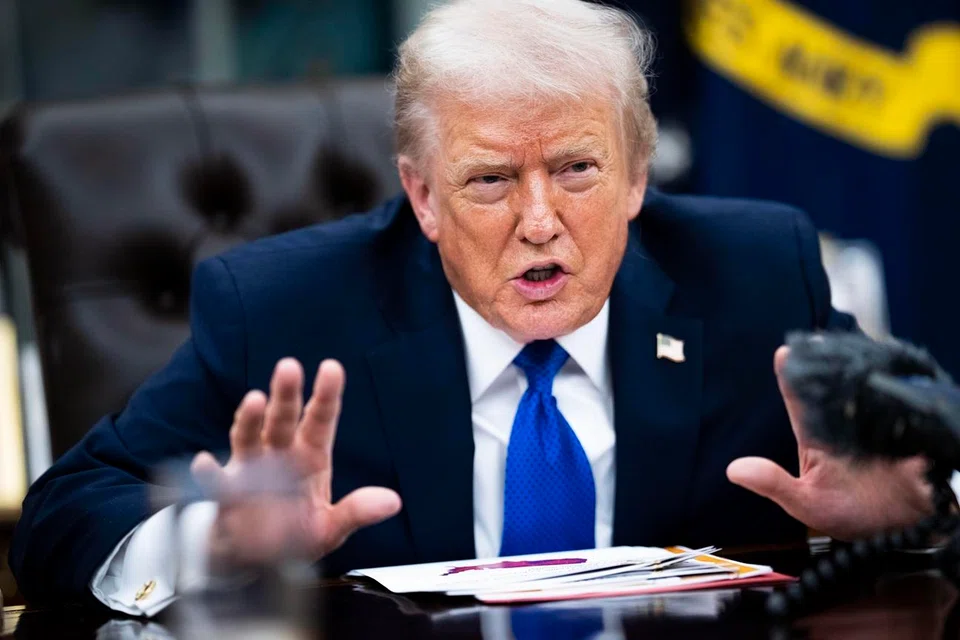
WHEN US President Donald Trump announced his “Liberation Day” tariffs on Apr 2, 2025, economics professionals around the world braced for catastrophe.
The Asean+3 Macroeconomic Research Office (Amro) forecast that Asean economies would suffer gross domestic product losses of 0.5 to one percentage point, with export-dependent nations such as Vietnam and Cambodia facing severe disruptions.
Major financial institutions predicted a US recession, and stock markets crashed nearly 20 per cent in days after Apr 2.
Yet, by the end of 2025, Asean’s growth remained robust at around 4.4 per cent; China’s growth held up at about 5 per cent; the US economy expanded by around 2 per cent; and stock markets reached new highs.
What happened? More importantly, what does this reveal about the blind spots in how economists analyse modern trade policy?
The “Taco” effect
Our initial assessment followed conventional economic theory: higher tariffs raise import costs and therefore increase prices, reduce demand and lower GDP. We modelled impacts using historical elasticities and standard macro frameworks. We calculated exposure ratios and dependencies.
The mathematics was impeccable, but reality proved more complex.
We failed to account for three non-traditional factors: psychology, structural shifts and monetary policy response.
First, psychology. Our modelling frameworks taught us to model policy as fixed parameters rather than negotiating tactics. We therefore took announced tariffs at face value, assuming implementation would follow threats.
However, the pattern that emerged was what Financial Times columnist Robert Armstrong dubbed “Taco” – Trump Always Chickens Out.
Trump would announce devastating tariffs. However, when markets panic or when Trump is confronted with equally devastating counter-tariffs by a strong opponent, he would delay or reduce the tariffs and seek a compromise.
Trump’s behaviour was turned into a trading strategy on Wall Street and survival strategy on Main Street. Having placed bets on a Taco move, markets barely blinked when negotiated rates came in at 19 to 20 per cent in July – instead of the threatened 30 to 50 per cent.
Meanwhile, producers ramped up their exports during the 90-day pause period for negotiation, keeping growth stronger than forecast. Exporters and retailers largely absorbed the initial tariff costs due to uncertainty over the permanence and level of the new tariffs.
Such gaming behaviour and psychology-driven moves kept growth stronger and inflation lower than expected, and affected policy responses.
Structural shifts and the AI wild card
Second, structural shifts. China’s ongoing renewable energy export boom was game-changing.
Clean energy contributed US$1.9 trillion to China’s economy in 2024 – 10 per cent of GDP and 26 per cent of growth.
Although US-China bilateral trade dropped sharply by 33 per cent, Chinese electric vehicle (EV) exports to Asean surged 75 per cent, increased 10 per cent to Europe and almost trebled to Africa.
This was not just trade diversion – it represented a global shift in supply and demand for EVs and renewable energy. Asean economies benefited indirectly through component manufacturing, increased Chinese investment and sustained regional logistics.
Our aggregative models could not capture this sectoral shift. As a result, we missed out on how the green energy transition was powering China’s growth independent of traditional growth drivers.
Perhaps the most surprising outcome was the extent of artificial intelligence (AI)-driven US growth resilience. Harvard economist Jason Furman estimated that without data centre and AI-related investment, US GDP growth in the first half of 2025 would have been just 0.1 per cent annualised.
Tech giants poured over US$100 billion into AI infrastructure in a single quarter – 92 per cent of US GDP growth, despite representing only 4 per cent of the economy.
The AI boom sustained US import demand and consumer spending despite tariff chaos.
Our models assumed a tariff-induced US slowdown would dampen import demand; we did not anticipate a structural investment surge overwhelming the tariff effect, which was also dampened by front-loading.
Asian exporters consequently benefited from continued American spending, while capturing trade diverted from China.
Monetary policy space as a crucial buffer
The third factor we failed to account for was the crucial role of monetary policy buffer.
Asean entered 2025 with inflation at or below target in almost all its economies, allowing countercyclical easing precisely when needed. Ironically, China’s deflationary producer prices also contributed to the low inflation.
Equally important, the weakening US dollar – driven in part by the uncertainty and credibility loss created by Trump’s erratic policy – gave Asian currencies room to appreciate.
This currency strength reduced imported inflation pressures and provided additional space for monetary easing.
Malaysia cut its policy rate for the first time in five years in July 2025. Thailand similarly cut its rate in August and December last year, while Indonesia reduced rates in May, July and September in the same year. The Philippines delivered 125 basis points of cuts.
Standard macro models do not incorporate monetary policy responses endogenously. We had assumed financial conditions would remain constant or tighten.
Instead, subdued inflation combined with US dollar weakness gave central banks ample space to support growth. Monetary offset is likely to have mitigated significantly the direct tariff impact.
Predicting the highly unpredictable
This episode reveals several methodological gaps.
First, we need frameworks for analysing gaming behaviour around policy implementation. Announced policies are not necessarily executed policies, especially with leaders known for using threats as negotiating tools.
Second, models must incorporate monetary policy responses endogenously. Interactions between trade shocks, inflation dynamics, currency movements and central bank reactions proved crucial.
Third, we must recognise structural transformations in real time. The renewable energy transition represents a structural shift in global trends, not cyclical fluctuation.
Fourth, we should embrace humility about predicting outcomes in highly uncertain environments. The range of potential scenarios was, and continue to be, wide-ranging – from deep recession to continued growth. Point estimates created false precision. Probabilistic forecasting acknowledging radical uncertainty would serve policymakers better.
But this experience teaches humility. Economic analysis must evolve beyond mechanistic application of historical relationships. We need frameworks accounting for gaming behaviour, policy uncertainties, psychological factors and rapid structural change.
We must recognise when unusual coincidences of favourable factors create outcomes standard models cannot predict.
Asean’s vulnerability to policy whiplash
Our forecasting errors do not vindicate Trump’s tariff weaponisation. The minimal actual impact thus far has resulted largely from factors beyond his control – China’s green tech export surge, the AI investment boom and Asean’s monetary response.
While markets have adapted to Trump’s Taco behaviour, the higher tariffs and continued uncertainty over their eventual levels have created huge uncertainty costs that continue to be a drag on businesses. Higher tariffs feeding through into higher prices of consumer goods would also dampen demand in the new year.
Moreover, the current favourable conditions may not last. US monetary policy remains suspended, due in part to the effects of tariff uncertainty. The AI boom may moderate. Green tech overcapacity could trigger disruptions. The Taco trade might break, given Trump’s idiosyncratic personality.
The tariff episode has also exposed Asean’s vulnerability to policy whiplash from major economies. Recovery depending partly on China’s green tech boom and US AI spending – both potentially temporary – validates concerns about over-dependence on external demand, and the need for greater diversification and deeper regional integration.
The 2025 tariff war that was not should prompt serious reflection about analysing modern trade policy in an era of economic nationalism, technological transformation and policy uncertainty.
The writer is professor of international economic relations at the S Rajaratnam School for International Studies, Nanyang Technological University. He was the former chief economist of the Asean+3 Macroeconomic Research Office.
This is the first essay in our new series, New Global Order, which explores how the changing world landscape is reshaping business, politics and beyond