
THE BOTTOM LINE

Tariffs, geopolitical tension and a US$800 billion deal: World Economic Forum 2026

Businesses batten down at Davos as global policy uncertainty reaches two-decade high
Summarise
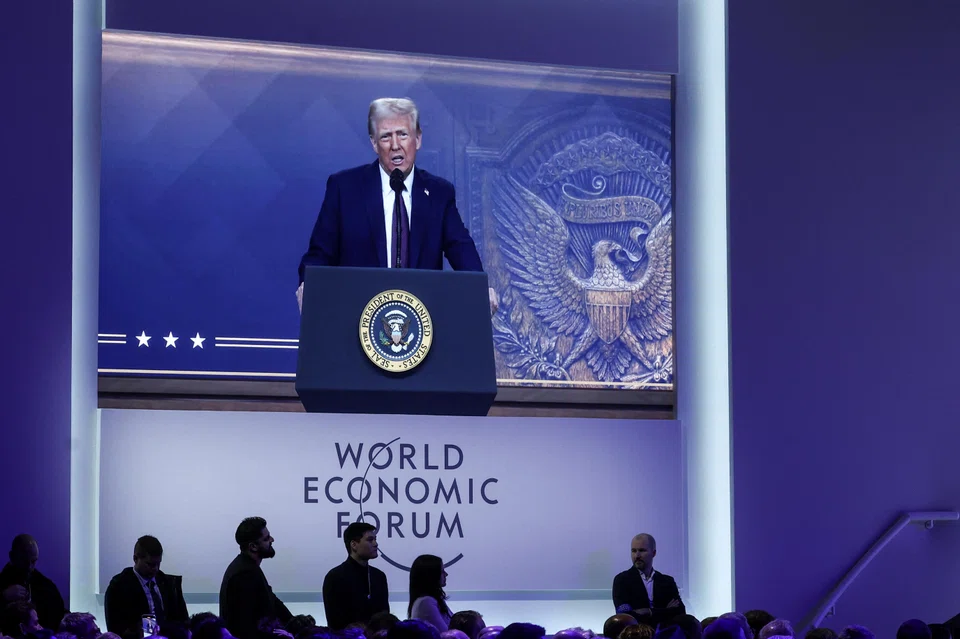
    • Trump has become the proverbial fox in the henhouse at WEF with his “America First” mantra.
    • Trump has become the proverbial fox in the henhouse at WEF with his “America First” mantra. PHOTO: REUTERS
    Published Wed, Jan 14, 2026 · 07:00 AM

    A HALLMARK of US President Donald Trump’s political career has been his avowed opposition to “globalism”. Yet, one of his paradoxes is how much he enjoys attending Davos, the annual meeting of the World Economic Forum (WEF), which starts on Jan 19.

    Joining him is a high-level delegation including Treasury Secretary Scott Bessent, Commerce Secretary Howard Lutnick, Energy Secretary Chris Wright, US Trade Representative Jamieson Greer, Special Envoy Steve Witkoff and tech czar David Sacks.

    Trump has become the proverbial fox in the henhouse at WEF with his “America First” mantra, forcing business elites to adjust to the significant changes his second presidency is bringing. During the billionaire’s two terms, the US has increasingly turned from a global rule-maker to a nation undermining the post-1945 system it helped create.


    The extent of these challenges, of which Trump is a key but not singular driver, is shown in a new report released this week by WEF, Boston Consulting Group and IMD Business School. The study argues that global policy uncertainty is at a two-decade high, driven by a growing polycrisis, including weakening multilateralism, changes in the trade policy landscape and the growing weaponisation of economic tools.

    This report is not alone in sounding the alarm. Lloyd’s of London, an insurance and reinsurance market, recently warned that a potential geopolitical conflict could devastate the global economy, triggering US$14.5 trillion in losses over a half decade.

    The report, developed with the Cambridge Centre for Risk Studies, highlights that with more than 80 per cent of the world’s imports and exports – around 11 billion tonnes of goods – at sea at any given time, the closure of major trade routes due to a geopolitical conflict is one of the greatest threats to economic resilience.

    The growing uncertainty gripping the global business landscape was exemplified on Monday (Jan 12), when Trump doubled down on his threats to Iran.

    He declared on social media that “any Country doing business with the Islamic Republic of Iran will pay a tariff of 25 per cent”, a move that could put pressure on Teheran as anti-government protests continue. While specifics remain unclear, the impact could be wide-ranging. China is Iran’s largest trading partner, followed by Iraq, the United Arab Emirates, Turkey and India.

    Yet, even as 2026 looks to be yet another year of very high political and economic risk, Davos will offer some glimmers of optimism for assembled elites. These will include not only world political leaders, but also hundreds of WEF partner companies, other business leaders, civil society and social entrepreneurs.

    A key reason for hope is reports that Ukraine President Volodymyr Zelensky and Trump plan to sign a US$800 billion deal to rebuild Ukraine and kickstart its economy. Kyiv hopes that the deal, configured around the minerals deal signed in 2025 granting US investors preferential access to future mining projects in Ukraine, will pave the way for private loans, grants and investment.

    This embodies the international cooperation agenda WEF has long championed. The forum has previously hosted pivotal dialogues, including the 1988 Davos Declaration between Greece and Turkey, the first North-South Korea ministerial meetings in 1989, and German reunification talks between then East German prime minister Hans Modrow and German chancellor Helmut Kohl that same year.

    The glass-half-full optimism these developments showcase was reflected in a second report released by WEF on Jan 8 in collaboration with McKinsey. The WEF Global Cooperation Barometer 2026 found that the overall level of international collaboration has unexpectedly held up in the face of sustained political and economic pressures.

    However, the shape of this cooperation is changing. The study found that cooperation is advancing most where it is targeted, interest-based and regional, potentially offering a road map for collaboration in the tumultuous late 2020s.

    The barometer examined global cooperation across five pillars: trade and capital, innovation and technology, climate and natural capital, health and wellness, and peace and security. Drawing on 41 indicators, the report highlighted where cooperation is persisting, where it is weakening, and how it is being reconfigured in response to shifting economic, political and technological realities.

    Metrics relating to multilateralism, including trade plus security and peace cooperation, weakened most. However, flexible, smaller arrangements – such as on data flows and select capital flows – have continued to grow.

    Innovation and technology cooperation saw IT service flows rise, while international bandwidth is now four times larger than pre-pandemic levels. New cooperation formats are also growing around artificial intelligence, 5G infrastructure and other cutting-edge technologies among countries with common agendas.

    The findings underscore the potential for adaptive, pragmatic approaches to cooperation in 2026. Collaboration is possible, but now needs to be cultivated carefully to rejuvenate innovation. For business leaders, understanding these emerging patterns may be key to strengthening corporate resilience, better managing risk and advancing shared prosperity in our volatile, uncertain, complex and ambiguous world.

    The writer is an associate at LSE Ideas at the London School of Economics


