

Tech as we know it is dead
To survive the next decade, we must torch our own playbooks before the market does
IN THE 1980s, my relationship with technology was defined by a 3 am time slot. The university’s mainframe was a humming, climate-controlled beast housed in a fortress, too busy during the day. So we stayed up to sit at dumb terminals, writing code in silence. There was no Windows, mouse or “undo” button.
Of course, in less than a decade, the tech one knew and sold was dead. As words such as the Internet and applications entered the lexicon, the jargon of dumb terminals and client-server systems retired to make way. A bigger and faster change is afoot now.
Software is dead
The first casualty is the very thing investors have prized most: the software moat. Writing code was hard and created a durable asset until now. That assumption collapsed for me recently.
Despite being a novice programmer, I used a newly announced application to build a Chrome Extension for our investment process in half a day.
A year ago, I attempted something far less sophisticated with programmers. We could not produce anything useful despite trying for weeks.
When a novice can build enterprise-grade tools in one afternoon, the economics of the software industry invert. We are moving from “software scarcity” to “software abundance” – the tool is being generated on demand.
The barriers protecting software-as-a-service (SaaS) companies’ 80 per cent gross margins are dissolving.
The disruption goes deeper than creation. The consumption of software is dying, too. For 20 years, we loved the “program” model: distinct, walled gardens where you go to do a specific task. These containers are now liabilities. Generative artificial intelligence (AI) does not work in silos; it needs to traverse your entire digital life to be useful.
Our desktops are becoming graveyards of icons. On most knowledge-worker laptops, native applications opened daily are plunging. Work has moved into browsers and into agents. Unused SaaS logins are soaring. And, unlike dead desktop icons, they are a monthly cost burden.


Software is not going away; it is dissolving into something more permeable, generated on the fly, invisible and boundless.
The Internet is dead
Within the AI mode of Google Search recently, I got an immersive webpage-like result built instantly, just for me. They showed that even the text-based AI chatboxes we know may soon be dead.
Last Christmas, ChatGPT quietly turned into a shopping front end. Shopping Research now reads product pages, reviews and prices across the Web and produces a personalised buyer’s guide, with Instant Checkout letting you complete purchases without visiting a merchant’s site. US stats showed a ninefold increase in AI-driven referrals over the holiday season.
The “Web”, that tangled mess of SEO-optimised pages, is turning obsolete. AI surfs the Web for users. The “page” is no longer a fixed document to be fetched. It is an experience assembled live, for each user, for each question.
AI summaries now devour 35 per cent of US queries. Click-through rates have halved to barely 8 per cent, with some publishers reporting traffic drops of 50 to 80 per cent. Some estimate a 25 per cent drop in search volume by 2026, and they may prove optimistic.
Education’s massive open online course era has turned to AI tutors adapting each sentence to the student’s needs. Social media feeds are under pressure as human creation struggles against machine-generated engagement loops. ChatGPT and Google have launched protocols for AI agents to make payments without human involvement.
The Internet is now a substrate of application programming interfaces, feeds, embeds and protocols that models swim through, while users talk to one or two front ends. Its pages are reduced to training fodder for models that no longer need to send users there.
Hardware is dead
This brings us full circle, back to my 3 am escapades. Those were days in front of dumb terminals, with an all-powerful computing behemoth hidden somewhere behind. The subsequent era’s personal computing devices seemed to mark irreversible evolution. We had more supercomputer power in our pockets than was required for the first moon landing.
The pendulum is reversing sharply. Our devices are turning into their own kind of dumb terminals. The Central Processing Unit has been demoted. It is no longer the chief of the computer; it is a glorified middle manager while the real work is done by massive arrays of processing units.
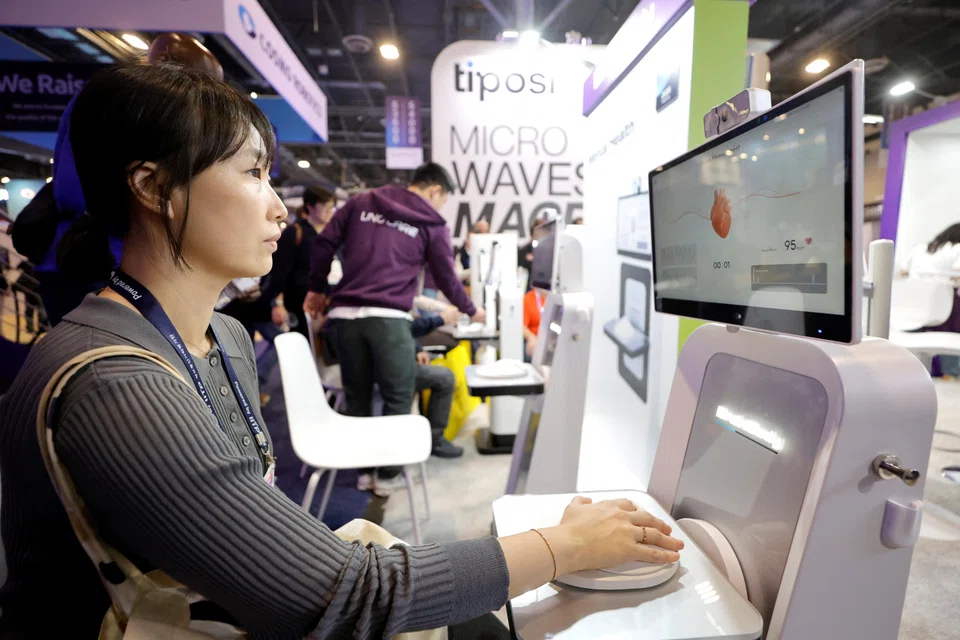
Data-centre spend in 2025 could exceed total spend on PCs and laptops, and may surpass mobile phones in a few years. Tech event CES recently confirmed the shift. The show floor buzzword was “physical AI” and robotics. Consumer devices felt like afterthoughts; the real audience was data-centre buyers.
The utility share of front-end devices such as laptops and phones has fallen below 4 per cent of total compute cycles for a typical knowledge-worker query, down from about 95 per cent in 2019. The remaining 96 per cent occurs in hyperscale data centres.
AI workloads are breaking the old architecture. The unit of compute is no longer a single board but a “pod” or “supercluster” – thousands of chips wired together with cabling, 100 times faster than the Internet. We aren’t building computers anymore; we are building synthetic organisms the size of warehouses.
The industry is dead
Old habits die hard. I am writing a newspaper essay to be read in formats that feel like sending smoke signals in the age of Starlink. We are all cosplaying modernity while clutching rituals already fossilised.
This denial bleeds into our investment decisions. We sit in committees demanding multiyear revenue forecasts, pretending we can see across a horizon that changes every Tuesday. We stack spreadsheets as if pricing and competition remain slow-moving variables.
The hardest admission is simple: We cannot know what the future of “tech” will look like. Hardware is becoming a utility, software a commodity, the Internet a ghost town.
To survive the next decade, we must torch our own playbooks before the market does. Every aspect of tech as we knew it is afire. The only durable edge now is to accept that the old is gone, even before we strap ourselves to make judgments on the new.
The writer is chief executive officer of Singapore-based, global innovation investment company, GenInnov
This is an adaptation of an article first published on https://www.geninnov.ai/blog/
Decoding Asia newsletter: your guide to navigating Asia in a new global order. Sign up here to get Decoding Asia newsletter. Delivered to your inbox. Free.
Share with us your feedback on BT's products and services






