EDITORIAL

Thailand’s next leader faces hefty task to rebuild confidence after Pita’s exit
Published Mon, Jul 31, 2023 · 05:24 PM
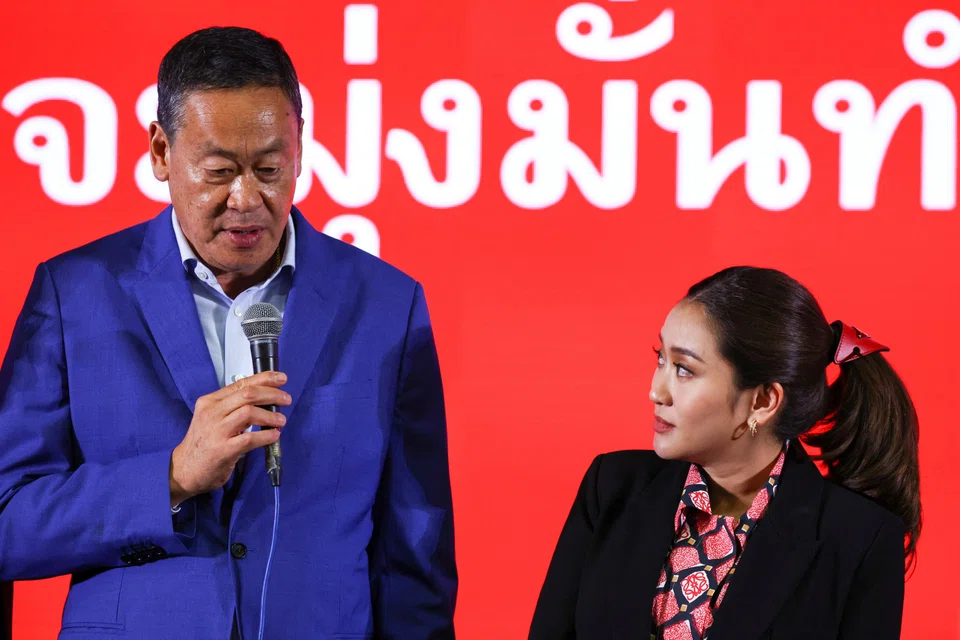
    • Srettha Thavisin (left) and Paetongtarn Shinawatra from Thailand's Pheu Thai party are contending to be named as candidates to become the country's next prime minister.
    • Srettha Thavisin (left) and Paetongtarn Shinawatra from Thailand's Pheu Thai party are contending to be named as candidates to become the country's next prime minister. PHOTO: REUTERS

    THESE are unique, uncertain and interesting times in Thailand. Eleven weeks after the last general election was held, the country remains deep in a political deadlock that continues to drag on with seemingly no end in sight.

    The leader of the surprise election winner Move Forward party, Pita Limjaroenrat, has had his chances of becoming the next prime minister dashed. This came after he was twice rejected in parliament by the conservative, military-appointed senators who delivered a firm rebuke to his ideals and agendas, including the plan to amend a law that punishes those who insult the monarchy with up to 15 years in prison.

    Compounding matters was his suspension as a member of parliament by the Constitutional Court, due to allegations that he broke election rules by owning shares in a media company.


    Pro-democracy protesters have already started to gather in the streets of Bangkok and elsewhere to denounce the Senate for preventing Pita from becoming the country’s next leader. The demonstrations have been largely peaceful so far. 

    With Move Forward out of the picture, the spotlight has shifted to the election runner-up Pheu Thai – the new leader of the coalition of pro-democracy parties that is now seeking to name a candidate for prime minister and eventually form the next government.

    Parliament was supposed to meet last week to vote for the next prime minister, but that session was postponed to this Friday (Aug 4). But this new date could be pushed back again if the Constitutional Court accepts a petition that is asking the court to rule if the vote to reject Pita’s re-nomination should be deemed unconstitutional.

    The fascinating subplot to all this was the recent revelation that Thaksin Shinawatra – the billionaire tycoon and former premier who has been living abroad in self-imposed exile since 2008 – could finally return home on Aug 10. The 74-year-old remains popular with Thailand’s rural and working-class masses, but it is unclear if he will make good on this latest promise to come back as he will face potential jail time on corruption charges.

    All eyes, meanwhile, are on Thaksin’s youngest daughter, Paetongtarn Shinawatra, a senior leader in Pheu Thai and in contention to be named as a candidate for prime minister. Another name in the running is Srettha Thavisin, the former chief of property developer Sansiri.

    Whoever eventually gets the green light to become Thailand’s 30th prime minister will have a lengthy to-do list – chief of which will be to ensure a peaceful transition of power, boost local and foreign investor confidence, and unite a divided nation.

    South-east Asia’s second-largest economy has largely weathered the storm, with the World Bank recently projecting that growth for 2023 will come in at 3.9 per cent – well ahead of last year’s 2.6 per cent expansion. The tourism and hospitality sectors have also experienced a healthy rebound, as leisure and business visitors have returned in droves after the reopening of borders last year.

    That rosy outlook could all change if the political impasse drags on, and if the street protests grow larger and turn violent. Thailand’s tourism-reliant economy can ill afford another painful setback if travellers and investors are spooked and end up taking their business elsewhere.