

Thailand’s proposed land bridge will be decided on economic viability
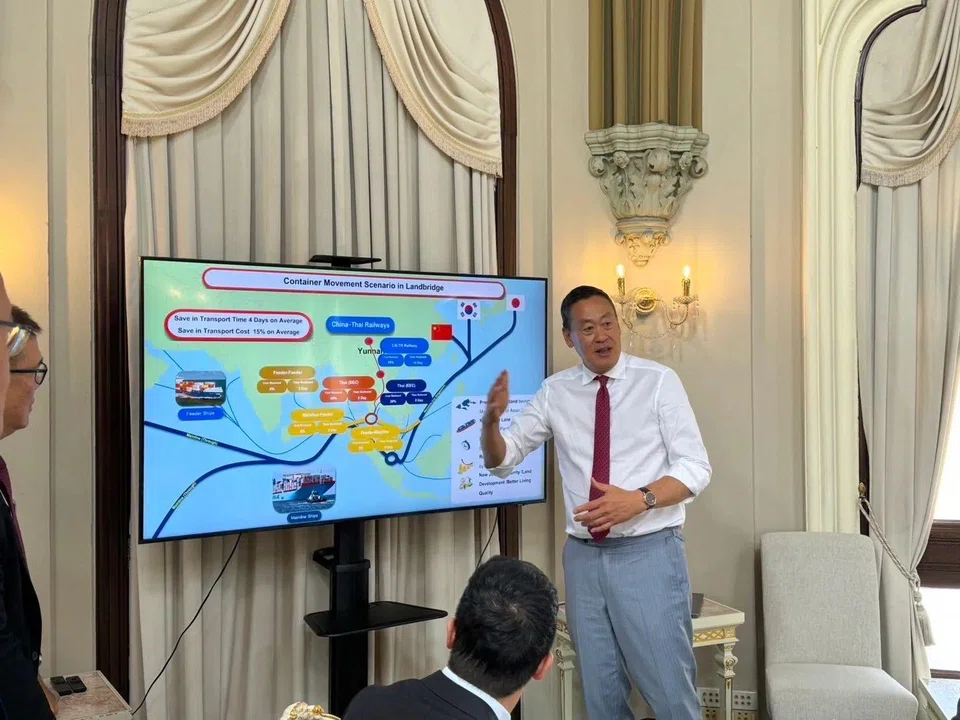
THAILAND’S proposal to build a land bridge that removes the need to sail around the Malayan peninsula is just one of many such ideas pushed over the years. Historians date the first such plan to the 17th century: A far-sighted Siamese king wanted a quick way to move his navy without having to loop around the peninsula. He sought to dig a canal across the Kra Isthmus.
More recent proposals have been profit-motivated. The main thrust of all such ideas is to provide a shorter sea trade route between the Indian and Pacific Oceans. As recently as 2015, an agreement was signed between the China-Thailand Kra Infrastructure Investment and Development Company and Asia Union Group, to build a Kra Canal. It fell apart on security concerns at the prospect of dividing a Muslim majority region from the rest of the Buddhist kingdom.
This time the proposal is for a 90 km land bridge. Thai Prime Minister Srettha Thavisin envisages a project that would obviate the need to sail via the Straits of Malacca, pointing out that there are more than 60 maritime accidents a year on average on the existing route. More contentiously, he argued that the growth in maritime traffic would mean that the Straits would reach full capacity by 2030.
His project is estimated to cost about US$28 billion, with seaports on either side of the country’s southern peninsula linked by roads and rail. The project is conceived not as an alternative to the traditional route, but as an ancillary that could handle up to 23 per cent of the tonnage through the Malacca Straits.
If all goes according to plan, Ranong port in the Andaman Sea would have the capacity to handle 19.4 million 20-foot equivalent units (TEUs), while Chumphon port in the Gulf of Thailand would have the capacity for 13.8 million TEUs. Srettha says the project would create 280,000 new jobs and boost Thailand’s gross domestic product growth to 5.5 per cent from the lacklustre 2.6 per cent last year.
Land bridges can be a useful alternative to canals. Right now, because of drought-related restrictions on Panama Canal operations, some shippers are reported to have tried unloading cargo at one end of the canal and transporting it by land to the other side. But then, the Panama Canal cuts about 12,000 km off a journey bypassing South America. The Suez Canal reduces the distance of a trip between Europe and South Asia by 10,000 km. In contrast, a Kra shortcut would slice off only about 2,000 km in sailing distance.
Certainly, starting major infrastructure projects is a time-honoured strategy for governments seeking to boost economic growth. Over the last 50 years or so, Thailand has enjoyed impressive growth as it transformed from a low-income to an upper middle-income economy. During the boom years from the 1960s to the onset of the 1997 Asian financial crisis, it grew an average of 7.6 per cent annually. Growth slowed to about 5 per cent post-crisis and has suffered further slowdowns with the 2008 global financial meltdown and the Covid-19 pandemic.
Bangkok wants a gamechanger that will propel the economy back to the glory days. Srettha has pitched the proposal to both Chinese and Western investors. It remains to be seen if there is enough interest in the idea. Ultimately, economic viability will be the only basis on which the fate of the proposal will be decided.
TRENDING NOW

Government to bring forward raising of retirement age, give employers more financial support to create flexi-load jobs

If Europe goes to war, the fallout will be felt in East Asia

Indonesia stocks suffer worst plunge in nearly 30 years as MSCI proposes standalone status

Vietnam’s northern provinces, not Hanoi or Ho Chi Minh City, are powering near 10% GDP growth

