There are sound reasons for having more multi-owner strata office spaces

CONSTRUCTED in the 1990s, Suntec City is a major mixed-use development comprising a mall, office buildings and a convention centre.
Viewed aerially, its five office buildings and convention centre look like a left hand. The development’s Fountain of Wealth appears like a golden ring in the palm of the hand.
The group behind the development comprised leading Hong Kong-based tycoons such as Li Ka Shing, Lee Shau Kee and the late Run Run Shaw.
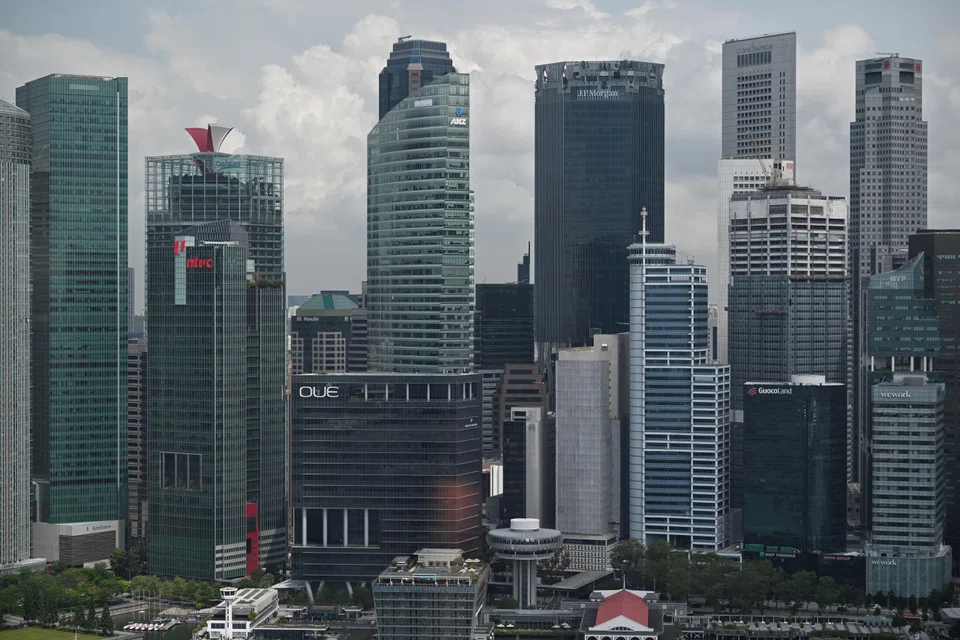
But another standout feature of Suntec City is that multiple strata owners own its office units – unlike the case for many other premier office buildings in Singapore’s city centre, which are owned by a single owner or a joint venture.
Opportunities for individuals to own strata office spaces in the city centre and Orchard Road area could well be shrinking.
The office spaces in buildings such as Shenton House along Shenton Way, Golden Mile Complex on Beach Road and Far East Shopping Centre in Orchard Road were held by multiple strata owners, but these buildings have been bought in en-bloc sales.
And, to encourage the upkeep and quality of developments, the Urban Redevelopment Authority restricted strata subdividing of the commercial component for developments in prime areas in March 2022.
The restrictions apply to developments along Shenton Way, Robinson Road, Anson Road, Raffles Quay facing Raffles Place Park and along the Singapore River, as well as developments along Orchard Road, Tanglin Road and Scotts Road. The restrictions also apply to developments that are near key or nationally significant landmarks.
Could and should strata office spaces held by multiple owners become a relic from here on?
Arguably not. From the demand and supply perspectives, sound reasons exist for good-grade, well-located office buildings that are owned by multiple owners to feature more significantly in Singapore’s property landscape in the years to come.
Demand factors
Consider the demand drivers. First, many businesses may be keen to own their own office space.
Today, many Singapore businesses adopt hybrid working models, with staff splitting their time between working from the physical office and remotely. Time spent working from the office often exceeds that spent working remotely. It is this return of knowledge workers to office buildings post-pandemic that has kept Singapore office properties resilient, unlike in cities elsewhere.
Smaller businesses operating in areas such as professional services will find that owning their own office space makes sense. Professional-services businesses are not capital-intensive. Such firms can channel retained earnings into buying their own office space, secure a permanent home and a hedge against rental hikes as well.
Firms which own their office premises can spend on retrofitting without fear that the expenditure would go to waste, unlike being in rented premises for which the landlord may not renew a lease.
A firm which owns its strata office space can also rent out excess space to generate recurring income, as well as hold an asset with value that appreciates over time.
Second, investors seeking direct exposure to physical property here may be keen on strata office units.
Tax-wise, for both local and foreign investors, buying non-residential property typically makes much more sense than buying homes. Locals buying multiple homes and foreigners buying any home pay Additional Buyer’s Stamp Duty of 20 to 30 per cent and 60 per cent respectively.
And consider that Buyer’s Stamp Duty and property taxes are usually much lower for non-residential properties than for investment homes.
The non-owner-occupier property tax rates for homes will rise to between 12 and 36 per cent of Annual Value (AV) in 2024, from between 11 and 27 per cent. Non-residential properties, on the other hand, are taxed at 10 per cent of AV. The AV of buildings is the estimated gross annual rent of the property if it were to be rented out, excluding furniture, furnishings and maintenance fees.
Among the types of non-residential properties, strata office spaces are relatively appealing to investors.
It should be noted that conservation shophouses may command scarcity premiums, but returns could be affected by spending on costly maintenance works or capital expenditure; warehouses, industrial facilities and malls demand more specialised asset-management skill sets.
Additionally, many strata retail spaces struggle from having poor tenant mix, as well as under-investment in asset upgrading, branding, marketing and promotions.
Supply drivers
On the supply side, developers could find it attractive to build developments where they can sell strata office units.
First, developers today operate in a high interest rate environment. Many are financially strong and can access debt financing for their projects. A developer may seek to hold the office component of a project when completed for long-term recurring income and future capital gains.
However, developers may also hope to improve their cash flow or internal rate of return by monetising part of the office component at around the time of physical completion. Selling some strata office units can be easier than finding a minority joint-venture partner.
A developer that owns many strata units in an office building could also value having the flexibility to sell some units to raise funds whenever a good offer arises.
Moreover, a developer who retains majority ownership of the strata office units can significantly influence how the office building is managed through the Management Corporation Strata Title.
Second, office buildings are more suited to ownership by multiple strata owners than other property types such as malls or warehouses.
Office developers have to ensure their offerings are competitive amid a flight to quality, under which some tenants pay premiums to house top talent in high-quality spaces that nurture the co-creation of ideas and talent retention.
Office buildings owned by multiple owners, especially those where a leading developer owns a majority of strata units, can be built and managed to provide spaces matching that of top-grade office spaces held by a single owner.
A newly built office building owned by various strata owners can offer green features, great design, efficient floor plates and strong public spaces, as well as high-quality property management.
Strong demand and supply drivers exist for strata office spaces held by multiple owners. To help democratise real estate ownership, the authorities should consider having more multi-owned strata office spaces islandwide.