NEW GLOBAL ORDER

Three challenges to South-east Asia’s technology ambitions

As the region accelerates its pursuit of high-tech growth strategies, it will confront the structural challenges of capacity, geopolitics and sustainability
Summarise
    • The rush to ride the technology wave has imposed an added strain on the power grid because of the need for a reliable, scalable power source.
    • The rush to ride the technology wave has imposed an added strain on the power grid because of the need for a reliable, scalable power source. PHOTO: BT FILE
    Published Tue, Mar 10, 2026 · 07:15 AM

    THE technology ecosystem in South-east Asia is growing at a phenomenal pace. Home to some of the most connected national populations on the planet, the region is poised for a major digital transformation with more than 500 million Internet users.

    With this expanding digital economy, data centre growth in South-east Asia is forecast to rise exponentially, with an estimated 15 per cent compound annual growth rate from 2023 to 2030.

    Meanwhile, tech giants such as Google, Amazon, Microsoft, Alibaba, ByteDance and Huawei, to name a few, have all set up shop in South-east Asia. The semiconductor design, assembly, testing and packaging industry has been growing steadily across the region.


    Asean is already the fifth-largest economy of the world. Digital transformation and critical and emerging technologies will be key to the future of growth and development in South-east Asia.

    But as the region accelerates its pursuit of high-tech growth strategies, it will confront three structural challenges: capacity, geopolitics and sustainability.

    Building capacity

    Across South-east Asia, there is already an evident rush for a piece of the high-tech pie, be it for economic growth, national pride, or movement up the industrial value chain. Even traditionally labour-intensive manufacturing and agricultural economies are nursing ambitions to jump onto the high-tech bandwagon.

    Once confined to the sidelines of the tech boom, Laos is now hastening efforts to build data centre infrastructure, while Cambodia is nurturing its semiconductor industry through a number of government-led initiatives.

    These economies want to secure their place in the global semiconductor and artificial intelligence (AI) supply chain by attracting foreign investments and enhancing their connectivity to the region.

    But with big ambitions come big challenges: the need for skilled labour, consistent national regulations (to ensure predictability), policy and political stability to facilitate smooth implementation and investment (critical because tech is a capital-intensive industry), and a robust framework for private-public partnership (for courting entrepreneurs and venture capitalists).

    These will require not just strong domestic policies directed at talent development and infrastructure building, but also cooperation among regional states. Therein lies the rub. While healthy competition is essential for regional economies to advance, cooperation is increasingly critical.

    This is why Asean is hastening the completion of the Digital Economic Framework Agreement this year – an endeavour proving difficult due to gaps in the level of digitisation and development, regulatory fragmentation and concerns over data sovereignty.

    But the arguably bigger issue is the fact that these efforts are taking place in a global climate where great power rivalries are sharpening and fault lines are widening.

    Put simply, scientific cooperation and cross-border investments, integral to regional ambitions to progress up the tech value chain, are now being weaponised.

    The complications of geopolitics

    Technology and geopolitics have never existed as mutually exclusive spheres. At a rudimentary level, technological capabilities augment state power, which, particularly in competitive geopolitical environments, can be brought to bear against rivals and adversaries.

    Indeed, whether in Europe, the Middle East or the Asia-Pacific, we are witnessing major powers harnessing – or as some would describe it, weaponising – capital and technology in service of geopolitical objectives.

    Today, this is most profoundly manifested in the relationship between the US and China, the world’s two largest economies with the most advanced research and development ecosystems that are building the critical technologies of tomorrow, but more importantly, two powers locked in comprehensive strategic competition.

    The harsh reality is that amid great power rivalry, technology has become a strategic asset, and the interdependence that once facilitated its development is now a source of vulnerability.

    To curb China’s access to advanced technologies, the US has in recent years tightened its export controls and investment restrictions on Chinese companies, especially in the area of critical technologies.

    In May 2019, an executive order signed by US President Donald Trump prohibited the use of information and communications technology and services from “foreign adversaries” as part of efforts to confront “critical national security threats”. Following this, more than a thousand Chinese companies and individuals have been sanctioned.

    China reciprocated with its own “unreliable entities” list, imposing strict export licensing mechanisms for critical minerals that are the foundational ingredients of modern technology.

    The US has also rallied its partners and allies around initiatives such as the Global Coalition on Telecommunications (GCOT), also known as the Telecomms Five-Eyes Group, comprising the US, Australia, the UK, Canada and Japan.

    Established in October 2023, GCOT focus on AI, 6G, cybersecurity, quantum technology and Open RAN (Open Radio Access Network), and was designed to counter China’s growing presence in global telecom networks.

    To reduce its exposure to American control of global supply chains, China has pursued self-reliance through initiatives such as Dual Circulation and New Productive Forces, deploying its considerable state resources to secure chokehold technologies.

    The impact of deepening US-China bifurcation in the technology sphere for South-east Asia has also evolved with this competition.

    In an effort to circumvent tariffs imposed by the first Trump administration, many of which continued under the presidency of Joe Biden, companies, including Chinese owned, pursued “China plus one” strategies.

    These involved the relocation of some of their operations to South-east Asia, or shipping their products to the US via affiliates based in the region. This benefited South-east Asian states that could pivot most quickly to attract such investments seeking out alternative logistics supply chains.

    But the second Trump administration is casting a harsh light on this supply chain relocation strategy. Indeed, Washington has made trade deals with regional countries such as Indonesia, Malaysia and Vietnam, contingent on them taking serious measures to address the issue of transhipment.

    This changing circumstance is leading South-east Asian companies to find alternative sources of imports that can replace Chinese components now under US scrutiny.

    The technology-sustainability conundrum

    South-east Asia’s tech ambitions also pose considerable challenges for their environment and sustainability ambitions, with which they sit somewhat uncomfortably.

    The amount of energy required to provide the kind of computing power needed for AI and the Cloud is enormous.

    By some estimates, the current rate of AI growth could put release anywhere from 24 to 44 million tonnes of carbon dioxide into the atmosphere. Meanwhile, the exponential build-up of data centre critical infrastructure, where cooling systems alone can account for up to 40 per cent of all energy required, places heavy demands on the grid.

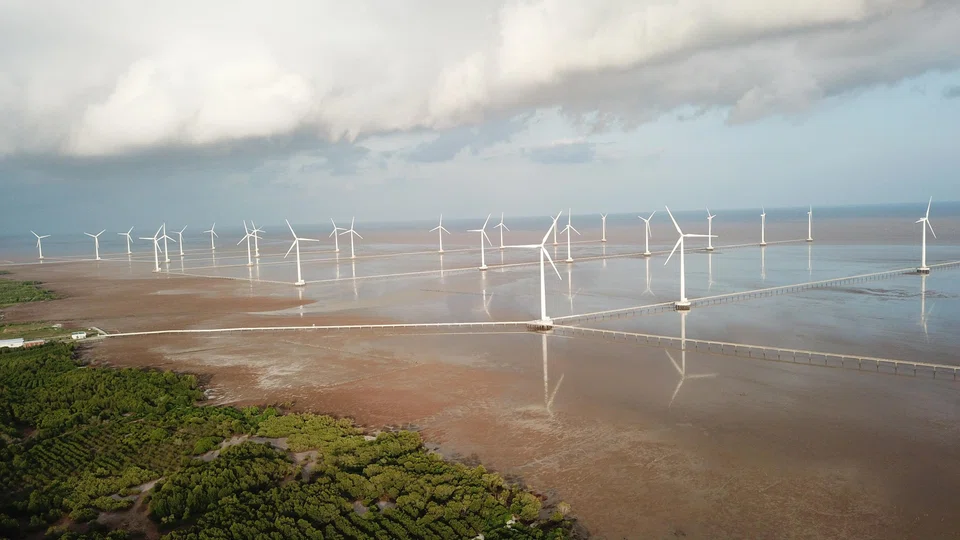
    The scale of such energy demands will further imperil efforts to fight climate change. At the heart of this conundrum is the growing tension between tech acceleration and environmental sustainability. The rush to ride the technology wave has imposed an added strain on the power grid because of the need for a reliable, scalable power source.

    For South-east Asia, the tropical climate further complicates matters by increasing cooling costs. This creates additional difficulties for economies such as Indonesia, the Philippines and Vietnam that are already struggling to reduce their reliance on coal and fossil fuels.

    As it stands, existing renewable power capacity is unable to meet short and medium-term energy needs, and these needs will only expand and accelerate as countries deepen their embrace of technology. A key question confronts the region’s policymakers: Will the environmental sustainability agenda be sacrificed at the altar of the digital wave?

    There is no doubting South-east Asia’s ambitions to ride the digital wave. Whether regional states can do this successfully, however, will require them to navigate the trilemma of capacity, geopolitics and sustainability.

    Indeed, if they can build domestic capabilities while deepening cooperation with each other to create and strengthen a deep regional ecosystem in the face of great power competition and rivalry, and if they can do this without compromising on sustainability priorities, then South-east Asia could well find itself on the crest of this wave.

    The writer is dean and Wang Gungwu professor in East Asian affairs at the Lee Kuan Yew School of Public Policy, National University of Singapore

    This essay is part of New Global Order, a series which explores how the changing world landscape is reshaping business, politics and beyond.