Time to introduce a Japan, Korea-style value-up programme, to drive Singapore market’s next leg-up
This move may be a crucial part of the ongoing holistic approach to restoring the vibrancy of the local market

[SINGAPORE] When the S$5 billion Equity Market Development Programme (EQDP) was unveiled in February last year, I remember being rather surprised by the audacity of the move.
With hindsight, I should have seen it coming.
Less than two months before the announcement, at an event marking the 25th anniversary of the Singapore Exchange (SGX), Minister for Trade and Industry Gan Kim Yong had said that the Equities Market Review Group was studying how public funding could best be used to mobilise private sector funds to broaden liquidity in the local market.
There was also general agreement quite early on that efforts to revitalise the local market had to include a significant “demand side” element in order to be effective.
So, why was a big injection of public funds into the market not widely anticipated?
One reason is that the whole issue was clouded by the government saying more than once that it would not be appropriate for GIC – a key steward of Singapore’s national savings – to directly support the local market.
The review group had also avoided presenting any single initiative as a silver bullet. Instead, it took a holistic approach that also addressed the “supply side” of the equation – that is, drawing more quality listings to Singapore; and included a review of the regulatory framework for public listings.
Indeed, Gan’s statement about the review group exploring how public funds could best be deployed to revitalise the market was shrouded in a recitation of all the other initiatives that were being considered.
The idea of injecting public funds into the market was also carefully framed as a means to an end, and not an end in itself. “While there have been suggestions to channel sovereign monies into our equities market, it is not practical to rely on sovereign monies alone to sustain these funds and to support the equity market,” Gan said.
“Instead, any use of public funding has to catalyse commercial capital for trading interest in our equities market to be sustained over the long term.”
Mandatory “value-up” disclosures?
Last week, the government responded in a similar fashion to a call for another initiative to boost the market that many market watchers have been talking about – namely, the introduction of a value-up programme that encourages companies to disclose plans to enhance their profitability and market valuations, as Japan and Korea have done.
Louis Chua of the Workers’ Party said in Parliament on Feb 3 that 61 per cent of Singapore-listed companies are still generating a return on equity (ROE) of less than 8 per cent; versus 44 per cent in Japan and 24 per cent in Korea.
He added that 69 per cent of Singapore-listed companies have suffered a fall in market capitalisation over the past decade, based on research in early 2025. By comparison, only 14 per cent of Japanese companies saw their market capitalisations fall during the same period.
On the other hand, only 11 per cent of Singapore-listed companies have doubled their market capitalisations in 10 years, compared to half of Japan-listed companies.
“While we are asking the EQDP fund managers to deploy more than S$5 billion in capital and expect returns, our listed companies feel no compulsion to demonstrate commitment to improving fundamentals,” Chua said.
To address this, he said market regulators should institute mandatory value-up disclosure requirements immediately. “At the most basic level, all listed companies should conduct formal board-level assessments of capital costs, profitability and market valuation,” he said.
“Companies must then disclose quantified ROE and (return on invested capital) targets across medium to long-term time horizons and spell out specific plans with annual progress reporting.”
Chua also called for stronger governance and enforcement actions during his speech in Parliament. “Regulators should not micromanage. But regulators have to maintain standards that protect investor confidence, ensure fair and timely disclosure, and enforce meaningfully against wrongdoers.”
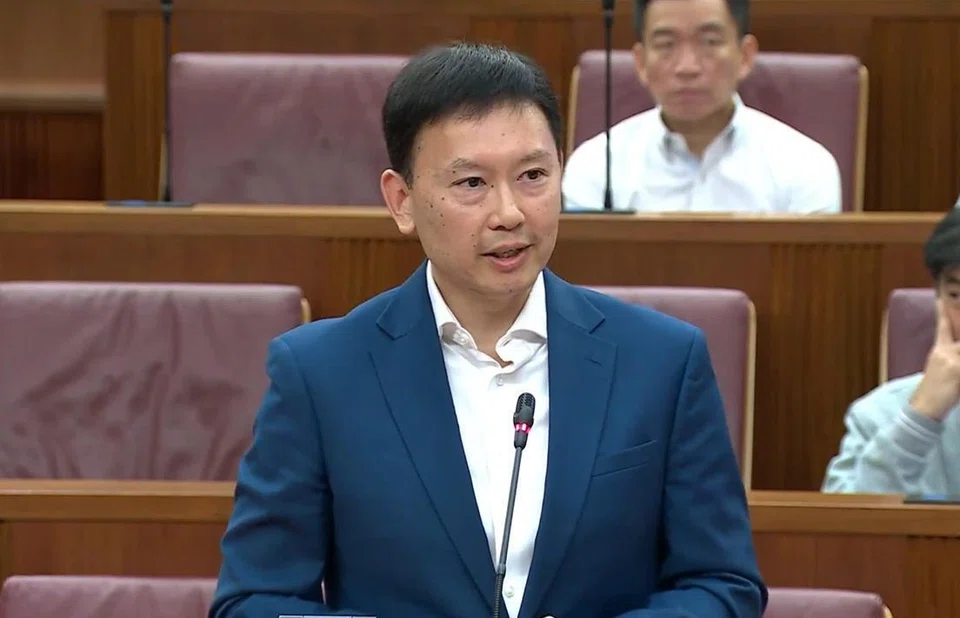
Minister for National Development Chee Hong Tat did not directly reject these views.
He said, “I take Mr Louis Chua’s point that some requirements may have to be mandatory and we are certainly open to looking at these examples, but I hope Mr Chua will agree with me that not everything that can add value to the company needs to be mandated, because companies themselves would have strong commercial interest to want to make sure they can increase their market value.”
Chee went on to reiterate the review group’s holistic approach to revitalising the market. “We are not trying to go for a silver bullet that can, on its own, solve all the problems. There is no magic pill. We are also not trying to ‘force’ outcomes through quotas or administrative allocation.”
He added, “We are building capabilities – in fund management, in listed companies’ ability to enhance shareholder value, to engage investors, by investing in market infrastructure – so that investors and issuers choose Singapore because they are convinced this makes commercial sense and this has longer-term strategic value for them.”
Crucial part of holistic approach
My understanding is that there were doubts last year about whether emulating Japan and Korea’s value-up programmes would necessarily draw a favourable reaction from the local corporate sector and investors.
But things may have changed since then.
In February last year – a couple of weeks before the EQDP was announced – the Straits Times Index (STI) was just beginning to breach the highs it had set back in 2007. This column pointed out then that the index’s gains were being driven by a narrow group of its constituents.
They included DBS, OCBC and UOB, which were enjoying elevated profitability and returning excess capital to investors; Hongkong Land and Singtel, which were actively unlocking value and repositioning their businesses; and Sats and ST Engineering, which had made bold, strategic investments.
Since then, investor enthusiasm has widened considerably. Last year, the STI chalked up a total return of 28.8 per cent, with only a single constituent in negative territory. The iEdge Singapore Next 50 Index achieved a total return of 26.7 per cent, with only six of its constituents at the end of the year in the red.
In 2025, securities daily average value in the local market rose 21 per cent to S$1.5 billion – its highest level since 2010.
The way I see it, adopting a value-up programme similar to that of Japan and Korea could now be the key to sustaining this bullish sentiment and driving the market’s next leg-up.
It would focus market attention on companies that are actively unlocking value and improving their profitability, and empower investors to push other companies to follow their example, leading to a self-reinforcing cycle of higher valuations.
While this move is not a silver bullet or a magic pill, it may be a potentially crucial part of the ongoing holistic approach to restoring the vibrancy of the local market.