Time to overhaul the education system
Now, more than ever, the skill our children need is resilience – to pick themselves up after they fail
SINGAPORE faces many challenges.
Geopolitical ructions and tariffs are forcing a rethink of trade and economic models, but the biggest upheaval, arguably, will come from technology. Artificial Intelligence (AI) threatens to make some university degrees obsolete and erase jobs. Graduate unemployment is already on the rise.
Singapore’s response
The Singapore government has one formula to tackle all challenges: resilience. We need a resilient economy (starting with a resilience task force!), a resilient work force, and future cohorts of resilient children.
But beyond the aspiration, what does building a resilient next generation entail?
Resilience is the ability to pick yourself up after you fail. It requires curiosity for new things, and adaptability when the first effort does not succeed. Individuals who develop differently must have space to thrive. The system must itself be agile, adapting to changing environments, technology and needs.
AI can already replace some human tasks. Technology will remember more content than students.
But human effort is needed to make sense of AI-generated data and determine its implications – that is, critical analysis. AI cannot predict human response; this is where interpersonal skills come in.
Large language models work on historical products, so there is room for human creativity and innovation. AI also cannot replace the human touch or personal connection. The future economy will pay a premium for people skills.
The education system must evolve to adapt to an AI-powered future.
Focus on academics
Among Asian families, education is still seen as the main determinant of a child’s future success. With fewer children, parents pour more of their resources, and hopes, into the kids they have.
From the child’s birth, parents apply for the best preschools, save for a home near top schools, and plot the child’s future subjects and co-curricular activities (CCA) for a place in the best university.
“Top” schools and “best” universities are determined largely by the academic scores of their students. They are thus incentivised to focus on academics, and groom pupils with scholastic potential. This focus on examination results means parents pack their children’s schedules with enrichment classes.
The primary school years should be filled with discovery, play and developing social skills. But children have little head space for imagination and creativity, and less time to make friends at play.
CCAs were originally designed to build physical, creative and social skills. In my day, I could try different sports and activities. These days, to secure direct admission to a good secondary school, children have to choose their CCA early, and commit to it – or risk losing “points” that affect their chances of admission. Preschoolers are hot-housed in sporting academies because only those with potential are selected for the coveted CCAs.
CCAs are picked based on that school’s track record, often forcing students to choose outside their skills and interests.
Achievement in CCAs becomes an added burden on the child – in time commitment and the pressure to excel. The system, well-meaning to start, has created unintended negative consequences.
In order to pay for this, parents work harder. Digital screens now play babysitter. Children interact through messaging, hampering the building of interpersonal skills.
This is more than a terrible childhood – it is not preparing our youth for the future.
Future-proofing our country
The system needs a new design that all its stakeholders get behind.
First, let us allocate time to playing, trying new things, and giving children the headspace to let their imagination roam free. Creativity and entrepreneurship will be next to impossible to nurture in scholastic robots.
Schools must reduce heavy academic content, teaching enough to understand the topic, but leaving mental room to apply critical thinking. My husband, educated at Cambridge University, read a fraction of the cases I was prescribed at the National University of Singapore. He is a better lawyer than I am, in part because this system allowed him to understand, apply and critically analyse.
Second, make the CCA system less about scoring and more about experiencing. Give students the opportunity to try out different activities, rather than force them to be good at one. Discovery is its own teacher.
Next, allow different development pathways and timelines. Our system supports the gifted, but does not create the same opportunities for late bloomers, the neurodivergent or those with skills and interests outside their school’s core focus.
Having fewer national-level exams that lead to streaming will give more space to develop.
The Ministry of Education (MOE) will have to kill some sacred cows. But the stakeholders to make the biggest change will be the parents.
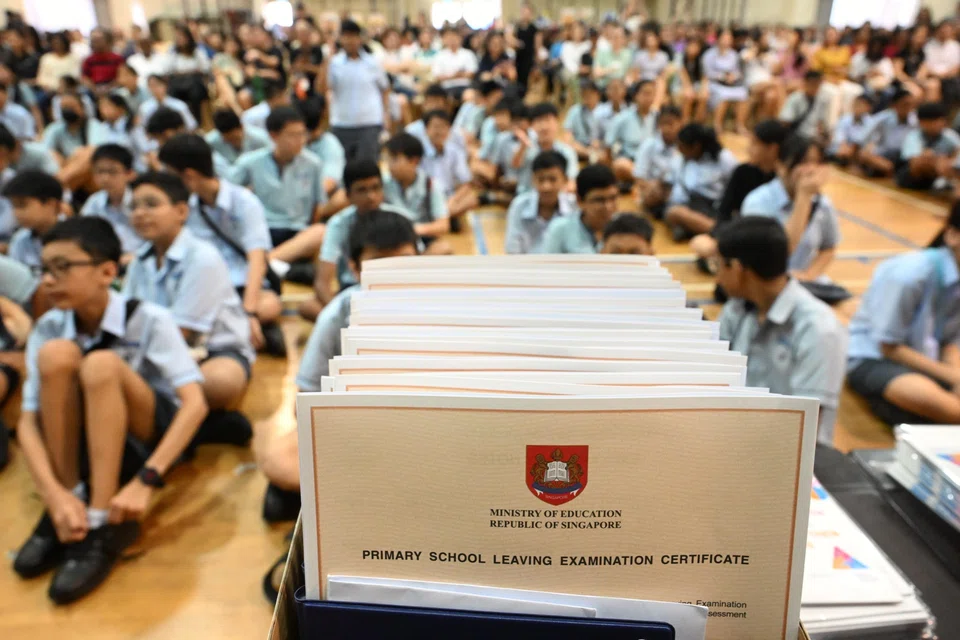
When MOE rolled out a programme for learning through purposeful play, parents complained about wasting time. Discussions to scrap the Primary School Leaving Examination to reduce focus on examinations have also drawn ire.
The anxiety parents feel is understandable. You cannot control the world your child will inherit, so you try to equip them for it. What parents need to realise is that the content their children are absorbing will be replaced by machines, and the pressure to achieve awards and top grades may be holding back their kids from skills and experiences that they will need in adult life.
The operating environment of the future will be uncertain and constantly changing. Individuals whose lived experience is not linear, who know what it is to fail and make a comeback, and who are adaptable to different environments, are the ones with the needed survival skills. They will cope better than the straight-A student because acing exams is no longer the path to career success.
Children will gain more from the occasional defeat than the repeated win, and learn more from trying multiple things than focusing on just one discipline. The education system must not just allow this; it must encourage it.
Singapore Minister for Education Desmond Lee summed up what an AI-transformed world needs: we “must teach beyond disciplines, by providing opportunities for self-discovery, resilience-building, and interdisciplinary solutioning for real-world challenges”.
Let us start with the education system.
The writer is joint managing partner, TSMP Law Corp
TRENDING NOW
Three ex-employees of Envy group join Ng Yu Zhi in bankruptcy
He built the Vingroup empire. Now South-east Asia’s richest man is handing some key roles to his sons
Grab CEO’s wife Chloe Tong on life with Anthony Tan and finding her purpose
Incidence of civil servants buying property near unannounced MRT stations ‘a concern’, but may not establish misconduct: PSD