

Time to revamp and relaunch the STI?
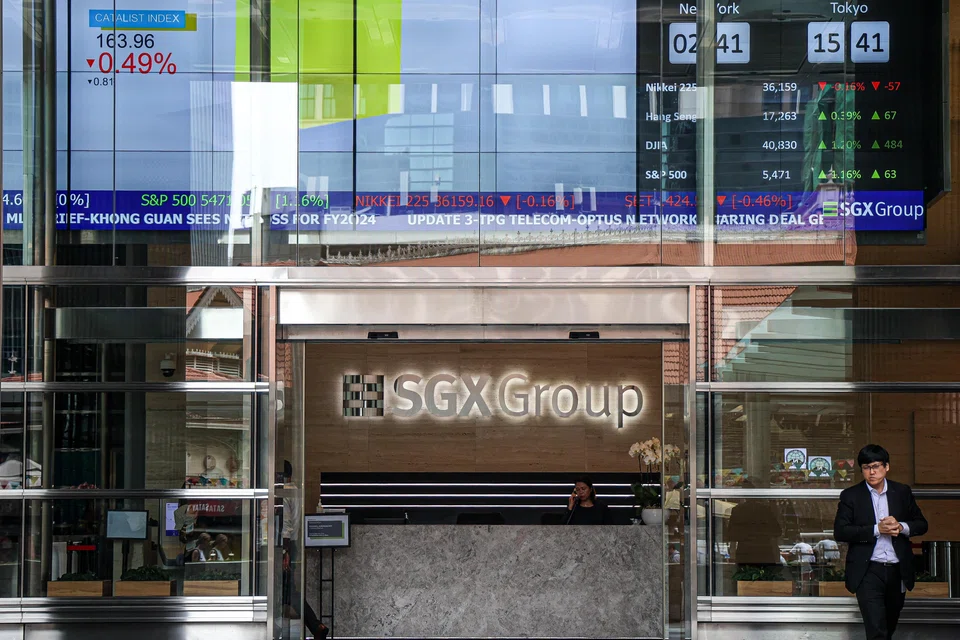
IT WOULD not have escaped the attention of those who watch developments in the local stock market that the Straits Times Index (STI) owes most of its rises over the past few years to the record-breaking gains in the three banks.
In fact, for many days in November as the STI broke above 3,600 and then 3,700, setting fresh 17-year highs along the way, the broad market actually weakened, recording more falls than rises each day.
This is because as at Oct 31, the combined weighting of the three banks was 51 per cent, followed by property at close to 17 per cent. This means that these two sectors account for two-thirds of an index whose 30 components cover about two-thirds of the whole market.
This raises the issue of whether the index in its current form truly represents the local stock market and whether there is a need to change the criteria for calculation and inclusion so as to generate interest in more sectors.
There’s also the question of sufficient diversification since anyone buying the index today is actually heavily concentrated in one or at most two sectors.
In the 1970s, the benchmark was called the Straits Times Industrials Index, comprising 30 manufacturing stocks. At the time the thinking was the index had to represent the economy, which in the 1970s and 80s was heavily reliant on manufacturing as the country industrialised.
In 1998, the word “Industrials” was dropped, the number of stocks was raised to 50 and price-weights were replaced by market-cap weights.
New entrants were the Jardine group, which at the time had just listed here after leaving Hong Kong ahead of the 1997 handover to China, as well as banks and property.
The logic was that since the exchange was positioning itself as an Asian gateway, the index should reflect the market and not only the domestic economy.
The new STI was therefore designed with two main criteria in mind – size, so as to capture a significant portion of the market; and liquidity, which was taken as proxy for market interest. It was then streamlined in 2008 down to the present 30 components.
The problem is with banks and property already accounting for around 68 per cent of the index, this leaves little room for the other sectors.
The question that should be asked, both by index providers and the committee set up to study ways to inject more interest in local stocks, is whether to stick with the STI in its current form with such a lopsided dependence on the banks and property, or to revamp it to ensure broader coverage and adequate diversification.
It might be useful to study the 2021 changes to the Hang Seng Index, which included increasing the number of components progressively from 52 to 80 and eventually 100; limiting all individual constituents to a weight of only 8 per cent (so that individual stocks cannot dominate); and picking constituents by industry group based on target coverage and also with the goal of achieving market capitalisation coverage of not less than 50 per cent for each industry group.
The changes were aimed at bringing in “new economy” firms in technology and healthcare, while reducing the dominance of heavy-weighted sectors, namely the banks.
Given the disproportionate effect exerted here mainly by banks but also property, maybe it’s time the STI underwent a similar makeover.
TRENDING NOW

Once staunchly pro-China, Malaysian Chinese businesses are now distancing themselves from Beijing
AI can become superior to humans in certain aspects: TikTok’s Chew Shou Zi

DBS, OCBC, UOB face rate hike reality check

‘The market has spoken’: DBS CEO Tan Su Shan says market is repricing AI financing risks

