

Too afraid to quit? Welcome to job hugging
Amid economic uncertainty, employees are staying put for stability and security. What does this mean for employers?


[SINGAPORE] Forget about the Great Resignation. These days, “job hugging” is in vogue, with resignation rates hitting record lows.
The term, likely coined by Los Angeles-headquartered consulting firm Korn Ferry, refers to when employees “(hold) on to their jobs for dear life” – typically out of caution and a desire for security, rather than genuine loyalty.
What makes this different from other periods of stagnation in the labour market is that this holding pattern is driven by a sense that global events are “unpredictable and unprecedented, combined with looming AI (artificial intelligence) disruption”, writes Korn Ferry senior client partner Matt Bohn in an article.
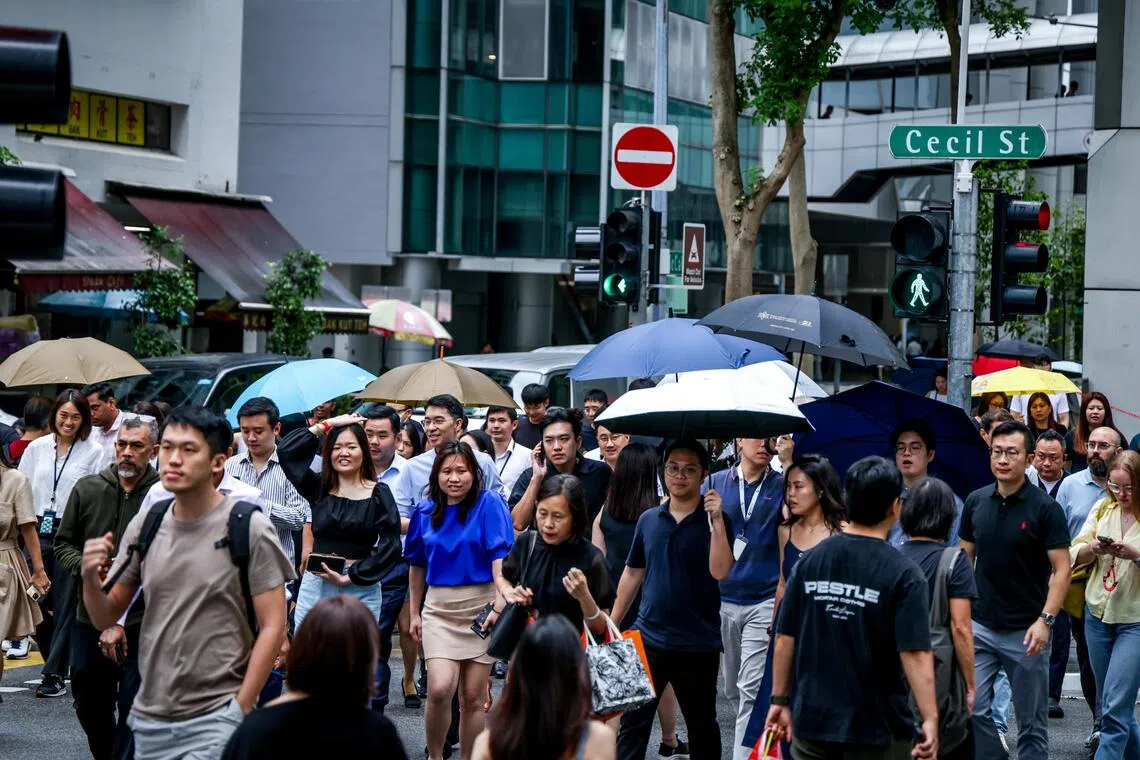
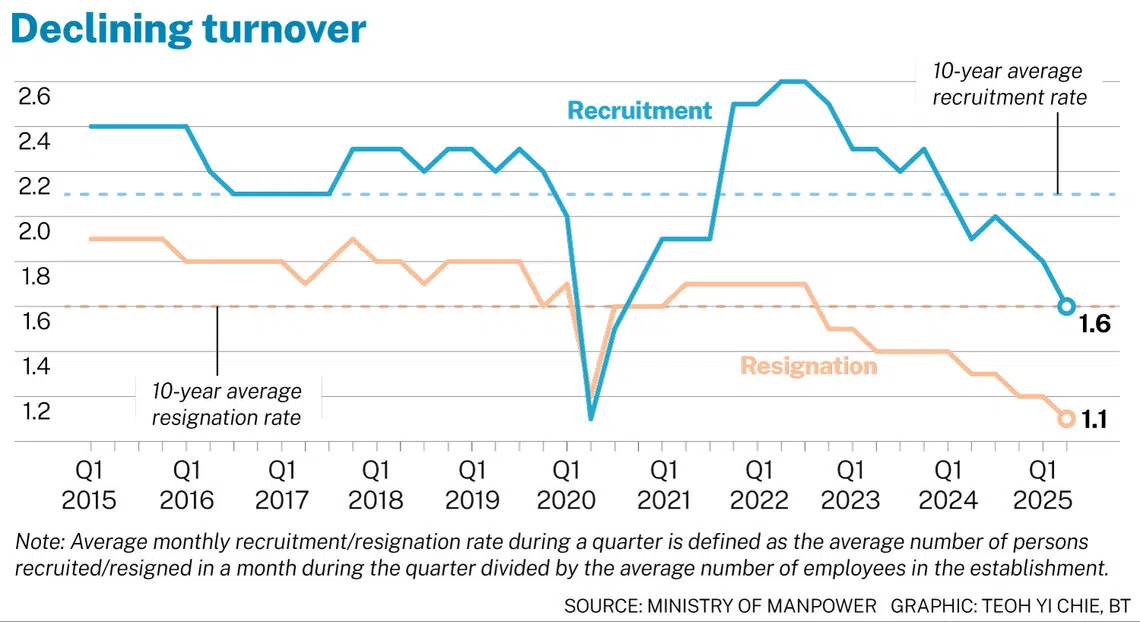
The trend appears to have taken hold in Singapore too, with turnover rates on a downtrend since the highs of 2021 and 2022.
The average monthly resignation rate hit 1.1 per cent in the second quarter of this year on a seasonally adjusted basis, data from the Ministry of Manpower (MOM) showed. This marked the lowest level since the ministry started tracking resignation rates in 1998.
Meanwhile, the average monthly recruitment rate in Q2, at 1.6 per cent, was just a notch higher than the record low of 1.5 per cent clocked in Q3 2020, at the height of the Covid-19 pandemic.
In comparison, the average resignation rate over the past decade was about 1.6 per cent, while the average recruitment rate was 2.1 per cent.
Recruiters tell The Business Times (BT) the numbers reflect a moderation in the wake of the post-Covid hiring spike.
At the time, many companies were facing a shortage of skilled workers, and businesses were struggling to recruit amid lockdowns and other policy fluctuations. The tech sector, in particular, was on a hiring spree as demand for digital services surged during the pandemic.
“Today, with market volatility and shifting global trade dynamics, businesses are prioritising efficiency and resilience,” says Nilay Khandelwal, senior managing director for Singapore and India at recruiter Michael Page.
“Leaders are taking a precision approach to hiring, focusing on critical skills rather than headcount expansion amid economic and policy uncertainty.”
Rahul Chawla, partner and head of talent solutions for South-east Asia at consulting firm Aon, says that as employers take on a “conservative ‘selective’ hiring stance” across the Asia-Pacific region, workers also hesitate to switch jobs, knowing that replacement hiring is “highly targeted”.
Many companies are redeploying existing employees and investing in upskilling, which reduces the need for external recruitment, he adds. At the same time, the adoption of AI and automation has enabled companies to increase productivity without adding more headcount.
David Blasco, country director at recruiter Randstad Singapore, says that companies are restructuring in response to ongoing AI disruptions and rising cost pressures amid the cautious global outlook.
This, says Kirsty Poltock, country manager of headhunter Robert Walters Singapore, leads to the fear of “last in, first out” that workers are looking to avoid.
While retrenchment figures have been fairly stable, hovering around 3,500 per quarter this year, recent high-profile layoffs across different sectors have been unnerving for potential jobseekers.

“Quiet” job market
Samantha (not her real name), a middle manager in the communications industry, tells BT she’s holding on to her job for now given the economic gloom.
She has been thinking of looking for a new job since her workload increased sharply a few months ago, but is reluctant to quit without a job offer on hand.
Samantha declined to be named for fear of reprisal at her workplace.
“I am not able to change my job as the job market has been very quiet,” she says. “There are not many relevant job postings available for us to choose from.”
This, she adds, has been a “common observation” among her friends who have been job hunting – some for as long as seven months.
Employee sentiment surveys align with Samantha’s experience.
Four in five Singapore professionals say fears around job security are preventing them from changing jobs, a survey by Robert Walters showed last week.
The survey also found that factors that have the biggest impact on their decisions to switch jobs include inflation, unemployment rates and gross domestic product growth.

A separate study by Randstad released in June found that the appetite for job-switching fell to 31 per cent this year, from 34 per cent last year. Those that said they switched jobs fell to 17 per cent, from 19 per cent.
From the Great Resignation to job hugging
It’s a marked change in mood from just four years ago.
Coming out of the pandemic, more people were ready to call it quits in what was then known as the Great Resignation. The life-altering and mentally draining pandemic had prompted a rethink of their priorities and purpose in life.
The following year, as people sought better work-life balance, “quiet quitting” gained prominence in response to pandemic-related burnout and overworking.
And now, amid the tariff-led economic uncertainty, quiet quitting has evolved into “job hugging”, says Swechha Mohapatra, assistant director for professional practices and certification at the Institute for Human Resource Professionals (IHRP).
Such employees stay in their roles, “often disengaged but unwilling to risk change”, she says. They see job security as a form of protection, as trade frictions and geopolitical instability dampen business confidence.
“Rather than seeking new roles in an unpredictable market, many are choosing the familiarity of their current positions, even if they feel unfulfilled, reflecting a preference for security over mobility,” she adds.
Fears around AI
Beyond the economic uncertainty, some watchers believe fears surrounding the ascent of AI could discourage job-switching to some extent.
In Michael Page’s Talent Trends 2025 report, 42 per cent of the 640 professionals surveyed in Singapore said they consider generative AI to be “a threat to job security”. Two-thirds expect it to “impact their long-term career plans”.
As AI and automation transform roles, particularly those involving routine tasks or at junior levels, Poltock believes workers may prefer to hold on to roles that are becoming harder to replace or upgrade.
“Fears of job disruption from AI can also lead to ‘job hugging’, where employees stay longer in their current roles to avoid uncertain transitions,” she said.
Unsure which jobs are “safe” from being eliminated by AI, Mohapatra says some workers also fear taking up a new position that may soon be automated or redesigned.
However, Singapore University of Social Sciences associate professor of economics Walter Theseira says there could be other reasons for the long-term trend of lower resignations, including broader changes in labour force dynamics and structure, particularly the rise of flexible forms of work and task contracting.
As short-term renewable contracts replace permanent contract positions, labour turnover often results from the non-renewal of a contract rather than outright resignation, he notes. With outsourcing and task-based work, one cannot “resign” from a task as it is not under an employment contract.

Unclear if AI impacts recruitment
Where recruitment is concerned, some watchers point out that it is unclear if the lower rates truly reflect the full impact of AI, since it is still early days.
Prof Theseira says recruitment data could also be affected by general outsourcing and the rise of flexible task-based work.
“While the recruitment rate has certainly fallen more sharply in recent years, it’s also hard to determine if this is ‘AI’ versus other factors such as post-Covid labour structure corrections, uncertainty resulting from changes to the global supply chain caused by the Ukraine war and Trump’s economic policies,” he says.
Concurring, Blasco believes lower recruitment rates are more strongly influenced by broader economic factors such as cost pressures and productivity demands.
“Additionally, many multinational companies are realigning their operations, including offshoring certain functions, which may also reduce entry-level roles locally,” he adds.
Chawla says Aon’s studies have found AI reshaping roles rather than eliminating them, and AI roles can carry “significant cash pay premiums”.
“(The) median pay for AI roles is about 54 per cent higher than other technology jobs and about 60 per cent higher than all jobs overall, signalling robust hiring appetite for AI-adjacent skills,” he says.
The biggest job huggers
Nonetheless, recruiters say mid-career professionals are most likely, among others, to job hug.
Mohapatra says that for many, staying put “offers a safer path to ‘future-proof’ their careers through upskilling and internal mobility, rather than taking risks in an uncertain job market”.
Blasco says that middle-management professionals also often have ongoing financial commitments and are more likely to prioritise job security.
“They face a complex environment where digital disruption and cost pressures may heighten their fear of instability,” he says. “Their higher salaries can make them targets for cost-cutting, and age-related biases could also impact their ability to secure new positions quickly.”
Poltock says workers in sectors experiencing slower technological disruption or those with longer tenures – such as government, education or certain healthcare roles – also tend to stay longer in their jobs.
Citing Aon data, Chawla says that, conversely, technology and sales remain among the hardest-to-fill groups in South-east Asia, implying relatively less stickiness at the top of these groups.
Wider impact
Labour turnover rates may offer a snapshot of the health of the economy.
Resignation and recruitment rates tend to be high when job openings are plentiful, reflecting movement of workers between jobs, says MOM on its website. Conversely, the rates tend to be low during periods of economic downturn.
Prof Theseira says both high and low amounts of labour churn may reflect underlying economic problems.
With low churn, there may be excessive rigidity in businesses and processes, whereas high churn could lead to an inability to develop skills and competencies.
“However, the link between labour churn and these potential issues likely has been weakened in recent years due to the significant rise of flexible and outsourced work, which is invisible to standard labour market statistics,” he says.
Still, as more employees hang on to their jobs, the need for employers to hire is reduced too, creating a vicious circle that ultimately leads to fewer vacancies.
Recruiters say this can make the job market more competitive for jobseekers, particularly new entrants.

Higher retention rates not quite a boon
In theory, lower resignation rates indicate higher retention rates – and that should be good news for employers.
Yet, that is not necessarily the case, watchers say. While lower resignation rates protect continuity and institutional knowledge, they can also conceal disengagement.
Poltock says the reduced churn may also imply decreased opportunities for internal mobility and innovation, as stagnant teams can lead to complacency and a lack of progress or fresh perspectives. In the long term, this can negatively affect organisational agility and employee engagement.
Blasco says organisations typically prefer lower turnover rates since they reduce the costs for recruitment and onboarding.
“However, that should not be the only measurement of outcome as employees may be choosing to stay put but are neither productive nor happy,” he says.
“Companies should also measure outcomes like productivity levels and employee sentiments to truly assess the workforce and take action on how they can upskill and improve work-life balance for their employees.”
Mohapatra says that, for employees, longer tenures can bring depth and stability, but they may also limit exposure to new skills and slow wage progression.
Khandelwal, meanwhile, says “staying compounds impact” when a role aligns with the employee’s aspirations and offers visible growth. “When those conditions fade, moving becomes viable, internally first, then externally if needed.”
For those who remain in the same role for extended periods without clear development pathways, Blasco says they could risk stagnation, leading to skill gaps that limit their growth and eventually pose challenges if they need to re-enter the job market.
“Employees should regularly seek opportunities to take on new projects and responsibilities to upskill and stay engaged,” he adds. “Working on new assignments can help develop skills that can contribute towards career progression within the organisation.”
TRENDING NOW

DBS remains analysts’ pick ahead of Q3 earnings after Singapore banks’ share slump

Singapore identifies 7 firms responsible for haze fires, notices issued urging action: Grace Fu

Good Class Bungalow market activity picks up pace on ‘realistic’ pricing

High Court rules against Julius Baer’s Singapore trust arm in US$50 million family trust dispute

