

Tories pay the price for the harms of Brexit
The Conservative government has damaged Britain’s most important trading relationship – and hurt itself immensely in the process.
MOST of the time, trade is an arcane subject only of interest to trade specialists and assorted business lobbies – and, of course, the editors of The Economist. But every now and again, it shifts from the far periphery to the molten core of British politics. This happened in the 1840s with the abolition of the Corn Laws, in the 1900s with the advent of imperial preference, in the 1970s with Britain’s entry into the European Common Market, and then again in 2016 with Brexit.
For the first six years of this Conservative government, the question of Britain’s withdrawal from the European Union was a hobby horse of has-beens and monomaniacs. Then prime minister David Cameron told his party to stop “banging on about Europe”.
But Cameron’s decision to concede an “in” or “out” vote to the eurosceptics in 2016 – a vote that he thought he would easily win – turned trade, in the form of Britain’s trading relationship with its biggest trading partner, into the defining issue of the Conservative’s years in power.
The Brexiteers made a succession of bold promises about Brexit. That it would be the easiest trade deal in history. (The deal was supposedly “oven ready” with Britain holding “all the cards”.) That goods and services would continue to flow easily between Britain and the EU. That Britain would be able to strike innumerable trade deals with the rest of the world. And that a great trading nation would be better off outside the EU than inside.
I remember a surreal interview I conducted at the 2018 Conservative Party Conference with Bill Cash, the grand old man of Tory euroscepticism, in which he explained the many advantages of Brexit, while a group of fishermen serenaded us with sea shanties.
How do these promises stack up?
Far from being “easy”, forging a trade relationship with the EU has proven to be a nightmare. The Brexiteers were infuriatingly vague about what a “no” vote meant. Did it mean continued membership of the single market? Or the customs union? They failed to consider the complexities of Northern Ireland – a tortured part of Britain which has a long land border with the EU. Sorting out these “details” has torn the Conservative government apart.
Withdrawal from the EU has inevitably led to the reintroduction of barriers at the borders: passport inspections, customs checks, import duties, health inspections on plants and animals. The British have to queue at long “other countries” lines at airports. Lorries are held up at Dover and other ports. Businesses have to deal with a lot more form-filling – a solvable problem for big companies but a potentially existential one for smaller ones.
An Office for National Statistics survey of businesses from early 2024 discovered that around half of exporting firms and two-thirds of importing firms reported extra costs associated with changes in regulations.
Britain has also found it much more difficult to forge trade deals with non-EU countries than it had expected.
Most new trade deals simply replicate existing EU arrangements, meaning a great deal of running simply to stay in the same place.
The two genuinely new deals, with New Zealand and Australia, are only expected to deliver a tiny boost to trade. The much-vaunted trade deal with the United States has eluded Britain despite Donald Trump being in the White House for four of the post-Brexit years (even a cursory look at US trade deals would have told the Brexiteers that, first, such deals take a long time, and, second, the US always plays hardball).
What about the biggest question of all – boosting the overall British economy? This is surprisingly difficult to answer.
Britain didn’t formally leave the EU until the end of January 2020 and, even then, it remained in the customs union and the single market for a “transition period” until the end of 2020. This prolonged leave coincided with a global pandemic that shrunk trade around the world and was then followed by an energy crisis produced by Russian President Vladimir Putin’s invasion of Ukraine.
That said, the latest figures suggest that withdrawal has been the very opposite of the growth-booster we were sold.
Yes, Britain’s trade has recovered after the pandemic just like global trade in general. But, the Office for Budget Responsibility (OBR) notes that UK trade intensity (exports plus imports as a share of gross domestic product) has not recovered in line with the rest of the G7. In the third quarter of 2023, UK trade intensity remained 1.7 per cent below its pre-pandemic level for 2017, whereas it rose by an average of 1.7 per cent above pre-pandemic levels in the rest of the G7.
The OBR calculates that the country’s productivity will be 4 per cent lower than it would have been had Britain remained in the EU, translating into a lower standard of living than we would otherwise have enjoyed and worse public services.
What will happen to Britain’s relationship with the EU in the future is far from clear. Both main political parties have been surprisingly quiet about Brexit during the current election.
The Conservative Party’s silence is as understandable as it is contemptible: it has nothing to boast about and a great deal to explain away. The Labour Party is in the odd position of treating Brexit as a disaster but refusing to undo it on the grounds that it must honour the will of the British people – a will that polls suggest has changed since 2016.
But not talking about Brexit doesn’t mean it will have no impact.
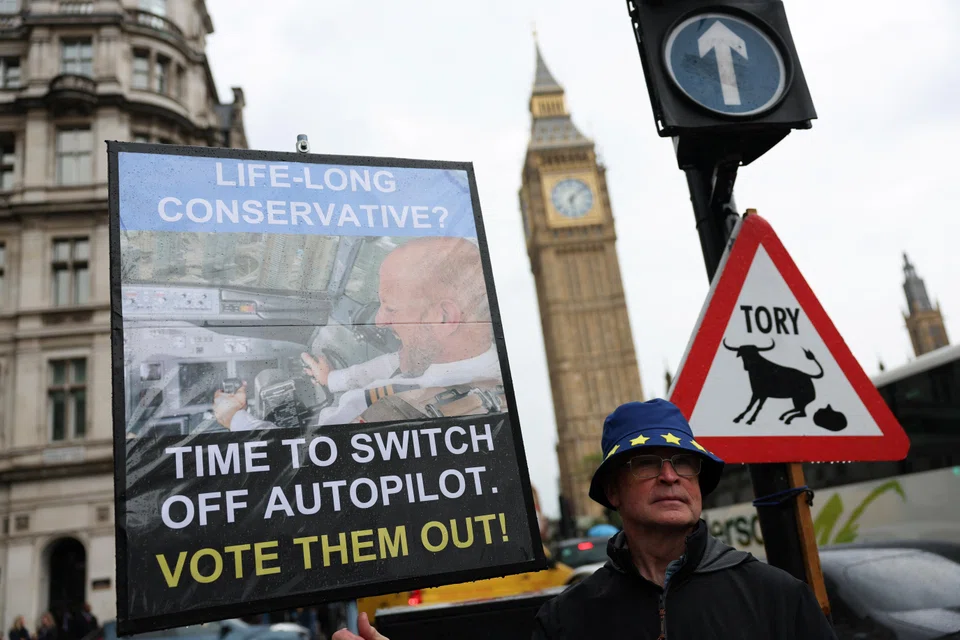
Given both the state of the polls and the Conservatives’ shambolic campaign, the most striking short-term effect of Brexit will not be on trade, which changes slowly, but on politics. The party that gave birth to the policy and then tore itself apart trying to understand what it meant, is about to experience a humbling and perhaps catastrophic defeat.
TRENDING NOW

ComfortDelGro appoints two new independent directors

Once staunchly pro-China, Malaysian Chinese businesses are now distancing themselves from Beijing

NoonTalk needs continued financial support from CEO Dasmond Koh, auditors warn

DP Architects sets the benchmark for sustainability disclosure and design

