

Transatlantic ties are topsy-turvy under Biden
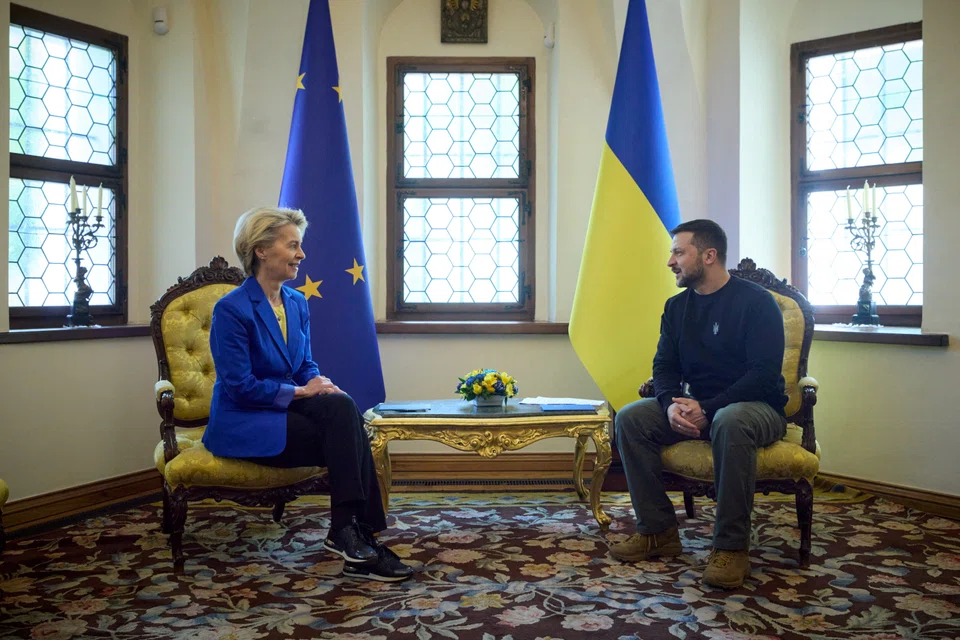
THE English term ‘topsy-turvy’, coming from the phrase ‘upside down’, is a potentially apt description of Europe’s relations with the United States under the Biden administration, as Washington and Brussels prepare for a summit this Friday (Oct 20).
To be sure, transatlantic ties with the US have improved dramatically, overall, since the end of the Trump presidency with significant cooperation, for instance on defence and security issues, such as the Ukraine war.
However, there have been significant tensions in some policy areas, including over the US Inflation Reduction Act (IRA).
IRA is the massive US$370 billion package for clean tech, which poses a potentially major risk for the European Union’s goal to remain a pre-eminent global centre for the green industrial revolution. There is a growing sense in Europe that its edge in this ‘race’ is imperilled by the assertive green industrial strategy of the US.
While these dynamics have defined transatlantic ties for the past year since the IRA’s passage, there has been a potential flipping point in recent weeks. For while the US and Europe remain aligned on Ukraine, there are growing concerns over Washington’s medium-term ability to finance Kyiv amid the great political dysfunction in Congress. At the same time, there are some signs that US and EU decision-makers are bridging differences on IRA and other key economic issues.
Turning to Ukraine first, there is new uncertainty over Ukraine’s war effort given that fresh US funding for Kyiv has been put on hold as part of a recent deal struck by the Biden team with congressional Republicans to avert a US government shutdown. In recent weeks, even US President Joe Biden has admitted that amid political gridlock in Washington it “does worry me” that US support for Ukraine might get derailed.
In this context, EU foreign policy chief Joseph Borrell has warned Ukraine that – while support for Kyiv will remain steadfast in Brussels – Europe will not be able to fully fill any funding gap left by the US. Borrell said that the recent political developments in Washington “were certainly not expected and are certainly not good news”.
The best case scenario for Ukraine, as European Commission president Ursula von der Leyen has set out, is that recent US political dramas only delay, not totally derail, US financial support for Kyiv, with the challenge just a question of “timing” for Washington. So the EU has moved to bring forward around half its previously promised aid to Ukraine – 50 billion euros (S$72 billion) over the next four years – to give Kyiv more “predictability and reliability” for its strained finances.
As concerns grow about US commitment to Ukraine, with the approaching 2024 election, transatlantic ties appear potentially on the verge of better times on IRA and wider economic issues to accelerate the global clean energy economy based on secure, resilient supply chains, and deeper cooperation in critical and emerging technologies, including digital infrastructure and artificial intelligence.
For instance, Brussels and Washington are discussing an agreement on critical minerals that will allow European-based companies to have access to certain IRA subsidies, if they provide part of the raw materials needed back in the US for manufacturing processes. This would replicate a similar US deal that was agreed with Japan.
At the same time, both sides are reportedly also deep in negotiations on a so-called Global Arrangement on Sustainable Steel and Aluminium to reach an agreement before an upcoming deadline.
If this is not reached beforehand, US and EU tariffs on steel and aluminium would potentially come back into force, according to the provisional bilateral agreement reached in October 2021, which relates back to original measures in 2018 when then-president Donald Trump imposed tariffs on European imports.
That said, if the two powers get close enough to the finishing line of a deal before the deadline, it appears increasingly possible the current tariff truce could be extended. That extension could potentially even last through the next 2024 US presidential election cycle.
The transatlantic allies are reportedly discussing an agreement that would see a ‘grand bargain’ on these issues which would end some or all existing US and EU tariffs on steel and aluminium imports.
Leaked documents indicate one headline idea to do this is the potential creation of a joint tariff zone of like-minded nations that will impose duties on steel, aluminium and potentially clean tech imports from high carbon-intensive, non-market economies such as China with excess capacity.
The club approach may eventually be open to other partners, including Japan. However, no such countries would join immediately, according to reports.
This club idea may ease transatlantic tensions. However, it may not be welcomed by a significant number of steel-producing countries which may bring Brussels and Washington to court at the World Trade Organization.
If the agreement eventually comes to pass, it would potentially create the political space for US and EU policymakers to try to find compromises too on the EU’s recently introduced Carbon Border Adjustment Mechanism.
There is no agreement yet on how US steel companies will deal with the new policy whereby European importers pay duties corresponding to the cost of emissions generated in production.
Overall, what Europe is seeking here, instead of competition in this area with the United States, is a more cooperative framework.
This comes amid fears that the IRA discriminates against firms exporting to the US, threatening to lure a critical mass of European-based firms, costing jobs and shuttering factories in the green tech sector.
This cooperation might be akin to that agreed earlier this year between von der Leyen and Canada’s Prime Minister Justin Trudeau that has been depicted as an EU-Canadian ‘Green Alliance’.
Europe is looking to Canada as a minerals-rich country, including potash, palladium, niobium and uranium. With Europe heavily dependent on sourcing raw materials, including from China, it is looking to reduce this dependency with trusted partners, including Canada.
It is not just Brussels driving this, but individual EU member states too. Last year, for instance, Germany reached an agreement with Canada that will see the latter export hydrogen from 2025.
Taken together, transatlantic ties are therefore at a crucial stage. The bilateral relationship will be stabilised if Washington and Brussels can agree to new accords in areas such as critical minerals, steel and aluminium, but new uncertainty could be injected into the partnership if US funding for Ukraine dries up as the 2024 election year nears.
The writer is an associate at LSE IDEAS at the London School of Economics
TRENDING NOW

First Resources blames El Nino, outside fires for Kalimantan hotspots amid haze scrutiny

High Court rules against Julius Baer’s Singapore trust arm in US$50 million family trust dispute
Singapore key exports jump by higher-than-expected 68.4% in September, led by non-electronics

MSCI proposes downgrading Indonesia to standalone market status

