Trillion-dollar Ukraine reconstruction issue back on radar

Many Western leaders think that a failure to rebuild could have profound consequences not just for the nation, but also for the broader region
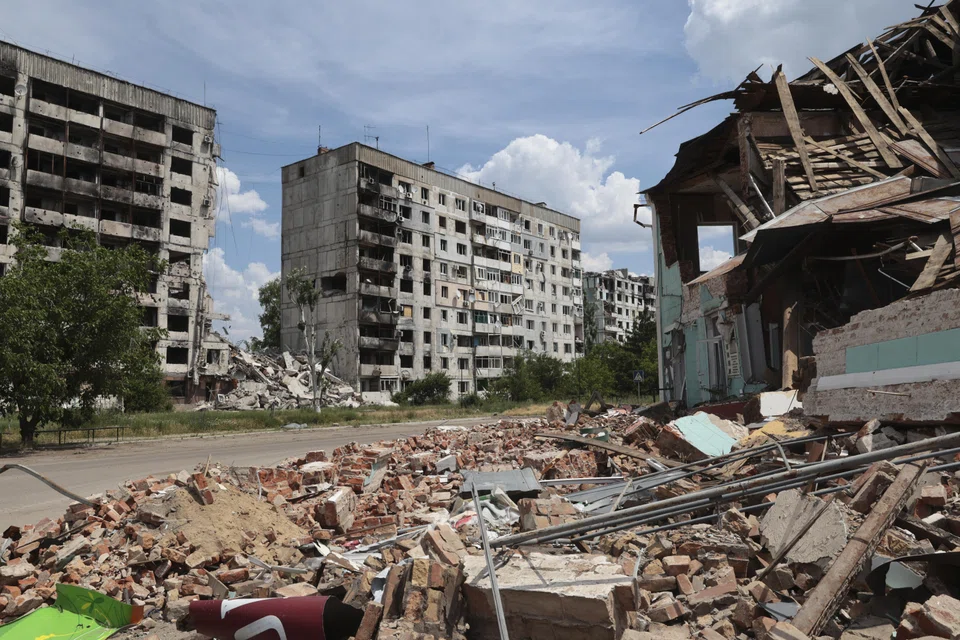
    • Buildings damaged by shelling in Orikhiv, Ukraine. The country has released a  recovery plan for not only rebuilding but also transforming itself.
    • Buildings damaged by shelling in Orikhiv, Ukraine. The country has released a recovery plan for not only rebuilding but also transforming itself. PHOTO: EPA-EFE
    Published Thu, Jun 13, 2024 · 05:00 AM

    WITH Russia gaining territory in Ukraine in recent months, the potentially more-than-a-trillion-dollar issue related to Ukraine’s reconstruction had slid off the global economic and political radar.

    There is increasing talk of Russia keeping a significant slice of the nation, as Peter Ricketts, a former UK ambassador and national security adviser, recently highlighted. He believes that there is a growing possibility of a Korea-style scenario with Russia keeping control of at least a fifth of pre-war Ukraine, and the remainder moving in a pro-Western direction in the years to come.

    This is part of the reason why Western leaders, including German Chancellor Olaf Scholz and European Commission President Ursula von der Leyen, hosted a two-day Ukraine Recovery Conference with Ukrainian President Volodymyr Zelensky, in Berlin this week. The goal was to frame the leadership discussion at the G7 meeting in Italy, and also a global peace summit in Switzerland this weekend.


    In Berlin, the European Union announced multiple new big financial commitments, building from the some-US$100 billion that the 27-member bloc has already provided in financial, humanitarian, emergency, budget and military support to Kyiv. The new announcements on Tuesday (Jun 11) included signed agreements worth US$1.6 billion with partner banks to attract private-sector investments in Ukraine; delivery of an additional US$2 billion from the EU’s Kyiv aid facility by the end of June; and more than US$500 million for urgent repairs to Ukraine’s energy sector through the Ukraine Energy Support Fund.

    Zelensky told the conference on Tuesday that, in the coming months, Ukraine badly needs equipment for heating and electricity plants that are currently out of action. According to the president, 9 gigawatts of electricity-generating capacity has been destroyed, including 80 per cent of thermal power and one-third of hydroelectric power.

    Almost 900 days into the Ukraine conflict, the hostilities show no obvious sign of ending in 2024. This is why leaders such as Scholz and Dr von der Leyen want post-war reconstruction to become more prominent on the political radar again, especially ahead of the G7 leadership summit in Italy this week (Jun 13 to 15).

    Many Western leaders view the international stakes of the nation’s rebuilding as so high that failure could have profound consequences not just for Ukraine, but also for the broader region, and the wider West to boot.

    Ukraine’s rebuilding will resemble that of Western Europe after the Second World War, Eastern Europe after the Cold War, and the Western Balkans after the break-up of Yugoslavia. It will cost over a trillion dollars, and be the most ambitious post-war reconstruction effort in the 21st century.

    So although the war rages on, Western decision-makers are now thinking more intently about these issues.

    Ahead of the G7 summit, for instance, Western powers are working on a plan to use the future income from US$300 billion in frozen Russian assets to boost funding for Kyiv. This includes a US proposal for its G7 partners to back a loan that could provide Ukraine with as much as US$50 billion in the near term.

    A number of security deals will be made at the G7 summit, the standout of which is a United States-Ukraine bilateral agreement. This will include commitments for prolonged military aid encompassing areas such as military training, the sharing of intelligence, and economic assistance.

    Beyond the question of money, however, is Western political strategy towards Ukraine. This is linked to the EU’s future enlargement, post-Russia’s invasion.

    The European integration process began in the 1950s, with the six founding members of Belgium, France, Germany, Italy, the Netherlands and Luxembourg, seeking to prevent another large war on the continent. In the decades since, the EU has steadily expanded, Brexit aside, while espousing the idea that economic and political integration among nations is the best way to promote general prosperity and peace.

    This approach paved the way for the creation of the euro currency in 1999, and also the accession in 2004 of 10 new member countries from formerly communist Central and Eastern Europe.

    In recent years, however, the enlargement process for nations such as Turkey and the Western Balkan countries has been much more challenging than was the case for Central and East European countries prior to 2004. This reflects “enlargement fatigue”, post the “big bang” expansion of 2004. Following the accession of Romania and Bulgaria in 2007 and the eurozone crisis of 2009-10, Brussels set stricter reform conditionality for accession states.

    With the process stalling for years, the rejuvenation of the enlargement agenda is now being driven by Russia’s invasion of Ukraine. In the period since, the European Council has sought to fast-track Ukraine’s potential accession.

    Dr von der Leyen said on Tuesday in Berlin that accession talks with Ukraine will start at the end of June, with Kyiv having fulfilled all the necessary reform requirements to enable it to become a member of the bloc. However, while there is much energy behind Ukraine’s bid in particular, EU enlargement is still a potentially lengthy process and French President Emmanuel Macron has warned that it could take several decades for Kyiv to become a full EU member.

    While the EU’s enlargement process may appear unrelated to Ukraine’s rebuilding, the two are actually closely linked in the eyes of many stakeholders. The EU accession process is widely expected to occur in parallel with reconstruction.

    In part, this is because of the acknowledgment of the need for wider political and institutional change in Ukraine following criticism prior to the war, including about corruption.

    Ukraine has released a National Recovery Plan (NRP) that lays out the country’s initial road map for not only rebuilding but also transforming itself. It is divided into three phases: immediate needs; medium-term needs; and longer-term needs for a modernisation phase into the 2030s.

    The first stage of this plan is therefore ongoing, including local authorities cleaning up and restoring key destroyed facilities. A later stage, which may be immediately after the end of mass hostilities, will be focused more upon recovery, including restoring more supplies of water, as well as providing housing. It will potentially be only after that that there can be a more fully fledged renewal of Ukrainian infrastructure and transport systems, which will be the most costly, longest stage.

    So while the war may last for a significant period longer, this week’s Berlin event, plus the G7 and Swiss conferences, shows that much activity is under way on the reconstruction agenda. Ukraine’s immediate-term future is still about survival amid the renewed Russian attacks and, until large-scale fighting ends, much of the massive reconstruction process will remain frozen.

    The writer is an associate at LSE IDEAS at the London School of Economics