

Trump inherited a strong America. That’s a weak Europe’s problem
The old world is especially unprepared for a protector turned rival
DONALD Trump’s inauguration speech was remarkable for many reasons, but what stood out watching from afar was the dissonance as he described a United States that was in existential decline and in need of rescue. In fact, America is in rude health, and its 47th president’s description was more apt for Europe.
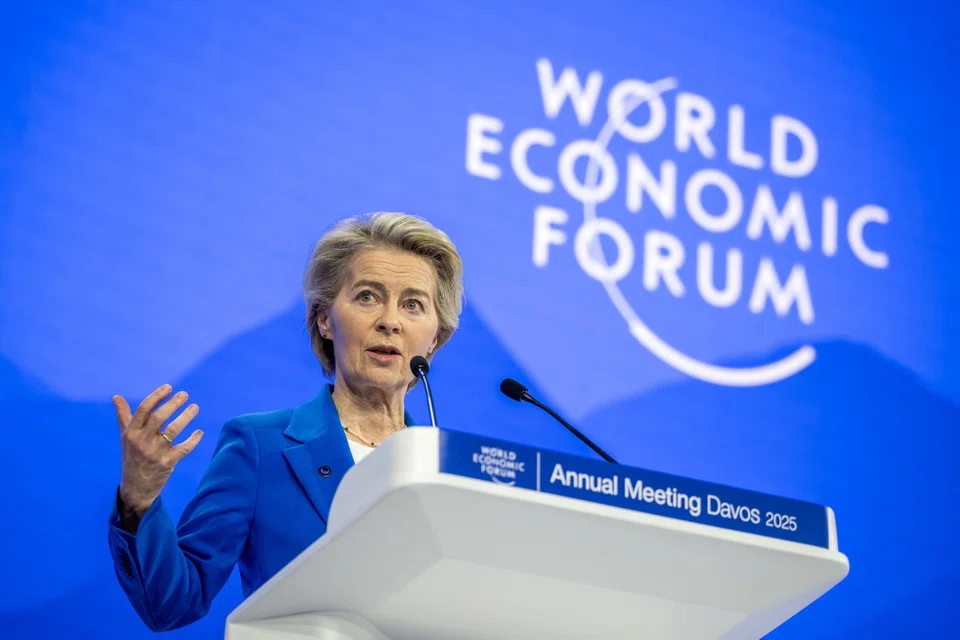
Across the pond, European Commission President Ursula von der Leyen set out a vision on Tuesday (Jan 21) that was equally hard to square with reality. Speaking at the World Economic Forum in Davos, at the start of her own second term, she described a continent of innovative strength, committed to immutable principles, ready for change and finding strength from unity in the face of adversity.
Europe’s actual circumstances are closer to Trump’s dystopia than Von der Leyen’s idyll. The continent’s business model has broken and it remains painfully slow to change. It’s increasingly riven as nationalist leaders challenge fundamental EU principles. One, Slovakian Prime Minister Robert Fico speculated this week that the European Union and Nato may not long survive a changing world.
The US, by contrast, remains an extraordinarily powerful nation state, with its dynamic market a key driver not only for its own economic health, but for Europe’s. Look at virtually any data, whether on long-term demographics, energy prices, currency, innovation, trend rates of growth or deployable military power and that case is clear. Even inflation, a core voter complaint against former president Joe Biden’s tenure, has subsided.
This US power is now in the hands of an ardent nationalist, who just declared territorial expansion as an American goal for the first time in well over a century. It is the marriage of capabilities to raw nationalism that makes leaders abroad nervous, and they should be.
Vulnerable allies
America’s allies are uniquely vulnerable in the face of this nationalist revival, because for decades they’ve organised themselves around the trust that the enormous power of the US would never be turned on them. Sure, Washington could be a bruising and domineering friend, but it was committed to maintaining the alliance, so there were guardrails.
Those rails have now gone. I’m not foolish enough to predict what Trump will actually do over the next four years, but the range of possibilities just widened in a direction dangerous for Europe. In theory, the EU has the scale and resources to stand alone, but not in practice. Time and again, from former Yugoslavia to Libya and Ukraine, European forces have proved unable to mount a major sustained operation without US support.
There are bright spots: Finland and Sweden have joined Nato, Poland has gone on a massive buying spree for equipment, while ammunition production is picking up across the union. Ukraine – should it emerge intact from the war – has the potential to become a major provider of lower cost munitions and drones for Europe’s armed forces.
But the EU’s vulnerabilities go beyond defence. Trump on Monday declared an energy emergency in the US, where there is none. There is in Europe. Average household electricity prices in the US are currently 50 per cent of Germany’s. Average US natural gas prices were the lowest on record last year, at US$2.21 per million British thermal units (MMBtu). In December, the European Union paid an average US$13.89 per MMBtu for the 90 per cent of natural gas consumption that it imports – and that was an improvement on recent years.
If energy is a key critical factor for competitiveness in the old manufacturing-based economy, then Europe is still more disadvantaged in the economies of the future. It lacks any equivalent to the tech giants that are driving US growth and have made common cause with Trump’s against policing content. As a result, the American economy is now 50 per cent larger than the EU’s, up from parity in 2010. Even if you pretend Brexit never happened, the US economy still has grown to be 28 per cent bigger than Europe’s.
The condition of the old world is far from hopeless. Europe remains a wealthy continent with high educational and other standards. But in its weakened state, it has few strong defences against a determined assault by Trump 2.0, should he decide to use the threats of military withdrawal, a trade war or both, to leverage gains. Europe’s leaders know this. It’s why they have rushed to curry favour with Trump. It’s also why the European Commission suddenly announced a “review” of its plans to enforce AI and data privacy laws on US tech companies.
Wake-up call
French President Emmanuel Macron on Tuesday called for Europe to “wake up” to the threat of abandonment and spend more on defence. Von der Leyen laid out a range of policy proposals aimed at reinvigorating Europe. She argued that in a new world of great power competition, the EU’s more collaborative, rules-based model will become more attractive to smaller countries.
These ideas are sound and if successful could be transformative. But they’re also long overdue and won’t – if Europe’s glacial response to wake-up calls past is any guide – come in time to deal with Trump. For the EU, a multilateral organism in an increasingly nationalist world, the challenge will be to escape the next few years without lasting damage.
TRENDING NOW

Singapore identifies 7 firms responsible for haze fires, notices issued urging action: Grace Fu

Could stablecoins be the future of money?

Singapore should prepare for prolonged haze until November, says Grace Fu

High Court rules against Julius Baer’s Singapore trust arm in US$50 million family trust dispute

