Trump meme coin: Promoting or destabilising the cryptocurrency space?
Summarise
    • While the actions of President Trump towards the deregulation of the US crypto industry have been promising in promoting it, the actions of citizen Trump have been concerning.
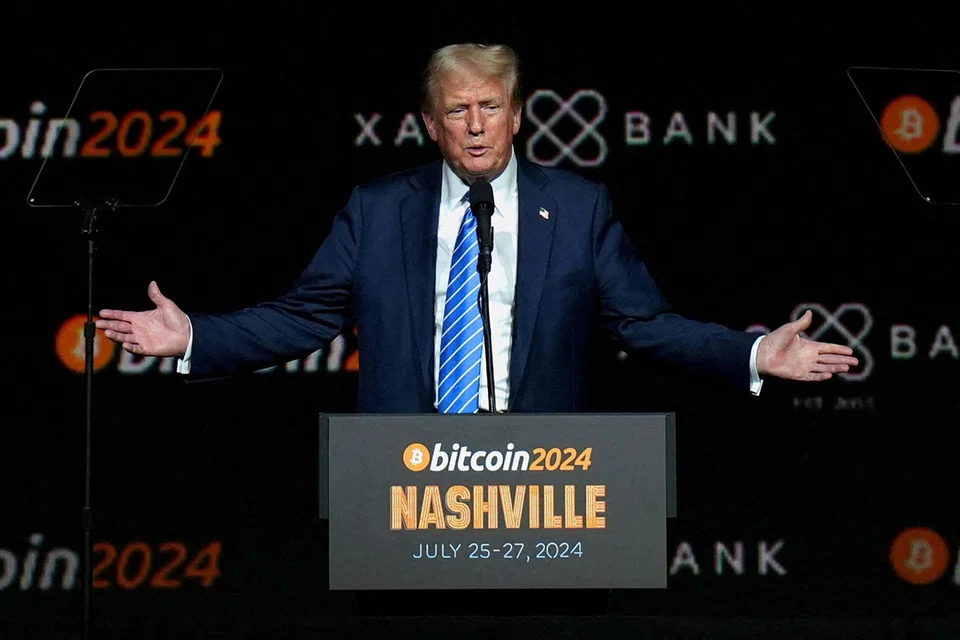
    • While the actions of President Trump towards the deregulation of the US crypto industry have been promising in promoting it, the actions of citizen Trump have been concerning. PHOTO: REUTERS
    Published Thu, Feb 6, 2025 · 05:00 AM

    DONALD Trump has become the first US president to launch a cryptocurrency bearing his namesake, even before his inauguration.

    Within a few days of its release, the newly minted $Trump reached a high of US$75.35 per coin, generating over US$15 billion for the returning president on paper. This groundbreaking event highlighted the increasing relevance of digital assets, but is also a stark reminder of how the poorly understood cryptocurrency space can be used for ethically questionable activities.

    Not all crypto coins are the same

    While most people may think of all cryptocurrencies as homogenous, there are vast differences among them.

    Many are familiar with Bitcoin. It was the first and most well-known cryptocurrency which launched the crypto industry, with the vision of bypassing traditional centralised financial institutions.

    Its secure blockchain technology made direct, peer-to-peer transactions possible. In addition, the limited supply, global accessibility and strong security of Bitcoin have established it as the bedrock of the crypto market, acting as a digital reserve currency and a widely recognised store of value.

    There is another class of cryptocurrencies known as utility coins. These are digital tokens that unlock specific services or products on a particular platform.

    Consider a voucher for a movie ticket at a specific cinema chain – that is how a utility coin works. Its value is tied to how useful and popular that service or product is. Ethereum, the cryptocurrency that powers smart contracts and other decentralised applications built in its ecosystem, is a good example.

    And then we have the stablecoins, which combine the benefits of blockchain technology with price stability, making them ideal for payments and remittances within typically volatile crypto markets.

    These provide a bridge between traditional finance and the crypto world, by pegging their value to stable assets such as fiat currencies or commodities. Tether and USD Coin are widely used stablecoins as each coin is backed by one US dollar.

    Despite their differences, these cryptocurrencies have the potential to revolutionise finance (or are already doing so) by offering decentralised, transparent and efficient alternatives to traditional systems. For example, cryptocurrencies can facilitate faster and cheaper cross-border payments, bypassing slow and expensive banking networks. Imagine sending money to family overseas instantly with minimal fees.

    Cryptocurrencies can also empower the unbanked, providing access to financial services through mobile wallets, even without a traditional bank account. Moreover, decentralised finance platforms, built on cryptocurrencies like Ethereum, are creating new ways to lend, borrow and earn interest, often with more favourable rates and fewer barriers to entry than traditional banks.

    For all the positives of cryptocurrencies, we also have the meme coins – cryptocurrencies that are inspired by Internet memes.

    The history of meme coins begins with Dogecoin, created in 2013 by software engineers Billy Markus and Jackson Palmer. It was initially intended as a satirical jab at the speculative frenzy surrounding Bitcoin and other cryptocurrencies.

    What started as a joke quickly gained a devoted following, fuelled by online communities such as Reddit and high-profile endorsements by Elon Musk. Dogecoin’s early use cases were primarily for tipping online content creators and supporting charitable causes, showcasing a community-driven, light-hearted approach to cryptocurrency.

    Meme coins are typically driven by hype and celebrity endorsements. They lack economic fundamentals or inherent utility, and they do not serve any economic purpose. Their value comes from extremely volatile supply-demand conditions and speculation.

    Exploitative nature of Trump Coin

    The Trump Coin is the latest meme coin that has entered the fray, and is facing criticism for its speculative nature, lack of clear utility and potentially for exploiting political fervour for profit.

    The value of Trump Coin is also highly volatile, driven by market sentiment and not by economic fundamentals. Slightly more than a week after its launch, $Trump fell to US$25.73 per coin, a drop of around 65 per cent from its high.

    Even though crypto finance started as a decentralised alternative to traditional finance, more recent crypto ventures pivoted towards centralised governance. Trump’s ventures control 80 per cent of the $Trump supply, yielding significant influence over the price.

    One significant concern is the potential for $Trump to serve as a conduit for funnelling money to Trump’s personal interests or political campaigns, bypassing traditional transparency and accountability mechanisms.

    Such cryptocurrency could obscure the sources and uses of funds, enabling corruption or unethical financial practices. The anonymous or pseudonymous nature of cryptocurrencies amplifies these risks, raising questions about the oversight and regulation of politically themed digital assets.

    Trump’s involvement in crypto also presents ethical and national security risks. His financial stake could influence regulatory decisions, disincentivising him from favouring restrictions that might negatively affect the value of his tokens. Concerns about foreign agents anonymously using the tokens to gain leverage over Trump’s policies are also valid.

    Prominent investor Mark Cuban echoed these sentiments, while expressing strong scepticism about the meme coin investments. “This is not crypto any more than (Bernie) Madoff was just buying and selling shares of stock,” said Cuban, while celebrity Bill Maher compared the meme coin to Madoff selling Pokemon cards.

    Invest in cryptocurrencies responsibly

    The world of cryptocurrency is diverse and dynamic. While crypto founders often grapple with gaining mainstream acceptance and demonstrating the legitimacy of their projects, $Trump highlights how the technology can be misused.

    Cryptocurrencies remain a poorly understood domain for much of the general public, and projects such as $Trump risk further undermining public trust by exploiting this lack of understanding. Such tokens can reinforce the perception that cryptocurrencies are speculative or manipulative tools, making it harder for the industry to gain broader acceptance.

    How $Trump will influence the new digital asset regulations is still up in the air. While the actions of President Trump towards the deregulation of the US crypto industry have been promising in promoting it, the actions of citizen Trump have been concerning.

    This underscores the urgent need for a balanced regulatory framework. Clear and enforceable regulations are crucial to prevent exploitation and promote transparency. Such a framework should focus on combating fraud, ensuring proper disclosure and establishing clear guidelines for token issuance and trading.

    The writer is academic director of UCLA-NUS Executive MBA, NUS Business School, and head of fintech training, Asian Institute of Digital Finance, at National University of Singapore