

Trump playbook with Putin looks to history
Is the US president ready for his meeting with the Russian leader, or is he about to repeat the mistakes he made with Kim Jong Un?
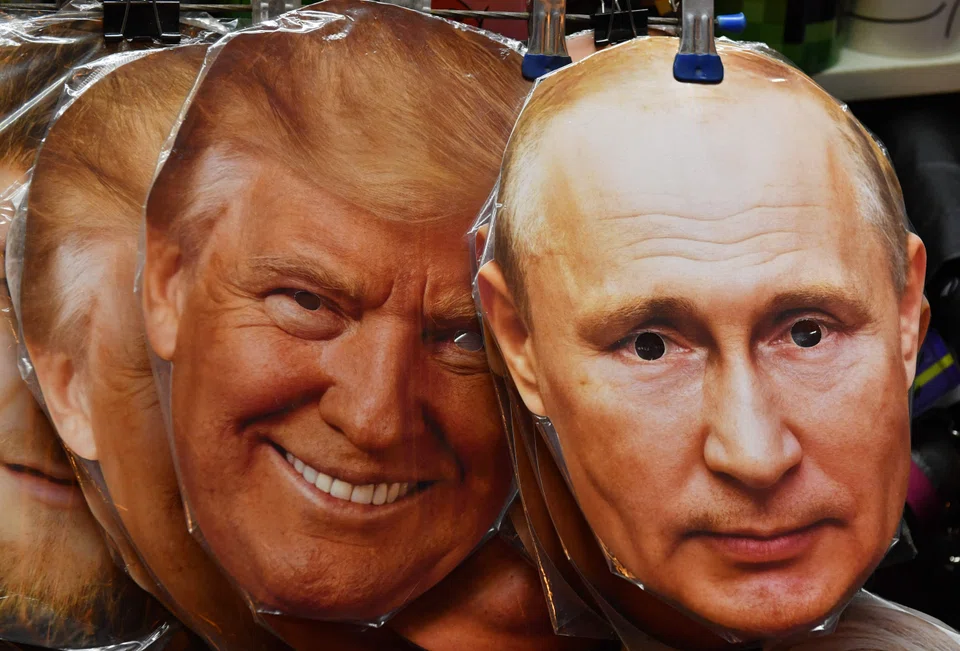
US PRESIDENT Donald Trump is looking to the history books for the summit on Friday (Aug 15) with his Russian counterpart, Vladimir Putin. A breakthrough could be possible, but many of the preconditions for a fair, robust and sustainable deal to end the Ukraine war may not yet be in place.
The template Trump is referencing includes the big meetings between then-US president Richard Nixon and Chinese leader Mao Zedong in 1972, plus the ones between then-US president Ronald Reagan and Soviet Union chief Mikhail Gorbachev in the 1980s. However, those historic breakthroughs required intense, careful preparation – a quality that is not Trump’s strong suit.
While Trump has shown himself to be an effective dealmaker on some trade agreements, he has consistently been ill-prepared for big, complex diplomatic negotiations. This was demonstrated during his first term in office with North Korean leader Kim Jong Un. The 2018 decision to hold a summit in Singapore, marking the first meeting between the US and North Korean leaders, was very spur-of-the-moment.
The contrast with Nixon’s 1972 visit to Mao is stark. That meeting came after years of careful diplomacy by the US president, national security adviser Henry Kissinger, and others.
Unsurprisingly, the Trump-Kim talks process eventually collapsed. Trump seemed not to have come to grips with key details of the North Korean nuclear challenge, and was consumed instead with the perceived prestige of the Singapore and subsequent 2019 Hanoi summits.
History could repeat itself
Fast-forward to 2025, and there is a danger that history will repeat itself with Putin. As with Kim, Trump appears fascinated with the Russian leader, and accords him high respect. Yet Putin, who has consistently outmanoeuvred his US counterpart, secured a diplomatic coup with this Friday’s summit, at a time when he appeared to be on the political back foot.
After months of inertia, Trump issued the Aug 8 deadline for Russia to stop the fighting in Ukraine or face new US sanctions. However, the economic threat was soon overshadowed by the offer of a meeting – likely Putin’s calculation – and there has since been no further announcement of new sanctions on Russia.
While a breakthrough is possible, Putin seems more focused on securing bilateral concessions than engaging in a meaningful peace process. As much as the Russian economy is hurting from the conflict, there is little to suggest that Putin wants to end it.
With Moscow still making territorial gains in Ukraine, his calculus appears to be that time is on his side, and that he can outlast the West with his current term of office ending only in 2030, plus the possibility of re-election.
So it is Putin, not Trump, who has already gained the most from the announcement of Friday’s big event. The clear danger is that the US president may regard simply getting Putin to the table as a win. A weak, messy compromise may follow, doing little to provide sustainable solutions to end the Ukraine war.
Already, Trump’s focus appears to be on concessions from Kyiv, not Moscow. Last week, he said again that “there will be some swopping of territories”. He is reportedly pushing European leaders to accept an agreement where Russia keeps Crimea, which it annexed in 2014, and takes the entire Donbas region in eastern Ukraine.
This leaves the world wondering what concessions, if any at all, Trump expects Russia to make.
Eerie echoes
Even if the US president surprises on the upside on Friday, which is to be hoped, it may be much more luck than judgment. Despite his claims of being a master dealmaker, he has demonstrated time after time that there is indeed a difference between politics and running a privately held family conglomerate such as the Trump Organization.
Trump’s transactional style appears particularly ill-suited to situations like Ukraine, or the one with North Korea during his first presidency, where a sustained strategic dialogue was needed. The potential importance, complexity and challenging nature of the Russia talks are comparable to those Nixon conducted with Mao in the 1970s, but much of the pre-work has not been done by Trump.
This has eerie echoes of his negotiations with North Korea; it was clear at the Singapore and Hanoi summits that Trump lacked a coherent or comprehensive strategy, despite the fact that the events contained many intricacies around US alliances, the non-proliferation regime, and what exactly would constitute “denuclearisation” on the peninsula.
To Trump, denuclearisation appeared to mean unilateral disarmament. For Kim, it meant lengthy negotiations where he was treated as an equal, giving him further propaganda victories.
Like Putin today, Kim was wary about making concrete commitments, and wanted to win economic and political concessions from Trump before agreeing to any reduction in nuclear capabilities, let alone committing to full denuclearisation.
Kim received much from Trump in exchange for ambiguous pledges to “denuclearise”. This includes Trump cancelling joint military exercises between US and South Korean forces, despite reported evidence that North Korea continued uranium enrichment and stepped up missile production.
These shortcomings were compounded by Trump’s characterisation of what occurred in Singapore. What was no more than the start to a potentially transformational, sustained strategic dialogue ended with the US president declaring that the “there is no longer a nuclear threat from North Korea”, giving the impression that he had already completed the immensely complicated process of de-escalating tensions in the world’s last Cold War-era frontier.
A key lesson from Trump’s first term is that complex diplomacy requires meticulous preparation and managed expectations. For a tough, sustainable agreement with Putin to emerge, the president would do well to heed that lesson.
The writer is an associate at LSE IDEAS at the London School of Economics






