

As Trump scares off US scientists, China is racing ahead
From mapping the seabed to making AI innovations, Beijing is becoming the world’s scientific superpower
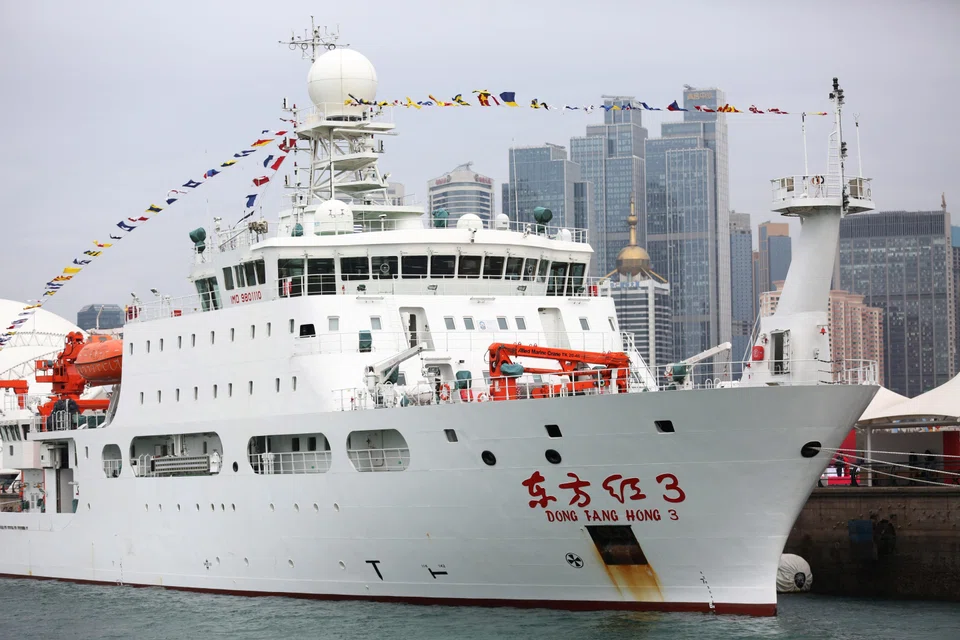
THE Dong Fang Hong 3 is the world’s largest “silent” research ship, supposedly able to glide through water without disturbing fish swimming just 20 m below it.
Equipped with laboratories and the ability to lay sensors, the 103 m vessel owned and operated by the Ocean University of China has spent the past two years mapping the ocean floor.
But, according to a recent Reuters analysis, the vessel – along with others – is collecting subterranean data that could confer a military advantage in the event of underwater warfare. Charting the subsea terrain could identify possible hiding places for submarines, as well as unmask underwater vessels operated by adversaries.
The Reuters investigation found that, as with much cutting-edge science, oceanographic research has both civilian and military value, and that sensitive applications can be hiding in plain sight, in papers written for scientific journals.
But the analysis speaks to a broader picture of China quietly gaining geopolitical strength and strategic advantage through science and technology, to an extent that few truly grasp.
Take the Chinese cut-price AI model DeepSeek, which suddenly emerged in January 2025. It stunned observers, challenged American AI dominance and wiped billions off the chipmaker Nvidia’s fortunes.
As China prioritises domestic innovation in its future development plans, its reputation as a taker of other people’s ideas, rather than a maker, may need updating.
Reuters examined articles in Chinese state media, scientific journals and government statements, and used ship-tracking data, to conclude that the tight, back-and-forth pattern traced by multiple China-registered ships in the Arctic, Pacific and Indian oceans constituted likely evidence of mapping activity.
Naval experts told Reuters that while the mapping might be relevant to fishing interests and mineral prospecting, it would also be valuable military intel. China’s policy of “civil-military fusion” means that civilian and scientific efforts are inevitably entwined with the country’s political and defence objectives.
The Chinese government has not commented publicly on the issue.
William Matthews, a defence researcher at King’s College London, said that the maritime manoeuvres exemplified a “broader pattern in China’s use of technology as a key instrument in securing geopolitical ends”, but that this was not unique to China.
The country, chasing self-reliance as relations with the US sour, has already remade critical mineral supply chains to its own advantage.
As well as gaining a defensive edge, the actions at sea could also be a jostle for first-mover advantage in seabed mining, seen by some as an extractive industry of the future.
In a commentary in Nature last November, Kerry Brown, director of the Lau China Institute (LCI) at King’s College London, urged the world to “wake up to China’s scientific leadership”. (The LCI has drawn criticism for taking funding from a wealthy donor with ties to the Chinese Communist Party.)
The article pointed out that China’s research and development expenditure increased sixfold between 2007 and 2023, overtaking that of the European Union.
China surpassed the US on this metric in 2024, spending US$1.03 trillion, against the US’ US$1.01 trillion, reported the Organisation for Economic Co-operation and Development.
Brown told Financial Times that China’s scientific rise – oiled by a national industrial policy that matches academics to entrepreneurs – is still largely flying under the radar.
China produced 3.6 million science, technology, engineering and mathematics (Stem) graduates in 2020, compared with India’s 2.6 million and the US’ figure of below a million.
DeepSeek’s creators trained not at Stanford University and the Massachusetts Institute of Technology, but at domestic universities like Zhejiang and Tsinghua, which are racing up the world rankings.
Brown said: “People in Britain just don’t get the scale and speed and will of this movement. We’ve still got politicians here banging on about people in China wanting to pinch our ideas. Those days are over. They don’t want our stuff. Our stuff is analogue.”
He expects the tables to turn. While issues like cyber espionage will remain problematic, the UK may soon covet Chinese technology in less sensitive sectors, like biotech, green tech and materials. China supplied a third of new drugs licensed by big US companies in the first quarter of 2025.
Meanwhile, China’s gravest foe, the US, is making helpful mistakes by cutting budgets and haranguing scientists into leaving the country. The US is pivoting away from science and technology as a means of tackling global challenges, unsettling friends and allies.
Actually, it is less a pivot and more a spectacular abdication of global scientific leadership – while China quietly sails into the top spot. FINANCIAL TIMES






