Trump’s policy moves still biggest risk amid DeepSeek-induced sell-off last week
The AI model’s success may drive the US government to take an even harder line on tariffs and trade restrictions

THE first Federal Open Market Committee (FOMC) meeting of 2025 may have seemed irrelevant to many investors against the global market turmoil last week, triggered by news that China’s DeepSeek had managed to develop a high-performing artificial intelligence (AI) model very cheaply and without using the most advanced chips.
With US inflation still slightly elevated and economic activity expanding at a healthy pace, the FOMC decided to do what almost everyone expected: it held the target range for the federal funds rate unchanged at between 4.25 and 4.5 per cent.
Yet, many of the questions Fed chairman Jerome Powell fielded during the post-FOMC meeting press conference were a reminder that the really big risk in the months ahead is the potential disarray US President Donald Trump may bring to the US economy and the functioning of the country’s public sector institutions.
Indeed, the very first question posed to Powell during the press conference was related to Trump’s pledge during a speech on Jan 23 via video at the World Economic Forum in Davos, Switzerland that he will demand that interest rates drop immediately in the US and around the world.
“Has the president done this to you? Has he made that demand?” Powell was asked. “What effect, if any, does the president making these kinds of remarks have on policy?”
Shortly after, another reporter broached the same topic, asking: “What reassurance can you give the American public that the Fed will continue to operate independent of politics under this administration?”
Powell was also asked a number of questions about Trump’s tougher stance on immigration and what that might mean for the US economy, given the country’s currently low unemployment rate.
Then there is Trump’s predilection for trade tariffs; and the impact that might have on US growth and inflation, and the conduct of US monetary policy.
Over the weekend, the US announced tariffs of 25 per cent on imports from Canada and Mexico. Energy imports from Canada will be taxed at 10 per cent. The US will also place tariffs of 10 per cent on goods from China.
All three countries have indicated they will take retaliatory action.
Powell did his best last week to not comment directly on any of Trump’s statements, or his administration’s policies. But he said the Fed is working to align its policies with the president’s executive orders, in a manner consistent with applicable laws.
He also offered a couple of insights on the Fed’s thinking about tariffs and immigration. For instance, he said that reduced flows of people across the borders might not have a big impact on unemployment now as job creation has been gradually slowing.
Meanwhile, import tariffs may not have exactly the same effect as they did during Trump’s first term. For one thing, the US economy may now be more susceptible to inflationary pressures. On the other hand, the profile of US imports has also shifted. “It’s not as concentrated in China as it was,” he said.
In short, it could be some time before the full impact of Trump’s second time in office on the US economy becomes apparent. Until then, investors may just have to live with the heightened uncertainty.
Development or disruption?
Global markets seemed to grasp the implications of DeepSeek’s low-cost AI models much more quickly, though.
The so-called DeepSeek-R1 model is said to deliver performance on a par with OpenAI’s ChatGPT, despite using much less computing power and costing far less to train. This challenged the consensus view that developing AI systems requires massive capital expenditure budgets and top-end computer chips, and created the sense that DeepSeek was about to disrupt the whole AI sector.
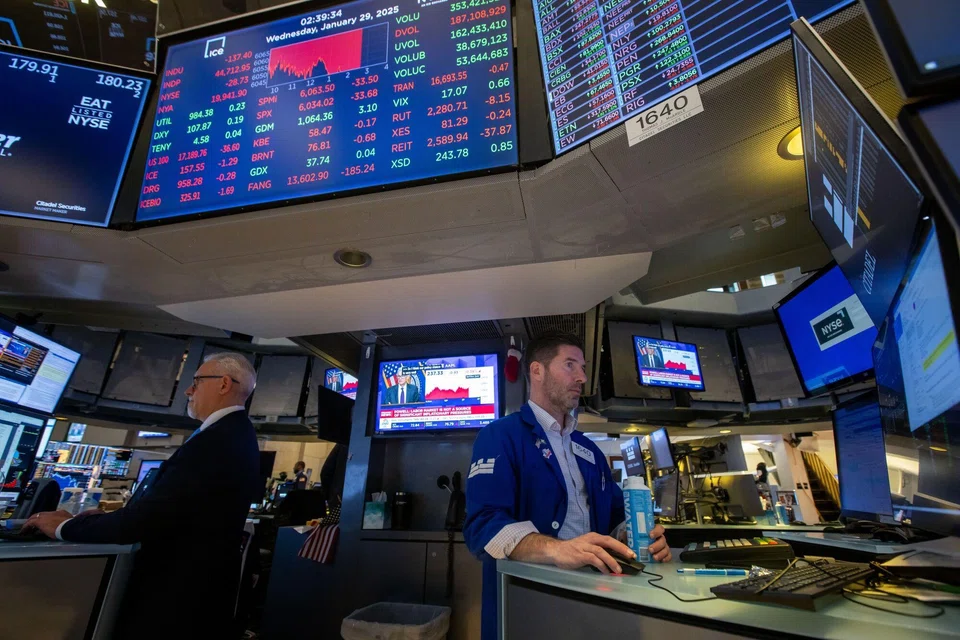
The result was a sudden sell-off in big US technology-oriented companies last Monday (Jan 27). Among the biggest casualties were chipmakers such as Nvidia, Broadcom and Micron Technology – all of which suffered double-digit percentage losses that day. The S&P 500 slipped 1.5 per cent.
The impact was felt even in the Singapore market, with real estate investment trusts that own data centres taking a beating.
Things soon calmed down, however, as the market came to the view that DeepSeek might bring faster development rather than disruption to the AI space. The thinking now seems to be that a low-cost AI model, made widely available, might spur adoption and drive even stronger demand for computer chips.
The major chipmakers pared some of their losses after the sell-off on Monday, but still ended last week in negative territory. The S&P 500 closed on Friday at 6,040.53, down 1 per cent for the week.
While the panic seems to have subsided, DeepSeek may still pose risks for investors if it drives the Trump administration to take an even harder line on tariffs and trade restrictions. Already, the US government is reportedly looking into whether the China-based company had improperly obtained chips from Nvidia, including through Singapore.
The Ministry of Trade and Industry said on Feb 1 that it expects US companies, such as Nvidia, to comply with US export controls as well as Singapore’s domestic legislation. It added that local customs and law enforcement agencies will continue to work closely with their US counterparts.
Be cautious, diversify
How should we cope with all the uncertainties out there?
“Uncertainty is with us all the time,” said Fed chairman Powell, in response to a similar question last week. “The tails are very fat, meaning things can happen way out of your expectations – it’s never not that way.”
This column has previously suggested that fat-tailed risks such as a hard landing for the US economy, or a geopolitical event that interferes with global trade, could trigger a slump in global stocks and a scramble for safe-haven assets.
In light of the tariffs the US has slapped on some of its top trading partners, and the retaliatory measures that will probably follow, investors should tread cautiously in the coming weeks by holding on to cash and waiting for compelling opportunities.
Meanwhile, the manner that DeepSeek roiled global markets last week suggests another fat-tailed risk we should be concerned about is the emergence of new transformative technologies that big US companies ultimately fail to dominate.
The Magnificent Seven – comprising Alphabet, Amazon, Apple, Meta Platforms, Microsoft, Nvidia and Tesla – have collectively become a magnet for global capital flows and a powerful driver of the S&P 500, largely on the back of their strong and sustained earnings growth.
Today, these companies have the financial heft to make massive investments in any new technology that comes along in order to maintain their market leadership. As DeepSeek has demonstrated, however, having resources is not everything.
For investors, mitigating this risk seems simple enough – they could just diversify their holdings, and avoid being too exposed to the biggest names in the S&P 500 index.
This might be a good idea anyway, as the superior earnings growth of the Magnificent Seven versus the remaining 493 stocks in the S&P 500 is expected to narrow this year.
This column said in December that the Magnificent Seven are forecast to deliver earnings growth of 21.3 per cent in 2025, down from 33.3 per cent last year. The non-Magnificent Seven companies within the S&P 500 are forecast to deliver earnings growth of 13 per cent in 2025, up from 4.2 per cent in 2024.
TRENDING NOW
Why US$100 oil, 5% US yields affect Singdollar, ringgit differently vs other Asean currencies
Anthropic to open Singapore office in October, sees it as ‘standout market’ for Claude
Singapore’s covered bond boom is largely a DBS story
Malaysian developer Eco World tops bids for Sin Ming area housing plot with S$1,612 psf ppr offer