UK foreign policy needs to regain relevance
    • While the immediate focus for UK Prime Minister Rishi Sunak's foreign policy may be Russia, a proper strategy is needed across all of the UK’s key relationships.
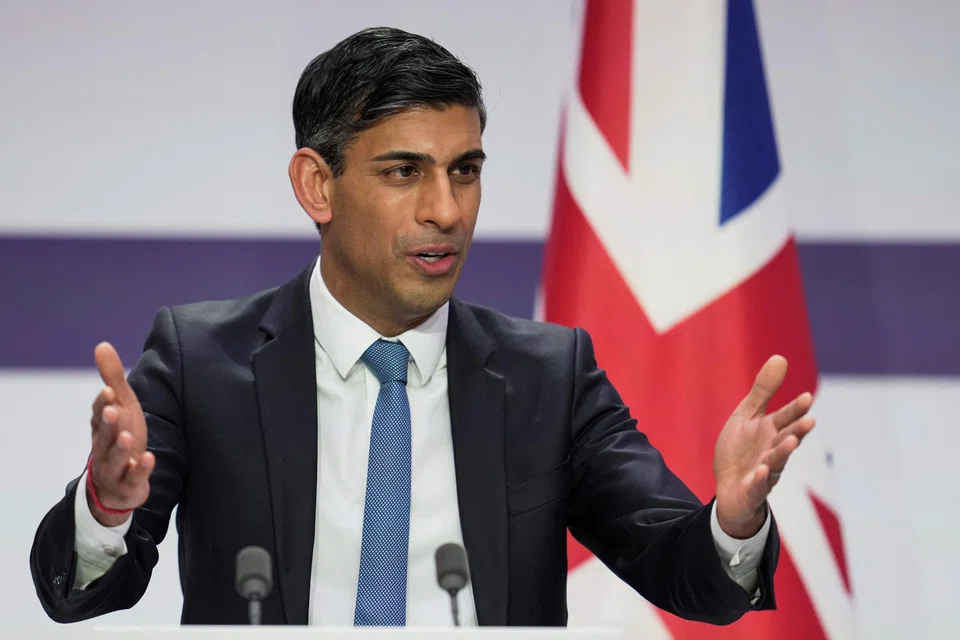
    • While the immediate focus for UK Prime Minister Rishi Sunak's foreign policy may be Russia, a proper strategy is needed across all of the UK’s key relationships. PHOTO: AFP
    Published Mon, Mar 20, 2023 · 01:31 PM

    IN THE 1990s, former Conservative foreign secretary Douglas Hurd asserted that the United Kingdom could “punch above its weight” in the post-war era despite no longer being a great power. That may have remained true in much of the decades since, but is under increasing scrutiny in the 2020s.

    That is part of the reason that the UK government released last Tuesday (Mar 14) a refreshed foreign policy strategy for the new era of international relations heralded by Russia’s invasion of Ukraine.

    However, members of parliament have noted that the document does not address gaps in the UK’s defence capabilities, which undermine the country’s Nato contribution. These include army forces which, with planned cutbacks to just over 70,000, will be at the lowest level since the 1700s.


    To be fair to the Sunak government, questions over the UK’s foreign policy plagued previous Conservative administrations too. In 2016, Richard Shirreff – then the UK’s top commander in Nato – said that London’s failure to act more prominently on the world stage has helped turn the nation into a “bit player” at danger of “foreign policy irrelevance”.

    More than six decades after former US secretary of state Dean Acheson said that the UK had lost an empire but not yet found a new world role, London’s policy is in drift again.

    Acheson made his remarks around the time of London’s first application to join the then-European Community in 1962. In the decades that followed, the nation did find a post-empire role, with an influential international voice powered by twin alliances with Europe and the US.

    However, challenges are now mounting. This includes the UK’s relationship with China, which is in flux following Covid-19, Beijing’s security clampdown in Hong Kong, and other developments such as London’s exclusion of Huawei from its 5G network rollout.

    The problem is that the government mantra of “Global Britain” is more of a slogan than a meaningful strategy. For years, multiple UK governments have failed to articulate a grand strategy, offering instead policies, plans and political direction driven by budget, rather than the other way round. This is despite the creation of the National Security Council in 2010.

    In the last decade in particular, this has resulted in foreign policy drift. With the Ukraine war a potential turning point in world affairs, there is an urgent need for greater strategic clarity.

    As the refreshed document last week indicates, a priority should be the UK’s posture toward China and Russia – key nations that need to be engaged.

    Another question is how productive the UK’s post-Brexit relationship will be with Brussels and the EU-27, especially with the agreement of the new Northern Ireland protocol. While this – along with the 2019 EU withdrawal deal and the 2020 UK-EU Trade and Cooperation agreement – have given some definition to future ties, there is still much to be decided.

    This is not least as the latter deal did not include defence and security collaboration, which will now be key post-Ukraine. The hope is that a new constructive partnership can be formed, perhaps expedited by the Ukraine crisis.

    Also vital is the UK’s future relationship with the US, as Atlanticist Joe Biden looks to reunify the Western alliance post-Trump and post-Brexit. While Biden has long been a friend to the UK, some policymakers worry about their country’s enduring value to Washington, now that it is no longer as effective as a bridge between Europe and the US.

    This underlines the massive task that London has in reorienting foreign policy. While the immediate focus may be Russia, a proper strategy is needed across all of the UK’s key relationships.

    One question is how much emphasis to put on regions such as the Asia-Pacific, versus redoubling the Euro-Atlantic posture following Russia’s invasion.

    Much of the focus must remain on Europe – unsurprisingly, given that the continent and the North Atlantic are the UK’s immediate strategic neighbourhoods.

    As the review highlights, Nato, the EU and Europe more broadly will be given central places, given that the continent’s prosperity, stability and security remain the UK’s top strategic aim.

    In the post-war period, the UK has evolved from a world power to a European regional power. But one mistake that pro-Europe advocates made in the 2016 Brexit referendum was failing to connect the UK’s own sense of its importance and uniqueness to its continued membership of the EU – which can amplify these strengths.

    Arguments that the UK should behave more like an “ordinary” nation overlook its history, and politicians who talk down their own country often suffer public backlash.

    That said, some Brexiteers have overemphasised the UK’s advantages. It is unrealistic to expect that London can decisively shift the global agenda on trade unless this goal is shared by economic superpowers such as the US and China.

    These issues are not just important for the UK, but also the wider international community. If the UK lacks its past international clout, this could damage global security and economic prosperity – at a time when both remain dicey in the wake of the pandemic and Russia’s invasion of Ukraine.

    The writer is an associate at LSE IDEAS at the London School of Economics.