UK Labour leader – and potential next PM – makes mark internationally
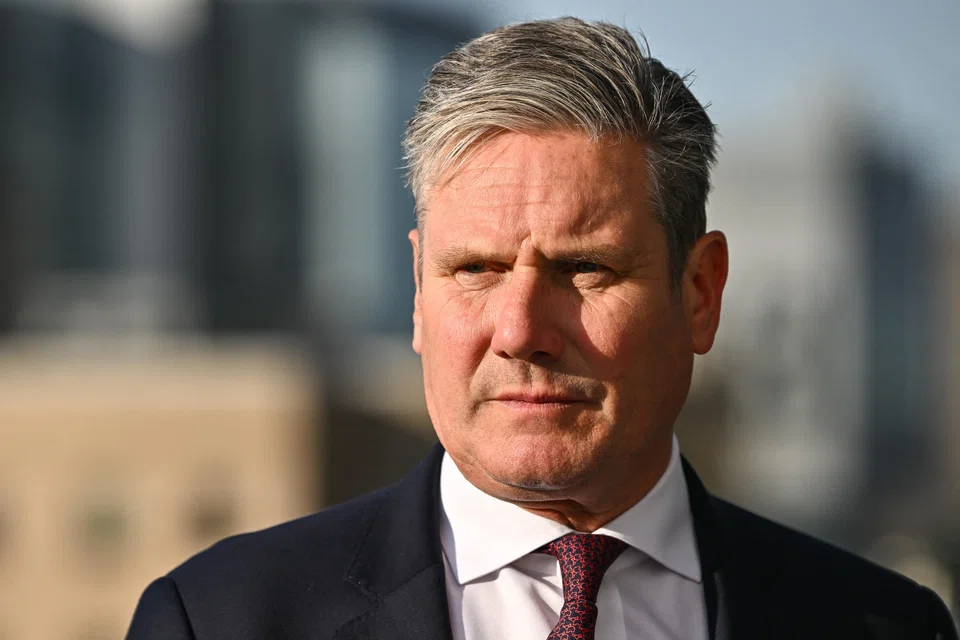
THE next UK general election could be more than a year away. However, it is not just an increasing number of UK politicians who anticipate a transfer of power to Labour, after around a decade-and-a-half of Conservative-led Government. There are growing signs that key world leaders are also planning for a new UK administration, headed by Labour leader Keir Starmer.
The latest indication came on Tuesday (Sep 19) with French President Emmanuel Macron hosting Starmer at the Elysee Palace. This builds from a session that the Labour leader had last year with German Chancellor Olaf Scholz.
Last weekend, Starmer met with other world leaders at a Montreal gathering of left-of-centre and centrist politicians, hosted by Canadian Prime Minister Justin Trudeau. Other leaders included Norwegian Prime Minister Jonas Gahr Støre and ex-European Commissioner Frans Timmermans, who hopes to become Dutch prime minister this autumn.
Starmer regularly cautions that he takes nothing for granted in next year’s UK election – as is absolutely right, given the unpredictability of modern politics. However, foreign politicians looking at UK opinion polls in much of 2023 will see Labour as most likely to win, potentially in a political landslide as Tony Blair did in 1997.
A third way
It was soon after that 1997 landmark win that Blair and then-US President Bill Clinton spoke of a new “third way”, a centrist political philosophy spreading across much of the world.
This approach distinguished between the free market capitalism espoused by prior conservative leaders Ronald Reagan and Margaret Thatcher, and the more statist or socialist approach of earlier politicians on the left, such as former US presidents Jimmy Carter and Lyndon Johnson, and former UK prime ministers Harold Wilson and Jim Callaghan.
While Blair sought to popularise this third way between free market capitalism and statism or socialism, Starmer is focusing on what he calls the potential for a “progressive moment”.
Whether this potential will be fully realised hinges not just on whether Starmer becomes UK prime minister, but also if US President Joe Biden can win a second term in Washington.
The Labour party has already sought to engage the Biden administration, including over its interventionist “Bidenomics” economic policy. This includes measures such as the Inflation Reduction Act – which Labour intends to mirror in the UK with a multi-billion pound Green Prosperity Plan.
Biden has yet to meet Starmer. However, the latter recently revealed that he speaks frequently often with ex-US president Barack Obama – to whom Biden is very close, having served as his vice president from 2009 to 2017.
Beyond election strategy, a core challenge for the progressive moment is how to embed left-of-centre and centrist policies on issues such as immigration, climate change, and economic policy.
For years, it has been rightist, often populist parties that have done most on this agenda – in both the UK and US, as shown by Donald Trump’s presidency from 2017 to 2021.
In an interview with Politico, Starmer said that one of his chief international priorities, if he becomes prime minister, would be “the restoration of the United Kingdom and its reputation on the world stage”.
“I feel very strongly that since Brexit, there’s been a sense that we’ve not just exited the EU, that we’ve somehow turned our back on the world and wherever you go people feel almost the absence of the United Kingdom, once a leading voice, now rarely consulted,” he said.
Starmer might be alluding to former Conservative foreign secretary Douglas Hurd’s assertion, in the 1990s, that the UK had been able to “punch above its weight” in the post-war era despite no longer being a great power. That statement was true during many of the decades since, but is under much greater scrutiny in the 2020s.
Starmer’s international agenda includes securing the possibility of a “much better” Brexit deal with the EU, if Labour wins the next general election. He asserts that the current deal agreed, due for review in 2025, is “too thin”.
While declining to comment on specifics, Starmer has said that he wants a “closer trading relationship” with the EU, but ruled out re-joining key European institutions such as the customs union and the single market.
“That’s not a question of going back in (the EU), but I refuse to accept that we can’t make it work” he said.
While the outlines of any deal are far from clear at this stage, it is plausible that the political opening will emerge from late 2024 onwards, when there may be a significantly different political map in London and Brussels.
Not only could Starmer be prime minister by then, there will also be a new European Commission – potentially still headed by President Ursula von der Leyen, for a second term.
International challenges
To help consolidate the UK’s presence on the international stage, Starmer has also identified a series of issues – what he calls an “axis of insecurity” – that must be tackled, including the cost of living crisis, illegal migration, the war in Ukraine, and climate change.
On illegal migration, for instance, Starmer visited the EU’s law enforcement agency Europol to discuss how better cooperation with the EU could help tackle the political challenge of small boats crossing the English Channel to the UK. The aim is to strike a deal to try to stop human smuggling gangs from bringing migrants across the channel.
Starmer is clearly looking to build relationships with world leaders given the huge range of international challenges that would confront him if he becomes UK prime minister. As the pandemic and Ukraine war have shown, there may be little time to grow into the job before his first foreign crisis knocks at his door.
The writer is an associate at LSE IDEAS at the London School of Economics