UK’s post-Brexit leadership tested by Ukraine
The political vacuum left by the Trump team’s stance towards Ukraine may now deliver a window of opportunity for the UK to lead
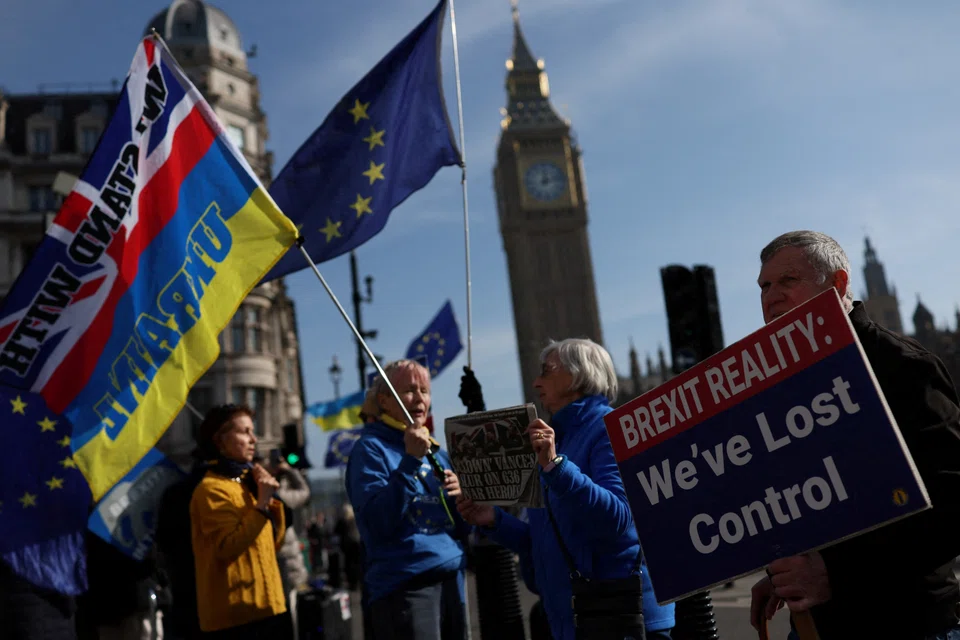
[LONDON] Many Brexiteers had hoped, following the UK’s exit from the European Union, that London would show greater global political and economic leadership. Yet, for almost a decade after the 2016 Brexit referendum, UK governments largely failed to deliver.
Fast forward to 2025, however, and the political vacuum left by the Trump team’s stance towards Ukraine may now deliver a window of opportunity for the UK to lead. Around two weeks ago, Prime Minister Keir Starmer hosted a Lancaster House summit of Nato allies in London, other than the US.
On Saturday (Mar 15), he followed up with a meeting of more than two dozen leaders from Europe, Canada, and beyond, including Turkish President Recep Tayyip Erdogan. Further-flung leaders also joined, including Australian Prime Minister Anthony Albanese and New Zealand Prime Minister Christopher Luxon. The group also has the backing of wider nations, including Japan.
Starmer said on Saturday that planning has now moved to an “operational phase”. This includes military chiefs of the nascent “coalition of the willing” meeting in London this Thursday.
The breadth of leaders attending on Saturday showed how President Donald Trump’s disruptive diplomacy is forcing longstanding US allies to take a clearer, coordinated approach if they are to have significant influence in coming weeks. These leaders know they now must step up to the plate, and broadly agree that any outcome in Ukraine that is perceived as a potentially significant Russian victory may only embolden President Vladimir Putin.
As much as French President Emmanuel Macron is a pivotal figure in these discussions, this may finally be the UK’s moment to show global leadership again. The nation is, uniquely, well-positioned to assemble the type of “coalition of the willing” now potentially needed to help Ukraine.
Not only does London retain close ties to EU powers. It also has wider global links through the Commonwealth and organisations such as the G7, G20, and the “Five Eyes” intelligence alliance. For instance, Five Eyes stems from the intelligence relationship that the US and UK enjoyed in the Second World War, which was institutionalised in the 1946 Brusa (later Ukusa) Agreement. Canada, Australia and New Zealand, as former UK dominions, began representing themselves in the intelligence pact in the late 1940s and 1950s, which led to developments such as the 1951 Anzus treaty.
These historical ties are being refreshed in new ways. For instance, Australia and the UK have signed the Aukus security pact with the US. Consultations on future cooperation between Aukus security pact partners and other nations have been underway for some time, with Canada and Asia-Pacific allies such as Japan, New Zealand and South Korea.
Nevertheless, the emerging “coalition of the willing” has its work cut out. On Saturday, Starmer sought to keep the pressure on Russia to back – unconditionally – the new US-Ukraine 30-day ceasefire plan.
The UK and many of its allies believe Putin is playing for time. This is not just to try to win more ground in Ukraine, but also to try to kick Volodymyr Zelensky’s troops out of Kursk, the first foreign troops in Russia since the Second World War.
If Putin continues to stall, Starmer said on Saturday, “we want to tighten the sanctions still further. And we discussed this morning how much further we can go, including the question of frozen assets”. This stance appears to be aligned with the US, and Secretary of State Marco Rubio hinted at further potential sanctions on Friday.
Moreover, Starmer told allies on Saturday that now is the time for them to be prepared to defend any longer-term deal that emerges in coming months. He said that “this means strengthening Ukraine so they can defend themselves... in terms of military capability, in terms of funding and in terms of the provision of further support from all of us to Ukraine, (and) secondly, being prepared to defend any deal ourselves through a coalition of the willing”.
It is increasingly recognised that such a coalition is, in the tight timeframes, the best way forward. For instance, the 27-member EU has a unanimity requirement which could hold up discussions due to objections from member states such as Hungary, with Prime Minister Viktor Orban’s close ties to Putin.
Yet, many of the coalition nations are reluctant to commit too far, especially on possible peacekeeping troops in Ukraine, until the position of the Trump team is clearer on US security guarantees. US allies are not expecting the Trump team to commit to sending troops on the ground, but they are seeking US military cover, including in the air, which the White House has so far refused.
Longstanding US allies therefore are hoping for the best to keep Trump on board, but also preparing for the worst. This latter scenario could see the US administration ultimately put emphasis on securing a fast, rather than fair, sustainable deal with Russia.
This is prompting difficult discussions about how realistic it would be for non-US Western powers and their allies to support Ukraine without Washington’s support. Far-fetched as this scenario may appear, it is a key part of the scenario planning that is now being done to try to deliver a lasting peace in the biggest conflict in Europe since the Second World War.
The writer is an associate at LSE Ideas at the London School of Economics