

UK’s Starmer seeks business backing, 100 days into office
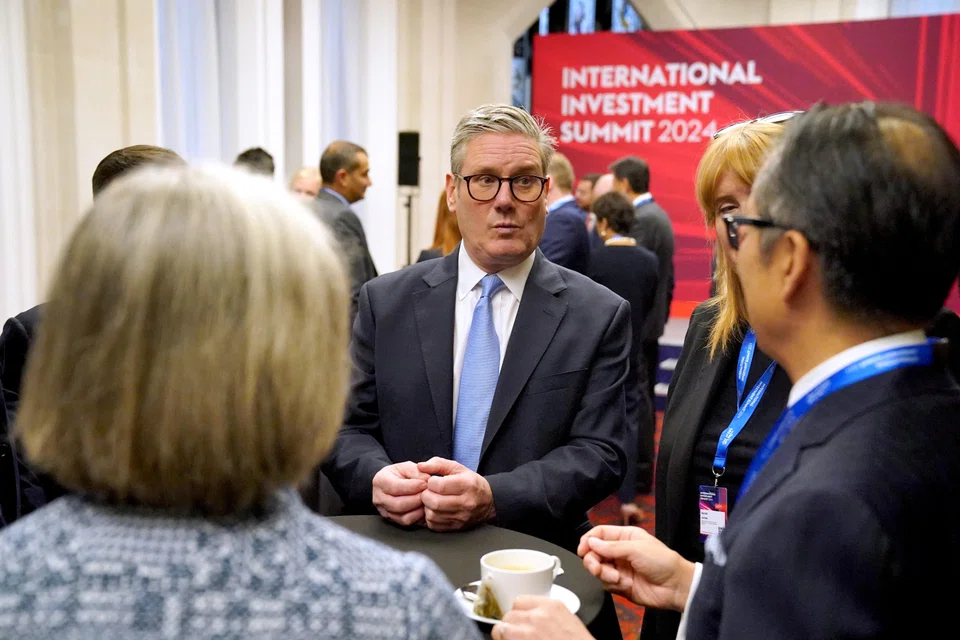
ONE hundred days into office, the new UK government has already had some setbacks. However, Downing Street sought to get on the economic front foot on Sunday (Oct 13) and Monday with events at the UK Investment Summit in London ahead of the big Oct 30 budget.
The end-of-month fiscal event is shaping up to be the most important UK budget since at least the emergency fiscal statement in 2010 of the new Conservative government of then prime minister David Cameron. Moreover, it may even prove as politically decisive as the early budgets of the Conservative government of Margaret Thatcher in the early 1980s.
Recognising the importance of the big occasion ahead, Keir Starmer’s Labour government has begun its political choreography for the event.
After uncovering a fiscal black hole of over £20 billion (S$34.1 billion) in July, after auditing the government’s books, ministers are putting forward a more optimistic mood music at the summit events centred around the UK’s long-term growth potential into the 2030s, including to become a “clean energy superpower”.
In attendance at the summit events on Sunday and Monday were over 300 senior international business people and thinkers, including from Singapore. Key names include former Google CEO Eric Schmidt and BlackRock CEO Larry Fink.
The political build-up for the summit began on Friday when Poppy Gustafsson, co-founder and former CEO of cyber firm Darktrace, was announced as the new UK investment minister at a meeting of English, Scottish, Welsh and Northern Irish politicians in Edinburgh.
This was followed over the weekend with investment summit events in London attended by firms including Alphabet, Goldman Sachs and DeepMind.
Overall, the government welcomed around £50 billion of deal announcements at the events. This is roughly twice the £28 billion unveiled at the last such summit held under the former Conservative administration in 2023 of then prime minister Rishi Sunak.
Gustafsson will lead a beefed-up UK Office for Investment, which will bring together expertise from industry and business leaders, plus also 10 Downing Street, the Treasury and the Department of Business and Trade. This is part of a wider reform of the UK central government, to strengthen the nation’s partnership with businesses.
An example of the innovation here is that the central government will harness other devolved political actors, including the first ministers of Scotland, Wales and Northern Ireland, and mayors of major cities including London, Birmingham and Manchester.
The goal is promoting the UK, including in Asia, to capture a greater share of internationally mobile investment in strategic sectors, and motivate domestic businesses to boost their investment and scale up their growth.
One key economic enabler of this revamped approach is a new UK industry strategy, announced on Sunday, with a new advisory council to spearhead this led by Microsoft UK CEO Clare Barclay. The full membership will be announced soon to help unleash the potential of high productivity sectors to spur growth, spread wealth and drive up employment.
The new industrial strategy focuses on eight areas the UK excels in, or has the potential to do so: advanced manufacturing; clean energy industries; creative industries; defence; digital and technologies; financial services; life sciences; and professional and business services.
Over the last quarter of a century, the top 30 per cent of UK sectors ranked by productivity in 1997 were responsible for generating roughly 60 per cent of the economy’s entire productivity growth so the government wants the new strategy to channel support to sectors and geographical clusters that have the highest potential for the next decade.
The government has also launched a supply chain taskforce. This will assess where supply chains critical to the UK’s economic security and resilience could be vulnerable to disruption.
The task force’s work will focus particularly on supply chains critical to the UK’s economic security and resilience, especially those in the eight growth-driving sectors outlined in the industrial strategy. The goal is seeking to ensure that the government works with business to address these risks, building the conditions required to deliver secure, inclusive growth.
Of the approximately £50 billion in investment announced at the summit, about half is in clean energy investment across the UK’s nations and regions.
One driver of this spurt is the launch of the new Great British Energy – an investment body and publicly owned energy generation company which aims to ensure a massive expansion in clean energy to help enhance UK energy security.
Earlier this month, the government also confirmed funding to launch the UK’s first carbon capture, utilisation and storage (CCUS) sites in Teesside and Merseyside. In a more than £20 billion commitment, two new CCUS-enabled hydrogen projects will help remove over 8.5 million tonnes of carbon emissions each year – the equivalent of taking around four million cars off the road.
In July, moreover, the government overturned a nine-year ban on onshore wind power construction under the last several Conservative governments. This was followed by one of the most successful renewable energy auction rounds in history.
Examples of the investment include that by Iberdrola – one of the biggest energy companies in Europe – which is doubling its UK investment, through Scottish Power, from £12 billion to £24 billion over the next four years. This includes £4 billion for the East Anglia 2 wind farm off the Suffolk coast in England.
Two wind energy players Orsted and Greenvolt have also confirmed they will invest a further £8 billion (Orsted) and £2.5 billion (Greenvolt), respectively, in planned offshore wind farms. Moreover, SeAH Wind has made an additional £225 million investment into a now total £900 million wind technology manufacturing project in Teesside, North East England, thanks to new backing from UK Export Finance.
Other firms making announcements include Macquarie, BW Group, and Holtec. Macquarie is planning investment of £1.3 billion into new green infrastructure including in Stow, Gloucestershire, and its Roadchef portfolio company, which installs electric car ultra-fast charging points along the UK motorway network.
Meanwhile, BW Group has green-lit a £300 million investment into a new battery energy storage project in Birmingham. Holtec has also confirmed £325 million in a new factory in South Yorkshire which will supply materials for power stations, including Hinkley Point C.
Taken together, the investment summit has therefore moved the needle significantly in the government’s attempt to shift the UK into a clean-energy superpower. While this is a vote of confidence from the international community, many market participants still await the Oct 30 budget before making final decisions on the new government.
The writer is an associate at LSE IDEAS at the London School of Economics
TRENDING NOW

Simba admits exceeding spectrum limits amid failed M1 deal; full-year profits surge 277%

Temasek’s Wan Chee Foong to helm PIL, Lars Kastrup to be board adviser

He built the Vingroup empire. Now South-east Asia’s richest man is handing some key roles to his sons
One-third of Singapore-listed firms at risk in severe AI downturn: MAS

