

Wanted: A Kissingerian foreign policy
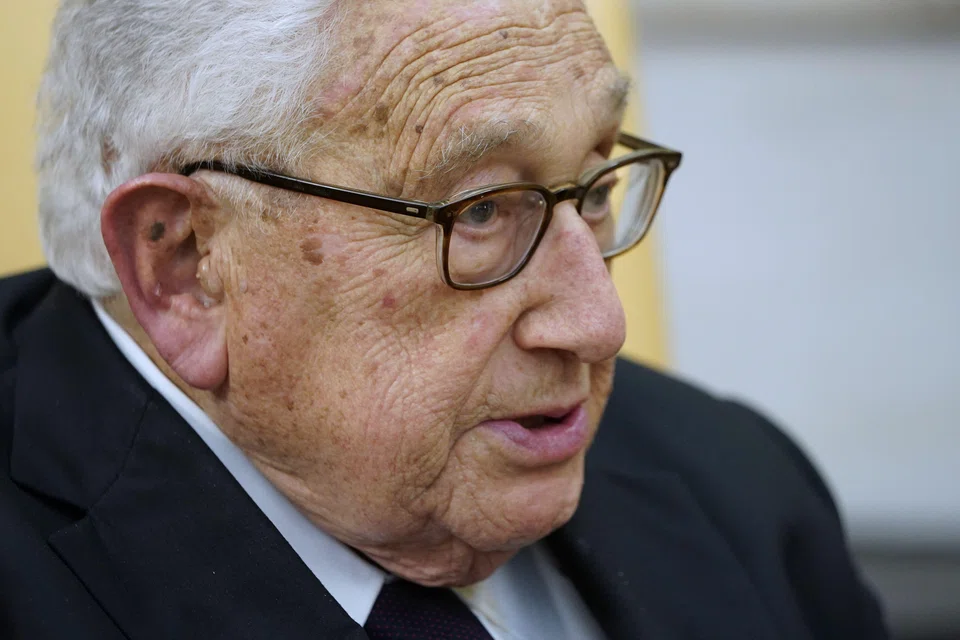
AGAINST the backdrop of growing global turbulence, including the threat of Russian aggression in Europe, rising military tensions between the United States and China in East Asia, and an Arab-Israeli war in the Middle East, it’s important to recall the legacy of renowned diplomat Henry Kissinger, a former adviser to American presidents, who died last Wednesday (Nov 29) at the age of 100.
Indeed, while serving as White House national security adviser, and later as secretary of state, Dr Kissinger had launched several diplomatic initiatives that helped transform the then Cold-War-dominated international system and provided it with relative stability at a time when many dreaded the risk of a nuclear war between the US and the Soviet Union.
On the top of the list of Dr Kissinger’s diplomatic triumphs was the so-called “opening to China”, overseeing the American clandestine outreach in the early 1970s to the People’s Republic of China, resulting eventually in the restoration of a full diplomatic relationship between Washington and Beijing.
The successful employment of the “China card” was credited with helping to tip the global balance of power against the then Soviet Union and opened the road to another major achievement by Dr Kissinger: A process of diplomatic detente between Washington and Moscow, including a series of arms control agreements, that helped reduce the Cold War tensions.
The improving relationship between these two global superpowers helped create the conditions for another diplomatic success – that of pursuing secret diplomatic talks that forged the Paris Peace Accords and ended the Vietnam War and America’s long and costly military campaign in South-east Asia for which Dr Kissinger won the Nobel Peace Prize in 1973 (along with Vietnamese leader Le Duc Tho).
Dr Kissinger also negotiated the end of the 1973 Middle East war (also known as the Yom Kippur War) that was sparked by a joint attack by Egypt and Syria on Israel. The negotiations ended with a ceasefire between Israel and Egypt and Syria that followed the dramatic US airlift of weapons and supplies to Israel that proved crucial to warding off the initial advances of the Arab armies.
In a way, Dr Kissinger’s diplomacy helped build the foundations of a new international system that led to the acceleration of China’s integration into the international economy, the continuing detente between the Soviet Union and the US that culminated in the end of the Cold War, growing cooperation between the nations of South-east Asia, and an Arab-Israeli peace process that led to the signing of peace agreements between Israel and Egypt, and eventually with several Arab states.
Dr Kissinger wasn’t a peacenik driven by idealistic instincts, but a foreign-policy realist who believed that international stability is achieved by securing the balance of power between great powers – a realpolitik approach that aimed at achieving practical goals and not dreamy fantasies.
That is the kind of approach that can help resolve some of the major international problems the world faces today, through pragmatic solutions as opposed to promoting ideological crusades and new cold wars: By engaging a surging China, not isolating it. By trying to reach an agreement that would end the war in Ukraine. And by pursuing a creative peace process in the Middle East that would bring about Israeli-Palestinian peace. All of which are the kinds of ambitious goals that Dr Kissinger would have sought to achieve.
TRENDING NOW

Olivia Lum, ex-CFO not giving evidence in their Hyflux trial

Bank on AI-resilient Singapore property via deep-value listed property groups

Positive pivot or premature? Analysts split on Keppel Reit’s S$610.9 million buy

Once staunchly pro-China, Malaysian Chinese businesses are now distancing themselves from Beijing

