

Wednesday’s UK Spring Statement will set 2025 agenda
It will be a key moment for the Labour government as it seeks to reset after a challenging first nine months in office
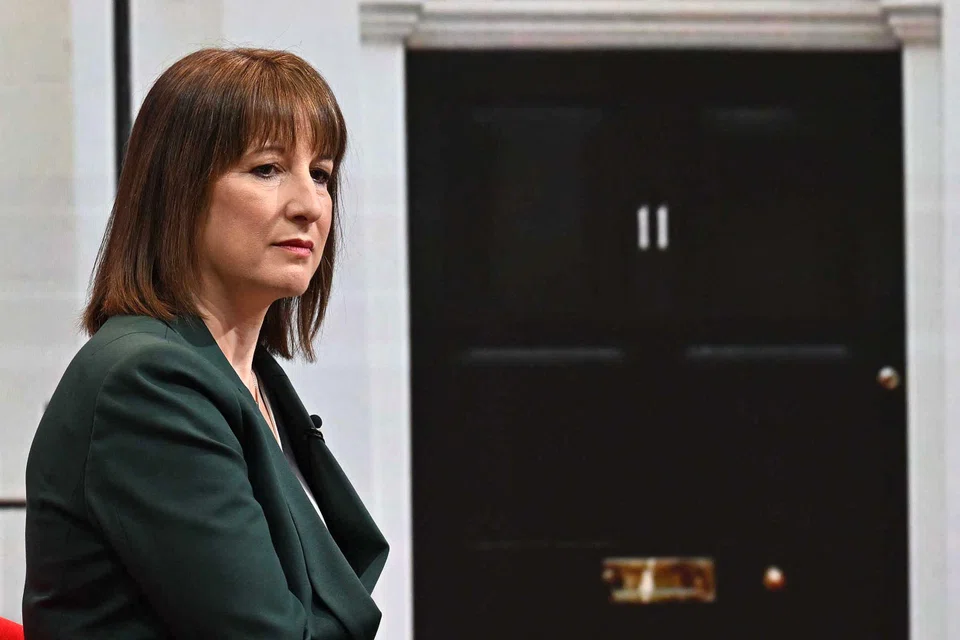
[LONDON] UK fiscal events relatively rarely hit the global headlines. However, last October’s annual Budget and this Wednesday’s (Mar 26) Spring Statement by Finance Minister Rachel Reeves are being much more closely watched than usual by international investors.
These fiscal events are the most important by any UK government in the post-Brexit era. This is not least in the context of ongoing economic uncertainty generated by US President Donald Trump’s tariffs.
The UK National Institute of Economic and Social Research estimates that the planned Trump tariffs could reduce UK economic growth by around 0.4 percentage point in the next two years. That’s the equivalent of around £24 billion (S$41.6 billion).
To help minimise the level of so-called US reciprocal tariffs, Reeves and her colleagues in the UK government are considering reducing or removing the UK Digital Services Tax. US Vice-President JD Vance has criticised this levy, which he perceives as an assault on US tech companies.
Following the period of heightened uncertainty that the US economy has experienced since January when the Trump team took power, stock markets have been rattled in the United States. In comparative terms, European markets have outperformed, including in the United Kingdom.
Indeed, the fallout from Trump’s tariffs could potentially even make many investors perceive the United Kingdom as an economic safe haven. In part, this is because of the City of London’s status as Europe’s key financial centre with the pound sterling still the world’s fourth largest reserve currency after the US dollar, the euro and the yen, amounting to around 5 per cent of global foreign exchange reserves.
Problematic economic inheritance
Nonetheless, the UK economy has had a challenging time since Labour entered office last July. To be sure the government had a problematic economic inheritance, especially with a public debt load that grew dramatically since the start of the pandemic.
This higher government debt spending continues with the £132.2 billion total for the latest financial year to February – around £20.4 billion more than the independent UK Office for Budget Responsibility forecast as recently as October 2024. The gap was driven by higher spending on public services, including social benefits, and came despite tax revenues being up on the equivalent period in 2024.
The Organisation for Economic Cooperation and Development (OECD) last week highlighted the UK’s “heightened vulnerability” to maturing debt on the horizon that amounts to around 15 per cent of gross domestic product. The UK government is one of four major industrialised economies (alongside France, Spain and the United States) facing such high increases in costs with the debt maturing by 2027 exceeding 15 per cent of their current GDP and the average yield-to-maturity on debt issued in 2024 surpassing that of this maturing debt by over 1.5 percentage points.
Despite this high-debt spending, the immediate backdrop for Wednesday’s big event is that the UK economy unexpectedly shrank in January, contracting by 0.1 per cent. The decline was mainly driven by a drop in manufacturing.
No surprise then that 2025 UK growth forecasts have been downgraded too. The OECD has lowered its forecast to 1.4 per cent growth for 2025, down from 1.7 per cent. This is significantly higher than the Bank of England, which has halved its forecast for 2025 to 0.75 per cent from 1.5 per cent.
In this context, there are growing concerns about so-called stagflation, the combination of low or negative growth and elevated inflation. Last week, the Bank of England Monetary Policy Committee declined by 8 votes to 1 the opportunity for an interest rate cut with the base rate kept on hold at 4.5 per cent after its latest meeting.
That could indicate moves to reduce UK interest rates further in 2025 may be slower than markets had hoped. Part of the reason for this is the latest data showing wages still rising at the highest level since last April.
Fall in living standards
Moreover, a recent report by the Joseph Rowntree Foundation think tank asserts that average living standards could fall for UK families by 2030, with those on the lowest incomes hit twice as hard as middle and high-earners. It forecasts that the average family looks set to end the decade £1,400 worse off than they are today, equivalent to a 3 per cent fall in disposable income.
This may be politically damaging as Prime Minister Keir Starmer’s government has promised a return to sustainable growth. This after around two decades of sub-par economic performance following the international financial crisis that began in 2007-2008.
The government has also attracted criticism, in particular, for the tax rises announced in last October’s Budget. To be sure, tax-raising is far from unprecedented following an election.
However, the tax take announced by Reeves comfortably exceeded those in the first Budgets of key recent predecessors as finance minister, including Labour’s Gordon Brown and the Conservative’s George Osborne in 1997 and 2010, which were £14 billion and £13 billion, respectively, in today’s prices. Indeed, the tax take was comparable with the biggest in half a century which was Conservative Norman Lamont’s in 1993, which raised £33 billion in today’s terms.
This has helped fuel voter distrust of Reeves. One recent survey by Opinium found that she is the least trusted politician on economic and financial issues in the United Kingdom with a net score of minus 38.
Amid this fiscal gloom, Reeves will be seeking on Wednesday to try to shift the mood music towards growth and away from the debates about austerity that dominated much UK debate since at least 2010 when then-prime minister David Cameron won power. This includes the Starmer government promoting its ambition for the United Kingdom to become a “clean energy superpower” to help drive the economy.
In last October’s Budget, Reeves also launched “a new era of public and private investment” to deliver on goals including enhancing the nation’s infrastructure. This attempted to draw comparison with the historic reform programmes begun in 1945 under then-prime minister Clement Attlee, in 1964 under then-premier Harold Wilson, and in 1997 under then-prime minister Tony Blair. On Wednesday, Reeves is likely also to reconfirm Starmer’s decision to boost defence spending to 2.5 per cent of GDP by 2027, reallocating money from international aid.
Taken together, the Spring Statement will therefore be a key moment for Reeves and the Labour government as they seek to reset after a challenging first nine months in office. Increasingly, the Starmer team is looking ahead to the next election in 2028 or 2029 to try to deliver an economic landscape that will help enable a second term.
The writer is an associate at LSE IDEAS at the London School of Economics
TRENDING NOW

Two Singapore-listed palm oil firms named in Greenpeace report on Indonesian plantation fires

Singapore Airlines flight returns to San Francisco after ‘unruly’ passenger incident

Singapore looking into which companies responsible for haze-causing fires: PM Wong
Deluge IPO 3.86 times subscribed ahead of SGX debut

